By Ceyda Yalcin
Everyone has experienced that strange nostalgic feeling that shows up in small moments: hearing a familiar song, craving a hometown meal, or realizing no one around you recognizes the earlier version of you. Homesickness doesn’t hit all at once, but it lingers between excitement and uncertainty, often catching you off guard. What actually is homesickness? And why does missing home hurt so much?
What is homesickness?
At first glance, homesickness seems simple. You miss your home, your people, your routines. Psychologically, it is much more complex. Homesickness is defined as the emotional distress caused by separation from familiar environments and attachment figures, often involving persistent thoughts about home, longing for home, and difficulty adjusting to a new place1. It often emerges during major life transitions2. If you left your hometown for college, studied abroad, or moved to a new city for a job, you may have experienced it. Many young adults report to experience some degree of homesickness or feelings related to homesickness when they have been separated from their primary support systems3,4.
At its core, homesickness is rooted in attachment theory2,4. Attachment theory defines the psychological mechanisms underlying how and why humans are biologically wired to seek safety in familiar relationships and environments5,6. Modern neuroscience suggests that attachment is supported by coordinated neural, hormonal, and behavioral systems that help individuals form and maintain close social bonds7. Neural circuits and different brain regions involved in reward, stress regulation, and social bonding help reinforce connections to caregivers and familiar social environments7. These neural processes also help explain why homesickness can come with a racing heart, restlessness, sleep problems, and trouble concentrating1,3. Thus, when those connections suddenly become less accessed, the brain can respond with distress signals that motivate us to seek safety, connection, and reunion8.
Home is not just a location. It is a place where the brain has learned what comfort, predictability, and belonging feel like. When that world disappears, the mind can respond with grief-like distress. Part of what is being lost is not only a place, but also a sense of self shaped by that place and a sense of belonging that is hard to replace immediately. Sensory cues in particular, such as a smell or melody, can reactivate autobiographical memories and attachment-related feelings very quickly9–11. Smell is especially powerful because in neuroimaging studies, olfactory pathways were shown to have strong connections to brain regions involved in emotion and memory, including the amygdala and hippocampus12. As a result, the scent of a favorite meal or a loved one’s perfume can evoke vivid memories and recreate feelings of comfort, safety, and belonging. Rather than simply reminding us of home, these cues can momentarily transport us back to it, which may explain why homesickness often arrives in sudden waves rather than as a constant mood. In this sense, homesickness reflects the brain’s attempt to protect us by pushing us toward what once felt safe.
Recent theories of attachment suggest that when people experience stress or uncertainty, the brain does not only activate a traditional “fight-or-flight” response but may also engage systems that motivate us to seek safety through social connection6. Some researchers have described this as a “flight-and-affiliation” response, in which individuals turn toward familiar people and environments during times of distress7,13. In this framework, homesickness may be part of an evolved biological response that encourages us to reconnect with places and people associated with safety and belonging. One concept of importance here is that some of these neurobiological systems can get activated even when attachment figures like caregivers or significant others are physically absent but present through phone conversations 4,6. However, the effects of these connections are not always straightforward. For some individuals, a phone call home may provide comfort and reduce feelings of separation, while for others it may intensify homesickness by reminding them of what they are missing. Personal experiences can differ substantially depending on circumstances. The experience of an international student whose only connection to home is a video call may be very different from that of someone who can visit home every few weeks.
Now imagine adding another layer: moving not just away from home, but into a completely different culture. For international and exchange students, the experience can be more complex. As per Institute of International Education’s (IIE) statistics, more than 1.2 million international students are currently enrolled at U.S. colleges and universities, representing approximately 6% of all students in higher education. For many of them, homesickness is intertwined with the challenges of adapting to a new language, academic system, and social environment. The stress associated with this kind of change/transition, known as acculturative stress, include feelings of loneliness, cultural barriers, and difficulties with social integration14,15. This new cultural context may also not yet feel safe or predictable. Studies show that international students often report higher levels of homesickness than domestic students, influenced by factors such as language proficiency and perceived discrimination15,16. Many universities, especially as higher education becomes increasingly globalized, have implemented support services such as counseling centers, peer-support groups, and workshops designed to help students navigate homesickness and cultural adjustment15. However, research suggests that international students are less likely to use these services and are more likely to discontinue them after an initial visit17,18. Proposed reasons include cultural stigma surrounding mental health, uncertainty about whether counselors will understand their experiences, and simply not knowing what resources are available to them15.
How do we measure homesickness?
Before diving into how something as subjective as homesickness can be measured, it is worth briefly discussing how psychologists study emotions and well-being more broadly. Unlike biological measures such as blood glucose levels, emotions cannot be directly observed. Instead, psychologists rely on a combination of qualitative and quantitative methods. Some approaches generate numerical data that can be statistically analyzed, such as questionnaires and controlled laboratory experiments in which participants respond to images, videos, or social scenarios. Other approaches involve structured interviews, allowing researchers to explore experiences in greater depth through follow-up questions. Each method has strengths and limitations, and psychologists often combine several approaches to better understand complex emotional experiences. For instance, interview-based approaches can also be complemented by biological measures such as electroencephalography (EEG), electromyography (EMG), or functional magnetic resonance imaging (fMRI) to provide additional insight into the physiological and neural processes associated with emotions and behavior.
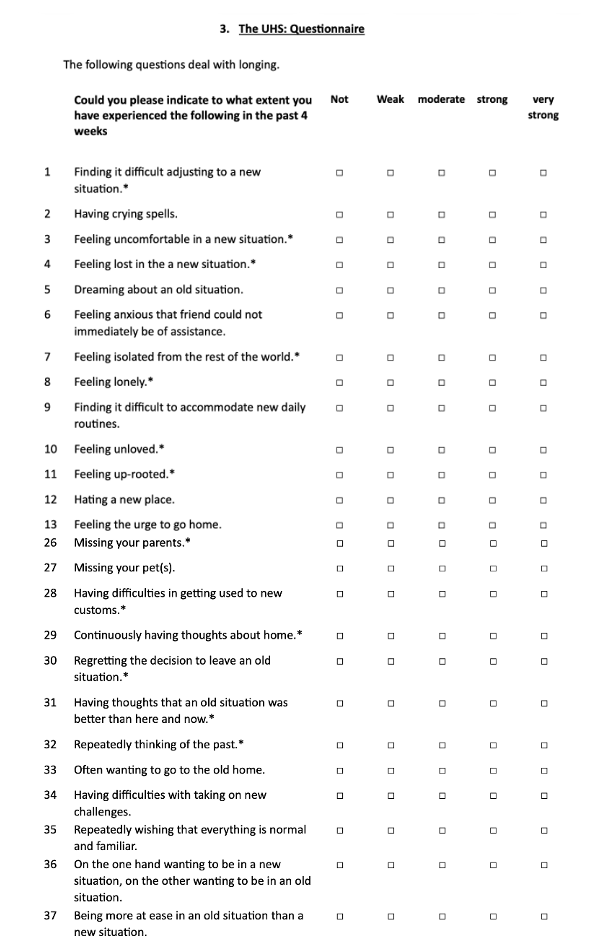
Psychologists used validated self-report tools, such as standardized questionnaires and the Utrecht Homesickness Scale19 (Figure 1), to assess emotional distress, longing for home, and difficulties adjusting to new environments. These methods allow researchers to quantify an experience that might otherwise seem like a subjective emotional experience. There is a significant relationship between the need to belong and homesickness, with individuals who feel accepted in their new communities reporting lower levels of distress20. However, there is also criticism that conceptualizing sense of belonging primarily through the number of social connections may oversimplify the broader and more complex construct described by Strayhorn (2019)21,22. Although homesickness is linked to the need to belong, studies have not fully supported the substitution hypothesis, which suggests that new social connections can replace those left behind and eliminate homesickness20. Using real-time assessments studies showed that homesickness fluctuates depending on context, such as interactions with loved ones or moments of isolation, highlighting its deeply social nature4. In that sense, more qualitative approaches, such as interview-based research, may provide richer insights though they require significantly more time and resources.
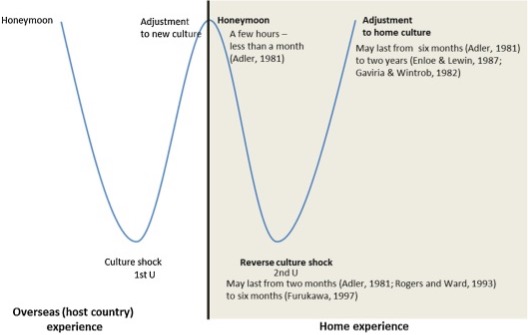
Interestingly, homesickness does not always appear immediately. Many individuals experience a “honeymoon phase” when they first arrive in a new environment, fueled by excitement and novelty23. Only later, as routines settle and the initial thrill fades, does homesickness emerge. This pattern aligns with the W-curve hypothesis of cultural adjustment summarized in Figure 2, which describes how individuals often move through stages of initial excitement, culture shock, gradual adaptation, and sometimes even reverse culture shock when returning home. That delayed reaction is normal, and feeling homesick months after moving does not mean you are failing to adapt. Homesickness often reflects a temporary struggle with separation, not an inability to grow. In fact, the W-curve hypothesis was originally proposed as the U-curve hypothesis24. It took some time for researchers to fully understand the emotional journey of cultural adaptation, including the challenges of readjusting both abroad and at home. In a way, science had to adapt, too. So do not put pressure on yourself if adjustment takes time. Growth is rarely linear, and learning to belong in a new place is a process, not a race.
Although uncomfortable, homesickness often fosters personal growth. It encourages individuals to build new relationships, establish routines, and redefine their sense of belonging. Over time, the unfamiliar becomes familiar, and the foreign begins to feel like home. Perhaps the goal is not to stop missing home, but to expand what “home” means. For anyone who has ever felt the quiet ache of missing something they love, for the international students who crossed oceans in pursuit of their dreams, for everyone who learned to call unfamiliar places home, know that you are not alone. Homesickness is not a weakness, but proof that somewhere in the world, you have truly belonged.
TL; DR
- Homesickness is more than just missing home -it is a universal response to separation from familiar people, places, and routines.
- Attachment, belonging, and cultural adjustment all shape the experience.
- Although challenging, homesickness can promote adaptation, resilience, and personal growth.
Reference
- Thurber, C. A. & Walton, E. A. Homesickness and Adjustment in University Students. Journal of American College Health 60, 415–419 (2012).
- Stroebe, M., Schut, H. & Nauta, M. Homesickness: A Systematic Review of the Scientific Literature. Review of General Psychology 19, 157–171 (2015).
- Fisher, S., Murray, K. & Frazer, N. A. Homesickness, health and efficiency in first year students. Journal of Environmental Psychology 5, 181–195 (1985).
- Nauta, M. H., Aan Het Rot, M., Schut, H. & Stroebe, M. Homesickness in social context: An ecological momentary assessment study among 1st‐year university students. Int J Psychol 55, 392–397 (2020).
- Cassidy, J., Jones, J. D. & Shaver, P. R. Contributions of attachment theory and research: a framework for future research, translation, and policy. Dev Psychopathol 25, 1415–1434 (2013).
- Bowlby, J. Attachment and Loss. (Basic Books, New York, 1980).
- Izaki, A., Verbeke, W. J. M. I., Vrticka, P. & Ein-Dor, T. A narrative on the neurobiological roots of attachment-system functioning. Commun Psychol 2, 96 (2024).
- Manicavasagar, V. & Silove, D. The biological foundations of separation anxiety. in Separation Anxiety Disorder in Adults 111–132 (Elsevier, 2020). doi:10.1016/B978-0-12-812554-0.00008-5.
- Reid, C. A., Green, J. D., Wildschut, T. & Sedikides, C. Scent-evoked nostalgia. Memory 23, 157–166 (2015).
- Berntsen, D. Involuntary autobiographical memories and their relation to other forms of spontaneous thoughts. Phil. Trans. R. Soc. B 376, 20190693 (2021).
- Janata, P. The Neural Architecture of Music-Evoked Autobiographical Memories. Cerebral Cortex 19, 2579–2594 (2009).
- Arshamian, A. et al. The functional neuroanatomy of odor evoked autobiographical memories cued by odors and words. Neuropsychologia 51, 123–131 (2013).
- Mawson, A. R. Mass Panic and Social Attachment: The Dynamics of Human Behavior. (Routledge, 2017). doi:10.4324/9781351153201.
- Berry, J. W. Immigration, Acculturation, and Adaptation. Applied Psychology 46, 5–34 (1997).
- Smith, R. A. & Khawaja, N. G. A review of the acculturation experiences of international students. International Journal of Intercultural Relations 35, 699–713 (2011).
- Poyrazli, S. & Lopez, M. D. An Exploratory Study of Perceived Discrimination and Homesickness: A Comparison of International Students and American Students. The Journal of Psychology 141, 263–280 (2007).
- Nilsson, J. E., Berkel, L. A., Flores, L. Y. & Lucas, M. S. Utilization Rate and Presenting Concerns of International Students at a University Counseling Center: Implications for Outreach Programming. Journal of College Student Psychotherapy 19, 49–59 (2004).
- Ang, P. L. & Liamputtong, P. “Out of the Circle”: International Students and the Use of University Counselling Services. Australian Journal of Adult Learning 48, 108–130 (2008).
- Van Vliet, A. J., Stroebe, W. & Schut, H. A. W. Utrecht Homesickness Scale. https://doi.org/10.1037/t66012-000 (2019).
- Watt, S. E. & Badger, A. J. Effects of Social Belonging on Homesickness: An Application of the Belongingness Hypothesis. Pers Soc Psychol Bull 35, 516–530 (2009).
- Strayhorn, T. L. College Students’ Sense of Belonging. (Routledge, 2018). doi:10.4324/9781315297293.
- Ferrara, T. Understanding Homesickness: A Review of the Literature. (2020).
- Gullahorn, J. T. & Gullahorn, J. E. An Extension of the U‐Curve Hypothesis1. Journal of Social Issues 19, 33–47 (1963).
- Lysgaard, S. (1955). Adjustment in a foreign society: Norwegian Fulbright grantees visiting the United States. International Social Science Bulletin, 7, 45-51. Journal of Counseling Psychology, 53(1), 126-131.

