By Anna Falco
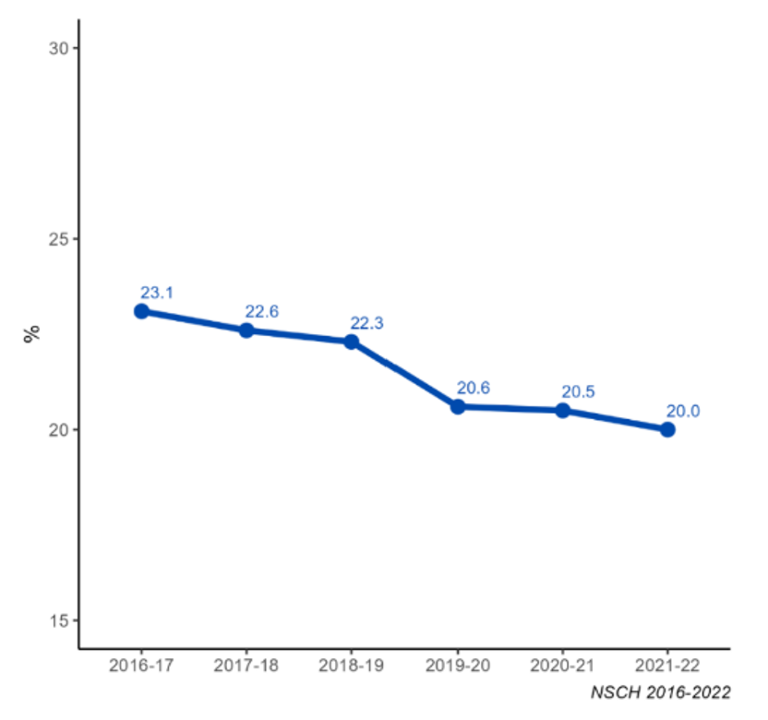
There is a physical inactivity crisis in the United States. While the problem is present among all age groups, it is especially concerning among children and youth (6-17 years old) because this is a critical window for developing lifelong habits related to physical activity. According to the 2024 US Report Card on Physical Activity for Children and Youth, only 20-28% of 6- to 17-year-olds meet the 60 minutes of daily physical activity recommended by the national guidelines (Figure 1). The problem intensifies as children age. Between 26% and 42% of 6–11-year-olds report meeting the physical activity recommendations, while rates for 12–17-year-olds appear to lie around 15%.
So, what is the solution to this crisis? You may be quick to say: “put your kid in a sport”, but that isn’t as effective as it seems. A culture shift in youth sports has undermined their initial purpose: to provide a fun space for children to be active and learn life lessons like resiliency. In the past, sports were more impromptu: children gathered and played games at their local parks. They were not training for one sport in particular, rather just spending time being active. Today, the playground has been seemingly replaced by a professionalized training ground for kids. More kids are specializing in single sports at a young age than ever before in the hope that it will give them the edge they need to get a scholarship or play professionally. This increase in specialization has contributed to less kids being involved in sports entirely. 70% of kids quit organized sports by age 13. Treating children as mini professional athletes has stripped play of its fun, driving down physical activity rates, while consequentially lowering the level of competition at elite levels.
Why are kids quitting organized sports?
The experience of playing sports has changed greatly for kids growing up today compared to previous generations. There has been a shift from low-barrier school-based and community-based sports to privatized club sports 1. This shift has contributed to higher rates of athlete injury and burnout as well as creating a gap in sport participation among children of different socioeconomic statuses. Additionally, screen time has replaced physical activity for many kids.
Injuries
The high volume of training imposed by now year-round training programs and repetitive stress brought about by specialization contributes to increased rates of overuse injuries among kids. For example, UCL tears, an injury to the inner elbow that is common among baseball and softball pitchers due to the repetitive throwing motion, were once rarely seen in youth athletes. Now, over half of UCL repair surgeries, commonly called Tommy John surgeries, are performed on people aged 15-19.
Burnout
While physical activity itself is associated with positive effects on mental health, kids who specialize in sports at a young age are at higher risk for mental health problems including depression, anxiety, and unhealthy perfectionism. The strong emotions and pressures that come along with playing sports, especially club sports, can be difficult for the young mind to cope with. Many youth athletes start to equate their athletic performance to their self-worth and can develop unrealistic expectations for themselves, resulting in a lack of resiliency and downplaying accomplishments. These mental health problems often lead to burnout. Burnout includes when a person is emotionally and physically exhausted, feels a reduced sense of accomplishment, and starts to dislike a sport they once loved 2. The high-pressure environment created by the club sport model is a breeding ground for burnout, leading many kids to drop out. These mental health concerns do not stay in childhood. Adults who dropped out of sports as kids reported worse mental health than both those who played all throughout childhood and those who never played a sport at all. The top two reasons for dropping out were not having fun and feelings of inadequacy.
Socioeconomic Status
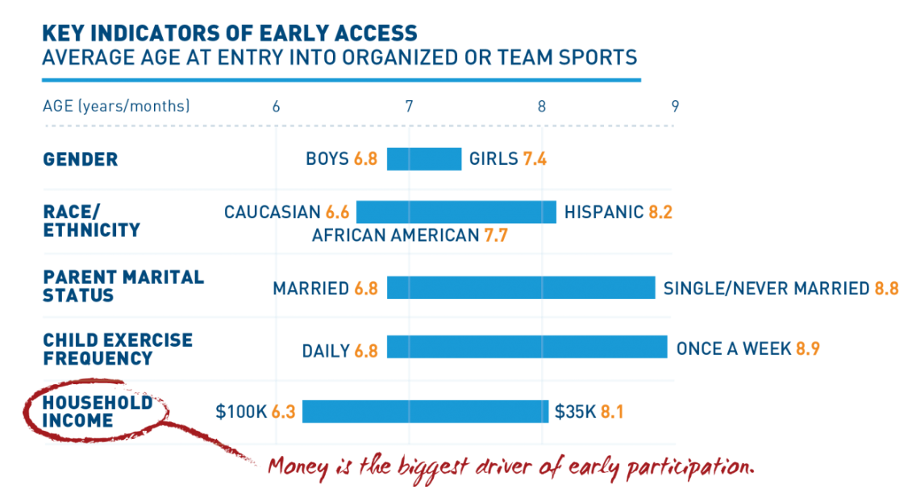
The expenses associated with club sports have created a gap between participation rates among children of different socioeconomic statuses. As school and community funded sport opportunities decrease, physical activity becomes more of a gated experience. In fact, household income is the biggest driver for early sport participation (Figure 2). The pay-to-play culture is one reason for discrepancies in overall physical activity rates. When the fees for a basketball league are equal to a month’s rent, the “choice” to participate in a sport is taken away from low-income families.
Screen Time
According to the CDC, about half of teenagers have 4 or more hours of screen time daily 3. Because technology is continuing to become better at keeping attention, sedentary, screen-based hobbies such as playing video games and scrolling on social media are competing interests in getting kids active through sport. The current youth sport environment is providing a path of very little resistance for kids to neglect physical activity and fall into an unhealthy screen use habit.
Elite Ambitions Backfire
Beyond contributing to the public health crisis of physical inactivity, the club sports model undermines its own goal to cultivate elite athletes. Elite athletes are those who compete at the highest levels of their respective sports. For most sports, there is no evidence suggesting that specializing before late adolescence is necessary for achieving this high status. Last year, 88% of athletes drafted into the NFL were multisport athletes in high school. Additionally, studies show greater proportions of Olympic athletes in various sports participated in more than one sport during their childhood when compared to their non-elite peers 4. Exceptions to this may include sports that have a young age of peak performance such as gymnastics. Not only do more elite athletes have a multisport background, but those with multisport backgrounds experience longer and healthier careers as professional athletes. This is attributed to the resilience formed by participation in multiple sports as well as fewer injuries across their career. Despite this, the club sport model continues to push early sport specialization.
In addition to not increasing personal chances of achieving elite status, the club sport model decreases the level of play across the national talent pool. Kids are being treated as mini professionals as early as age 10. This extraordinarily young age of specialization exacerbates the issues discussed above as well as cuts off a lot of potential before a kid has the chance to develop5. Club sport coaches often focus their attention on the kids who have developed the quickest, leaving late bloomers in the dust5. Because of this, the kids who lose a spot on a team or don’t get any playing time often end up quitting sports altogether.
The culture of youth sports that requires you to be good or not play at all is not one that fosters free play. Free play is very important when it comes to cultivation of overall talent, especially in team sports. For example, many South American and European nations have a culture of “street ball” that contributes to their great level of success in soccer on the international stage. This form of free play not only forces player creativity; it keeps more kids active for longer due to a decrease in the pressure for success. In contrast, the very structured and exclusionary club sport model in the US thins out the talent pool, making us less competitive at the international level, while simultaneously ignoring the importance of all kids being physically active.
The Importance of Physical Activity
Regular participation in physical activity has many benefits. Exercise improves academic performance, brain health, muscular fitness, heart and lung health, cardiometabolic health, long-term health, bone strength, and measures of a healthy weight. Because of these benefits, it is important to prioritize physical activity. To do this, we must fix youth sport culture.
Reclaiming Youth Sports
The current trajectory of youth sports is highly problematic. By prioritizing athletes with “elite” potential, we have sacrificed both the health of the majority and the success of the exceptional. We must move away from the club sport model and return to a culture that promotes fun and includes all children, regardless of current athletic performance. These efforts will positively impact the physical inactivity crisis and fix the broken funnel created by the high pressure, high-cost club sport model. Making these changes will require a shift in the way success is defined in youth sports.
The goal of youth sports must return to its roots. Sports should be fun! Programs should be aimed at developing kids’ competence and confidence around physical activity. To achieve this reset of goals a couple things will need to happen:
- Discourage early sport specialization. Playing multiple sports until at least age 14 is ideal. Encourage kids to sample different sports throughout childhood.
- Reinvest in low barrier to entry community and school-based sport leagues. This will help ensure equitable access to physical activity.
- Make youth sports fun again! Remember that the athletes are kids. They thrive during fun activities and free play. Structuring programs like adult training leads kids to burnout and quit.
Conclusion
The professionalization of youth sports was intended to create better athletes but has instead led to a generation of injured, burned out, sedentary kids. If we want to solve the physical inactivity crisis, we need to give the game back to the kids. When the goal is to prioritize the joy of movement, everyone wins, from the casual player to the future Olympian.
TL; DR:
- The shift to pay-to-play club sports contributes to the physical inactivity crisis.
- Early specialization can cause mental and physical health problems and is rarely needed at an elite level in most sports.
- The aim of youth sports should be fun, not to treat kids as if they are adult athletes.
Reference
1. Knoester, C., & Bjork, C. (2026). The Relative Frequencies of Playing Sports Informally Versus Formally, While Growing Up: An Analysis of Generational and Socioeconomic Status Differences in the U.S. Leisure Sciences, 1–23. https://doi.org/10.1080/01490400.2026.2620528
2. Brenner JS, Watson A. Overuse injuries, overtraining, and Burnout in Young Athletes. Pediatrics. 2024;153(2). doi: https://doi.org/10.1542/peds.2023-065129
3. CDC. (2024). QuickStats: Percentage* of Children and Adolescents Aged 12–17 Years Who Participated in 60 Minutes of Physical Activity Most Days or Every Day,by Daily Hours of Screen Time Use — United States, July 2021–December 2023. MMWR. Morbidity and Mortality Weekly Report, 73(44), 1013. https://doi.org/10.15585/mmwr.mm7344a5
4. Güllich, A., Macnamara, B. N., & Hambrick, D. Z. (2021). What Makes a Champion? Early Multidisciplinary Practice, Not Early Specialization, Predicts World-Class Performance. Perspectives on Psychological Science, 17(1), 6–29. https://doi.org/10.1177/1745691620974772
5. Henrique O, Figueiredo LS. Editorial: Relative age effect in sports: talent identification, performance, and fair practices. Frontiers in Sports and Active Living. 2025;7. doi: https://doi.org/10.3389/fspor.2025.1748381

