By: Sydney Callender
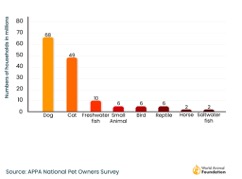
Cats are one of the most popular pets, with 49 million US households owning a cat (Figure 1). These furry felines are full of quirky behaviors, like waking up their owners at the crack of dawn every day, vanishing from sight at the first sign of an impending trip to the vet trip, and even recognizing when their human companions are feeling down and need some cat cuddles to feel better. As a cat owner myself, I have often wondered what is happening inside of their brains, even when they appear to have no thoughts at all. However, despite how common and beloved cats are as pets, a deeper dive into feline behavior revealed that scientists still know relatively little about how cats function, especially compared to dogs. This gap in knowledge highlights the importance of studying cats and the unique challenges that have historically limited feline research, as well as the growing efforts to improve our understanding of cats and their behavior.
Why does research into cats matter?
Gaining a greater understanding of how cats function, including distinguishing normal from atypical behavior, is extremely important for providing them with the best care and support in their lives. When cat owners fail to identify abnormal behavior that may be linked to underlying issues, this can lead to various behavioral problems, such as aggression, soiling, and social conflict, which are all major contributors to pet relinquishment.1 Therefore, cat owners should be equipped to recognize behavioral changes early and respond in ways that address underlying causes and support their cats’ daily well-being, which depends on continued research into feline behavior.
Additionally, cats serve as an important model for understanding sensory and nervous systems in humans and have been utilized in research on topics such as the development of cochlear implants, the role of light in visual system development in the brain, and neurological disorders including epilepsy. Understanding cat behavior will help create better tools for studying them, which in turn will advance these and other areas of research.
Finally, the use of cats in animal-assisted therapy (AAT) has increased significantly over the past two decades.2 Cats in AAT roles provide therapeutic benefits either as therapy cats, where cats are specifically trained to be a calming presence in places such as nursing homes and hospitals, or emotional support cats, which does not require special training and offers benefits for those with mental health conditions. As the use of cats in therapeutic settings continues to grow, further research into feline behavior and welfare is essential to ensure both the well-being of the cats and the effectiveness of these interventions.
Why has research into cats lagged behind dogs?
Cats and dogs have had very different routes of domestication that have greatly impacted their socialization and thus, their perception by humans. Dogs were amongst the earliest animals to be domesticated, over 14,000 years ago, as they were used for guarding and hunting food.3 In effect, dogs prefer to be in relationships with humans and are usually active within multiple social groups, leading humans to typically consider dogs to be the more social species when compared to cats. In contrast to dogs, wildcats, the ancestor of cats, were highly territorial animals and lived predominately solitary lifestyles.3 Domestication occurred much later for cats than dogs, just 10,000 years ago, with the driving theory being that wildcats that were more tolerant of humans took advantage of the food and shelter they were provided and were slowly accepted by humans.3 Owning cats seemed to have a beneficial effect for the human as well, as they were helpful for hunting rodents. However, these differences in origin and early domestication most likely afforded cats the perception of being more antisocial, even though since domestication, cats have become more social and display cooperative living with other cats.4 This perception as the more antisocial species likely contributed to the lack in motivation to learn more about them or take the time to understand their behaviors.
Another factor that has hindered cat research is that cats often do not respond as well as dogs to new environments, such as laboratory settings where experiments are commonly performed.5 Even when experiments take place in familiar environments, cats may still exhibit signs of discomfort when handled or quickly lose motivation to participate.6 As a result, extra care, such as extensive habituation periods before experiments can begin, are often necessary when working with cats, particularly in unfamiliar environments or with unfamiliar handlers.5 Since dogs generally require fewer of these accommodations, cats are often overlooked in favor of their more adaptable and flexible domestic counterparts.
New tools for cat research
Due to the sensitivity of cats as experimental subjects, it’s important to employ research techniques that can accurately capture a cat’s behavior by limiting stress and allowing them to act as close to “normal” as possible. Home-based studies offer one method to investigate natural cat behavior and cognition while minimizing the effects of stress on both the animal and the data collected. One fascinating home-based study sought to tackle the age-old question, “Do cats really know their names?”7 Through analyzing vocalization, ear, tail, and head movements, researchers determined that domestic cats are able to distinguish their own names from general nouns and even the names of other cats living within their households, even when spoken by unfamiliar people. Although completing experiments in individual cat homes in this manner may introduce some environmental variability, standardized protocols and procedures help to validate this approach. One example of standardization is the use of consistent inclusion criteria across studies, such as only using neutered cats in experiments, which helps ensure consistency between trials. Additionally, as in this study, researchers standardize the methods for trials by specifically instructing how to vocalize the names to the cats and implementing blind evaluation of recorded clips.
Another tool that has recently been developed is the Fe-BARQ, which is a questionnaire for cat owners that helps researchers, vets, and pet owners understand cat behavior. The Fe-BARQ consists of 100 questions and measures 23 different behavioral traits, including general activity, separation-related behavior, and sleeping location preferences, and has helped move the field away from anecdotal evidence to a more standardized methodology.8 In one study using the Fe-BARQ, cat owners were found to be more likely to see their pets’ behavior as problematic if they displayed traits including owner-directed aggression, spraying, and escaping behaviors.9 This study highlighted the need for educating cat owners on how to interact with more aggressive cats, such as paying attention to body language or limiting touch to temporal regions. Another interesting find was that cat owners were more likely to see their cat’s behavior as problematic if their cat was more active around dawn/dusk, which could be mitigated by changing feeding schedules or increased enrichment during the day. Understanding what type of feline behaviors are seen as problematic for cat owners helps highlight what type of education is needed to decrease pet relinquishment.
The Fe-BARQ was also recently used to look at the characteristics of cats that are being used in AAS, seeking to establish a pattern of behavioral traits in cats deemed more suitable for therapeutic use.10 The study found that AAS cats were much more social with people, social with other cats, and attention seeking.11 In turn, these findings could help to determine specific cats that could be best for AAS roles in the future, maximizing the therapeutic benefit to their human owners.
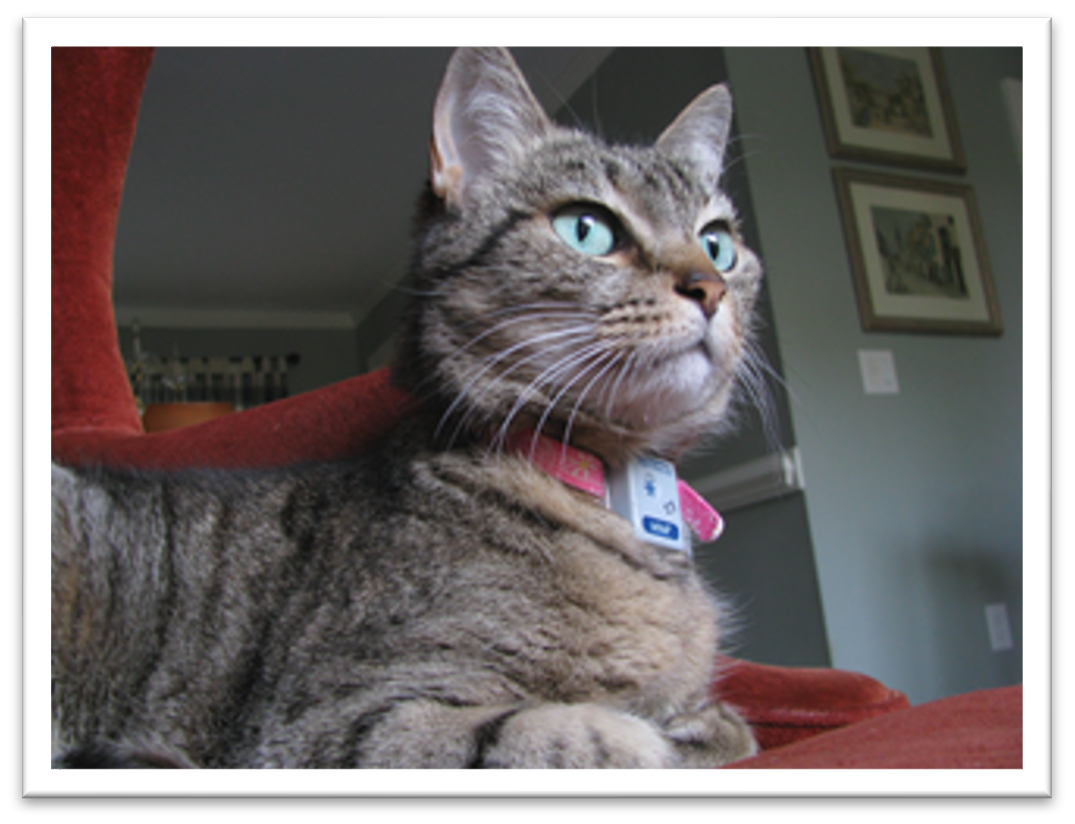
Additionally, with the development of better technology and AI tools, scientists are better equipped to also study cats outside the home without disrupting their normal behaviors.12 Accelerometers are particularly useful to this end, which are collar-mounted sensors that, when combined with GPS, continuously track the location and movement of cats (Figure 2).13 These devices allow scientists to monitor cats in a way that does not disturb them and without human involvement, which is especially useful for tracking stray cats that may be more skittish with humans. Accelerometer-based studies have expanded the understanding of movement patterns and range area of outdoor cats, as well as the daily activities of indoor cats. A recent study looking at the circadian rhythm of domestic cats found that there was higher activity during the day, with the peak activity aligning with when the caretakers were intervening (cleaning, feeding, or providing health care).14 This study highlighted the influence human intervention can have on the daily activities of cats. GPS and accelerometer-based technology has even been studied as an early detection tool for degenerative joint disease (DJD) in cats.15 This recent study found that, by using machine learning to analyze cat activity directly before and after high-activity periods, such as jumping or fast movement, scientists were able to distinguish between cats with and without DJD. The authors suggest these time windows may reflect periods of pain anticipation or recovery. Overall, this new method of combining machine learning with accelerometer data may be a key tool for improving DJD detection.
Slowly, but surely
There is still a long way to go until there is as much understanding of cats as there is of dogs, but with the implementation of innovative experimental tools and approaches to cat-based research, a new era of behavioral studies centered on our beloved feline companions may be on the horizon.
TL; DR:
- Research into cats has fallen behind that in dogs mostly due to perceived asociality and a lack of good tools.
- Understanding cat behavior is essential for knowing when things may be wrong and creating better tools for studying cats, which are good models for sensory and neurological systems.
- New methods such as the Fe-BARQ, AI tools, and home-based studies are helping to advance cat research.
Reference
- Kisley, M. A., Chung, E. J. & Levitt, H. Investigating the Reasons behind Companion Animal Relinquishment: A Systematic Content Analysis of Shelter Records for Cats and Dogs, 2018–2023. Animals 14, (2024).
- Therapeutic Role of Animals: A Comprehensive Literature Review on the Prevalent Forms and Species in Animal-Assisted Interventions | Journal of Education, Health and Sport. https://apcz.umk.pl/JEHS/article/view/45312 (2023).
- Driscoll, C. A., Macdonald, D. W. & O’Brien, S. J. From wild animals to domestic pets, an evolutionary view of domestication. Proc Natl Acad Sci U S A 106, 9971–9978 (2009).
- McGrath, A. P., Horschler, D. J. & Hancock, L. Feline Cognition and the Role of Nutrition: An Evolutionary Perspective and Historical Review. Animals 14, (2024).
- Uccheddu, S., Miklósi, Á., Gintner, S. & Gácsi, M. Comparing Pears to Apples: Unlike Dogs, Cats Need Habituation before Lab Tests. Animals (Basel) 12, 3046 (2022).
- Kraus, C., van Waveren, C. & Huebner, F. Distractible dogs, constant cats? A test of the distraction hypothesis in two domestic species. Animal Behaviour 93, 173–181 (2014).
- Saito, A., Shinozuka, K., Ito, Y. & Hasegawa, T. Domestic cats (Felis catus) discriminate their names from other words. Sci Rep 9, 5394 (2019).
- Duffy, D. L., de Moura, R. T. D. & Serpell, J. A. Development and evaluation of the Fe-BARQ: A new survey instrument for measuring behavior in domestic cats (Felis s. catus). Behavioural Processes 141, 329–341 (2017).
- Powell, L., Watson, B. & Serpell, J. Understanding feline feelings: An investigation of cat owners’ perceptions of problematic cat behaviors. Applied Animal Behaviour Science 266, 106025 (2023).
- Delanoeije, J., Moons, C. P. H., Peeters, E. H. K. A. & Pendry, P. Behavioural Profile Differences Between Cats in Animal-Assisted Services (AAS) and Non-AAS Cats Using the Fe-BARQ in Flanders. Animals (Basel) 15, 33 (2024).
- Delanoeije, J. et al. Behavioural Profile Differences Between Cats in Animal-Assisted Services (AAS) and Non-AAS Cats Using the Fe-BARQ in Flanders. Animals 15, (2024).
- Arshad, M. F. et al. Artificial intelligence and companion animals: Perspectives on digital healthcare for dogs, cats, and pet ownership. Research in Veterinary Science 193, 105776 (2025).
- Prigent Garcia, S. & Chebly, A. Accelerometers contribution to the knowledge of domestic cats’ (Felis catus) behavior: A comprehensive review. Applied Animal Behaviour Science 275, 106287 (2024).
- Chebly, A. et al. Assessing the circadian rhythm of cats living in a group using accelerometers. Applied Animal Behaviour Science 283, 106523 (2025).
- Montout, A. X. et al. Accelerometer-derived classifiers for early detection of degenerative joint disease in cats. Vet J 311, 106352 (2025). 16. Gruen, M. E. et al. The Use of Functional Data Analysis to Evaluate Activity in a Spontaneous Model of Degenerative Joint Disease Associated Pain in Cats. PLoS One12, e0169576 (2017).
- Gruen, M. E. et al. The Use of Functional Data Analysis to Evaluate Activity in a Spontaneous Model of Degenerative Joint Disease Associated Pain in Cats. PLoS One 12, e0169576 (2017).

