By Khadijat A. Olawuyi
In southwestern Nigeria, in the heart of Yorùbá land, sits a small town called Igbo-Ora. At first glance, it looks like any other lively town with busy markets, children playing, and families walking down the street. But if you spend just a few hours there, you will start to notice something unusual: you keep seeing double. Two identical toddlers holding hands. Two girls dressed alike. Two boys with the same smile. In Igbo-Ora, twins are everywhere.
The global average birth rate for twins is about 12 per 1,000 births. In Igbo-Ora, the rate is estimated at around 45 per 1,000 births, more than four times the global rate. Because of this, the town has proudly earned the nickname, “The Twin Capital of the World.” Every year, it even hosts a twin festival where twins from across Nigeria gather to celebrate. But behind the celebration lies a scientific mystery: why are there so many twins in Igbo-Ora? Studying the causes behind the unusually high rate of twins in Igbo-Ora could provide important insights into how ovulation and fertility are regulated, potentially improving reproductive health and fertility treatments in the future.
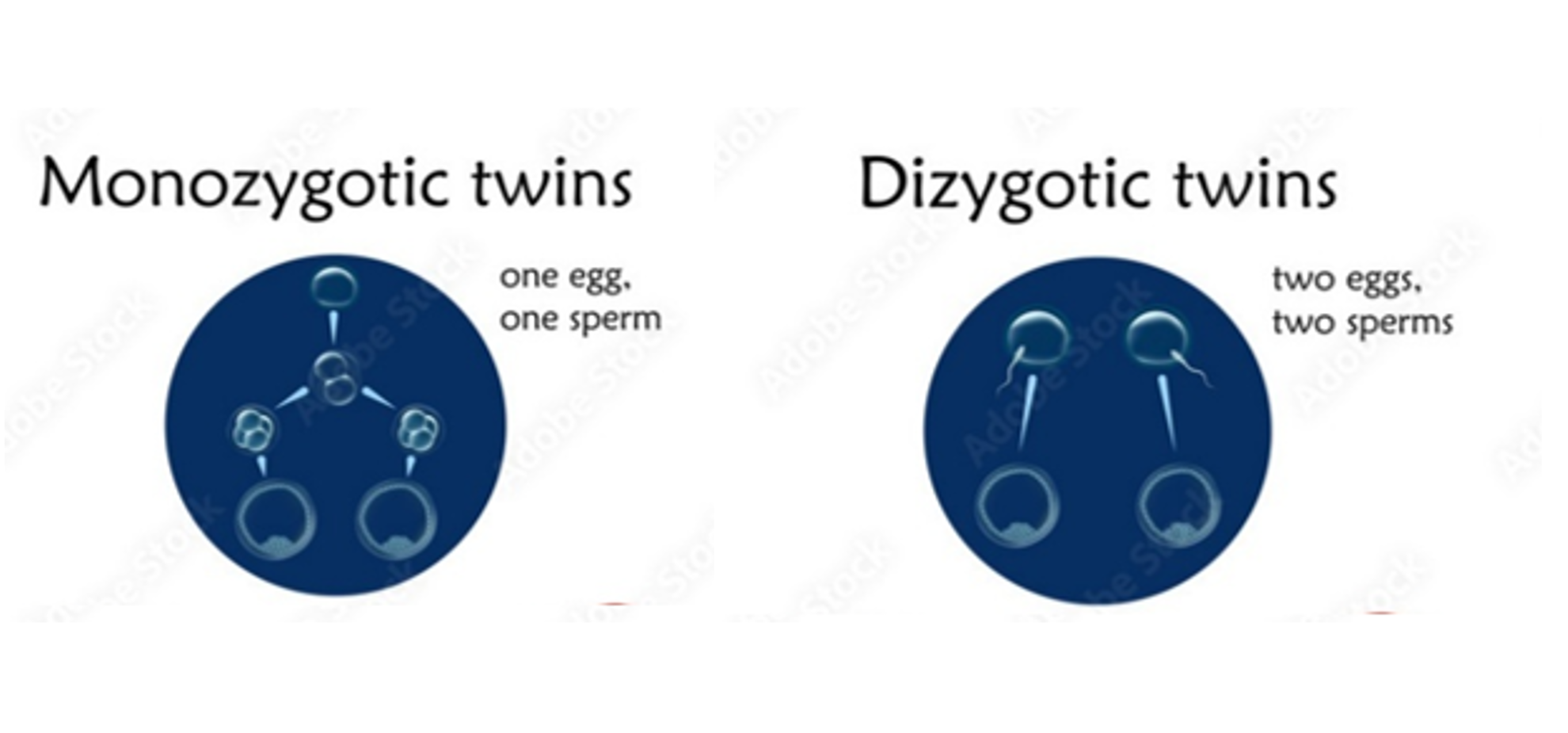
There are two main types of twins: monozygotic and dizygotic. Monozygotic twins occur when a single fertilized egg splits into two (Figure 1)1. This type of twinning occurs at relatively similar rates across populations worldwide, unlike dizygotic twinning, which varies greatly between populations2. Monozygotic twins are identical twins, sharing 100% of their DNA1. Dizygotic twins, fraternal twins that share about 50% of their DNA, happen when the ovaries release two eggs during one menstrual cycle, and both are fertilized1. This is called hyperovulation. In Igbo-Ora, most twins are dizygotic3. So, the real question becomes: why do people with ovaries in this population release multiple eggs more often?
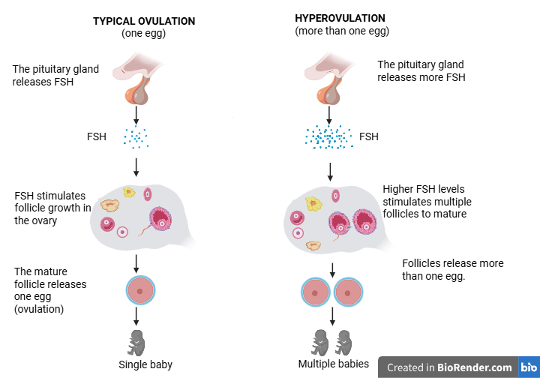
For years, many people believed the answer might lie in the diets of people living in Igbo-Ora4. Igbo-Ora is famous for dishes made with yams and okra. Some scientists have pointed to a compound in yams called diosgenin, which laboratories can use as a starting material to chemically synthesize steroid hormones such as progesterone. The belief of diet causing hyperovulation likely arose because, in the 1960s, pharmaceutical companies produced progesterone, androgens, and cortisone from compounds extracted from Mexican wild yams5. Hormones are chemical messengers that help coordinate processes throughout the body. In the reproductive system, hormones regulate the menstrual cycle by controlling when ovarian follicles —small sacs in the ovaries that contain immature eggs—grow and mature until the eggs are capable of being released and fertilized, when ovulation occurs, and whether an egg is released (Figure 2)6. Progesterone is especially important because it helps regulate the reproductive cycle after ovulation and prepares the uterus for pregnancy6. Since ovulation depends on tightly controlled hormonal signaling, some scientists wondered whether compounds related to steroid hormones such as diosgenin could influence the likelihood of releasing more than one egg during a cycle7. Although diosgenin can be industrially used to manufacture hormones, the human body cannot do the same—it cannot be converted from food into hormones able to be used in the reproductive cycle8,9. To date, researchers have not found consistent differences in yam consumption between mothers of twins and mothers of single babies, and there is no clinical evidence that eating yams causes hyperovulation10.

Environmental factors can influence reproduction. Age, overall health, body weight, and even environmental exposures such as pollution, industrial chemicals, and differences in lifestyle can affect hormone levels and fertility11. Living conditions and access to healthcare can also shape pregnancy outcomes12. However, when scientists closely examined twinning rates, they found that the high rate of fraternal twins is not limited only to Igbo-Ora13, but also appears across the broader Yorùbá population, even in different regions13. When Yorùbá women move to other countries, their higher twinning rate often continues14. If the environment alone were responsible for hyperovulation, one would expect the twinning rate to decrease when people move to new places with different diets, climates, and lifestyles. The twinning rate remaining the same, despite people moving away from Igbo-Ora, suggests that while the environment may be an important factor, it is likely not the whole story15.
The genetic explanation is currently the strongest one. Genes are made up of sequences of DNA, the instruction manual our bodies use, that influence how the body develops and functions, including how hormones regulate reproduction16. During a typical menstrual cycle, several ovarian follicles containing immature eggs begin developing. Hormones, such as follicle stimulating hormone (FSH) 17, normally ensure that only one follicle fully matures and releases an egg during ovulation18. FSH helps immature ovarian follicles grow by stimulating the cells surrounding the egg to support its development and maturation until it is ready for ovulation (Figure 3)12,19. As follicles grow, they also produce hormones such as inhibin B and estradiol which help reduce FSH levels and prevent additional follicles from continuing to mature20,21. Fraternal twinning, which depends on hyperovulation, can occur when this balance changes and multiple follicles continue developing instead of only one18. Some women naturally produce slightly higher levels of FSH while others may have ovaries that are more sensitive to the hormone22. Fraternal twinning often runs in families, especially along the mother’s side23. Certain inherited genetic differences may affect how the ovaries respond to hormones like FSH, increasing the chance that more than one egg matures during a cycle24. Studies have identified specific mutations in genes such as FSHB and SMAD3, which are involved in FSH production and ovarian responsiveness to FSH, as potential contributors to fraternal twinning24. About 20 percent of the variation in fraternal twinning appears to be genetic. When a population has a long history of high twinning, and that pattern persists even after people migrate to other countries, genetics becomes the most likely explanation.
A genome-wide association study (GWAS) published in Human Reproduction in 2024 analyzed genetic data from thousands of women25. GWAS studies work by scanning the genomes (the complete set of genetic material or DNA found in an organism) of large groups of people and looking for genetic variants—small differences in DNA sequence between individuals—that occur more frequently in people with a particular trait such as fraternal twinning. If a genetic variant is consistently found more often in mothers of fraternal twins than in women who do not have twins, researchers can infer that the region of DNA containing that variant may influence the biological processes involved in twinning. Using this approach, researchers identified several genes linked to fraternal twinning25. Some of these genes identified were found to be involved in regulating reproductive hormones and ovulation. A downside of this study is that it included only women of European ancestry25. The researchers noted that studying populations in Africa, where twinning rates are highest, and Asia, where they are lowest, could reveal much more about the biology of twinning and female fertility25.
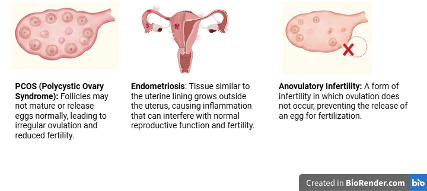
In another genetic study, women with a higher polygenic score for natural fraternal twinning—meaning they carry more genetic variants associated with having twins—tended to conceive faster than other women26. This suggests that the biological mechanisms involved in hyperovulation may also influence how efficiently the ovaries produce mature eggs. Researchers also found genetic correlations between fraternal twinning and several reproductive conditions, including anovulatory infertility, Polyendocrine Metabolic Ovarian Syndrome (PMOS), and endometriosis (Figure 4)26. The overlap in genetic risk factors does not mean that the same single gene causes all of these conditions27. Instead, the genetic correlations found suggest that some of the genetic factors involved in ovulation and ovarian function may overlap across these traits identified27. Hormonal pathways involved in ovulation are complex and connected to many aspects of reproductive health7. At the same time, the genetic variants identified so far explain only a small portion of fraternal twinning, suggesting that many additional genes and biological factors involved in ovulation remain undiscovered. Most genetic studies have also focused primarily on European populations, despite some of the highest twinning rates occurring in West Africa. Studying populations with unusually high twin rates, such as those in southwestern Nigeria, could help researchers uncover new insights into both twinning and female fertility.
At first, Igbo-Ora might sound like a charming curiosity, a town where people see double. But this mystery matters. Twin pregnancies carry higher risks, including preterm birth and low birth weight19. Understanding why some populations experience more twin pregnancies can help to improve maternal care and prenatal planning. Studying Igbo-Ora may also teach us more about how ovulation is regulated, how genes and hormones interact, and why fertility varies across populations. Such studies may even improve fertility treatments in the future by helping doctors better understand hyperovulation.
Most human traits vary across populations. Igbo-Ora stands out as a rare and concentrated biological outlier, almost like nature’s own experiment in human reproduction. What looks like a small mystery in one town is a window into how the human body works. Scientists do not yet have a concrete answer, but Igbo-Ora gives researchers something valuable: a real-world example of how biology, genetics, and population patterns come together in unexpected ways. The streets of Igbo-Ora may be filled with matching faces and shared birthdays, but behind the celebration lies an important reminder: sometimes the most fascinating scientific questions are hiding in plain sight, in the middle of a town, where you cannot help but see double.
TL; DR
- Igbo-Ora in southwestern Nigeria is known as the “Twin Capital of the World”.
- Most of these twins are fraternal, caused by hyperovulation.
- Recent genetic studies suggest twinning may be linked to fertility and hormone regulation. Studying Igbo-Ora could reveal new insights into human reproduction.
Reference
- Prescott, C. A., & Kendler, K. S. (1995). Twin study design. Alcohol Health Research World, 19(3), 200–205.
- Hoekstra, C., Zhao, Z. Z., Lambalk, C. B., Willemsen, G., Martin, N. G., Boomsma, D. I., & Montgomery, G. W. (2008). Dizygotic twinning. Human Reproduction Update, 14(1), 37–47. https://doi.org/10.1093/humupd/dmm036
- Fadoju, A. (2025). Genetics, diet or divine blessing? Local and scientific explanations for high dizygotic twinning in Igbo-Ora, Nigeria. Twin Research and Human Genetics, 28(5), 427–432. https://doi.org/10.1017/thg.2025.10029
- Steinman, G. (2006). Can the chance of having twins be modified by diet? The Lancet, 367(9521), 1461–1462.
- Olofson, R. A., et al. (1999). The “marker degradation” and creation of the Mexican steroid hormone industry 1938–1945. ACS Historic Chemical Landmark, 1–4.
- Sundström-Poromaa, I., Comasco, E., Sumner, R., & Luders, E. (2020). Progesterone – Friend or foe? Frontiers in Neuroendocrinology, 59, 100856. https://doi.org/10.1016/j.yfrne.2020.100856
- Thomas, C. (2025). Ovulation: A cellular symphony in three movements. Seminars in Cell & Developmental Biology, 174, 103634.
- Marker, R. E. (1940). Sterols. CV. The preparation of testosterone and related compounds from sarsasapogenin and diosgenin. Journal of the American Chemical Society, 62(9), 2543–2547.
- Ulbricht, C., et al. (2003). Wild yam (Dioscoreaceae). Journal of Herbal Pharmacotherapy, 3, 77–91.
- Omonkhua, A. A., Okonofua, F. E., Ntoimo, L. F. C., Aruomaren, A. I., Adebayo, A. M., & Nwuba, R. (2020). Community perceptions on causes of high dizygotic twinning rate in Igbo-Ora, Southwest Nigeria: A qualitative study. PLoS ONE, 15(12). https://doi.org/10.1371/journal.pone.0243169
- Popescu, C.-D., Sima, R. M., Poenaru, M.-O., Constantin, A.-A., Gorecki, G.-P., Diaconescu, A.-S., Mihai, M., Toma, C.-V., & Pleș, L. (2025). Environmental pollution, endocrine disruptors, and metabolic status: Impact on female fertility—A narrative review. Reproductive Medicine, 6(4). https://doi.org/10.3390/reprodmed6040037
- Muglia, L. J., Benhalima, K., Tong, S., & Ozanne, S. (2022). Maternal factors during pregnancy influencing maternal, fetal, and childhood outcomes. BMC Medicine, 20(1). https://doi.org/10.1186/s12916-022-02632-6
- Fernand Leroy, T. O.-O. G. K.-S., & E. B. (2002). Yoruba customs and beliefs pertaining to twins. Cambridge University Press and Assessment, 5(2), 132–136.
- Nylander, P. P. S. (1981). The factors that influence twinning rates. Acta Geneticae Medicae et Gemellologiae: Twin Research, 30(3), 189–202. https://doi.org/10.1017/S0001566000007650
- Creinin, M., & Keith, L. (1989). The Yoruba contribution to our understanding of the twinning process. The Journal of Reproductive Medicine, 34(6), 379–387.
- Pearson, H. (2006). What is a gene? Nature, 441(7092), 398–401. https://doi.org/10.1038/441398a
- Fauser, B. C. J. M. (2017). Patient-tailored ovarian stimulation for in vitro fertilization. Fertility and Sterility, 108(4), 585–591. https://doi.org/10.1016/j.fertnstert.2017.08.016
- Franks, S., Stark, J., & Hardy, K. (2008). Follicle dynamics and anovulation in polycystic ovary syndrome. Human Reproduction Update, 14(4), 367–378. https://doi.org/10.1093/humupd/dmn015
- Wang, B., Zhang, W., Fu, Y., Wang, Q., Wu, Y., Nie, J., Liu, L., Zhang, X., Zeng, H., & Huang, J. (2024). Risk factors and predictors of adverse outcomes in twin pregnancies: A review. Clinical and Experimental Obstetrics and Gynecology, 51(11). https://doi.org/10.31083/j.ceog5111246
- Orisaka, M., Tajima, K., Tsang, B. K., & Kotsuji, F. (2009). Oocyte-granulosa-theca cell interactions during preantral follicular development. Journal of Ovarian Research, 2(1), 9. https://doi.org/10.1186/1757-2215-2-9
- Burger, H. G., Dudley, E., Mamers, P., Groome, N., & Robertson, D. M. (2000). Early follicular phase serum FSH as a function of age: The roles of inhibin B, inhibin A and estradiol. Climacteric, 3(1), 17–24. https://doi.org/10.3109/13697130009167595
- Gerasimova, T., Thanasoula, M. N., Zattas, D., Seli, E., Sakkas, D., & Lalioti, M. D. (2010). Identification and in vitro characterization of follicle stimulating hormone (FSH) receptor variants associated with abnormal ovarian response to FSH. The Journal of Clinical Endocrinology & Metabolism, 95(2), 529–536. https://doi.org/10.1210/jc.2009-1304
- Lichtenstein, P., Olausson, P. O., Källén, A. J. B., & Källén, B. (1996). Twin births to mothers who are twins: A registry based study. BMJ, 312.
- Mbarek, H., Dolan, C. V., & Boomsma, D. I. (2016). Two SNPs associated with spontaneous dizygotic twinning: Effect sizes and how we communicate them. Twin Research and Human Genetics, 19(5), 418–421. https://doi.org/10.1017/thg.2016.53
- Hubers, N., Martin, N. G., He, Y.-M., et al. (2026). Epidemiology and genetics of dizygotic twinning. In V. Tsibizova & G. C. Di Renzo (Eds.), Twins lifelong health: From prenatal to adult life (pp. 313–326). Springer Nature Switzerland. https://doi.org/10.1007/978-3-032-09464-3_20
- Mbarek, H., Gordon, S. D., Duffy, D. L., Hubers, N., Mortlock, S., Beck, J. J., Hottenga, J.-J., Pool, R., Dolan, C. V., Actkins, K. V., Gerring, Z. F., Van Dongen, J., Ehli, E. A., Iacono, W. G., McGue, M., Chasman, D. I., Gallagher, C. S., Schilit, S. L. P., Morton, C. C., … Martin, N. G. (2024). Genome-wide association study meta-analysis of dizygotic twinning illuminates genetic regulation of female fecundity. Human Reproduction, 39(1), 240–257. https://doi.org/10.1093/humrep/dead247
- Boomsma, D., Hubers, N., Page, C., Pool, R., Mbarek, H., Lambalk, N., Mijatovic, V., Van Dongen, J., Corfield, E., Beck, J., Ehli, E., Håberg, S., Harris, J., Hottenga, J., & Martin, N. G. (2025). P-587 Natural dizygotic twinning is linked to female fertility and infertility. Human Reproduction, 40(Supplement_1), deaf097.893. https://doi.org/10.1093/humrep/deaf097.893

