By Christina McAninch
Once upon a time, drinking milk was a game of Russian roulette.
Prior to the 1800s, milk was produced in small dairies as close as possible to the consumer, minimizing transportation time while maximizing freshness and reducing the risk of spoilage.1 The risk of foodborne illness was relatively low, but certainly not zero. Before the Industrial Revolution, foodborne illnesses were a leading cause of death. Technological advancements and the creation of mills and factories led to rapid urbanization and industrialization all across Europe and the United States. The mechanization of agriculture and promise of employment opportunities caused families to leave the countryside in search of work in mills and factories.
During this time, there were also changes in the way commercial milk was produced and shipped. The milk industry had shifted from small dairy farms of approximately 70 cows to massive herds of up to 2,000 housed in close quarters in rural areas. Inadequate refrigeration and the absence of milk processing standards set the stage for outbreaks of many milk-borne illnesses including bovine tuberculosis, brucellosis, diphtheria, listeriosis, salmonellosis, streptococcal infections, and ‘‘summer diarrhea.” Sadly, knowledge about the origins of diseases was lacking as germ theory, the knowledge that microorganisms called pathogens cause infectious diseases, was still in its infancy.1 Many people still believed in the “miasma theory,” or the belief that diseases were caused by “bad air,” which made sense given the clear link between poor sanitation and infection.
Louis Pasteur
Along came the French chemist and microbiologist Louis Pasteur, who, in 1857, set up a laboratory in Paris. At that time, the theory of “spontaneous generation,” which postulated that living organisms could be created from nonliving material, was still commonly accepted but wholly inconsistent with Pasteur’s observations.2 In a clever experiment, he heated broth in swan neck flasks which permitted contact with air but not with microbes (Fig. 2). The broth remained sterile until he broke off the neck of the flask. The observation led to the conclusion that life could only come from life.3 This infamous experiment helped Pasteur grasp the omnipresence of microorganisms, how they multiplied, and how to keep liquids from spoiling. His findings also led to his namesake invention ‘pasteurization’ which was initially developed to preserve wine. Wine was a critical French export, and contamination threatened the industry’s viability. Pasteur discovered that by heating wine to a temperature of 55-60oC (131-140oF), he could prevent the growth of disease-causing bacteria while still preserving the wine’s bouquet.

Milk Pasteurization: A Life-Saving Intervention
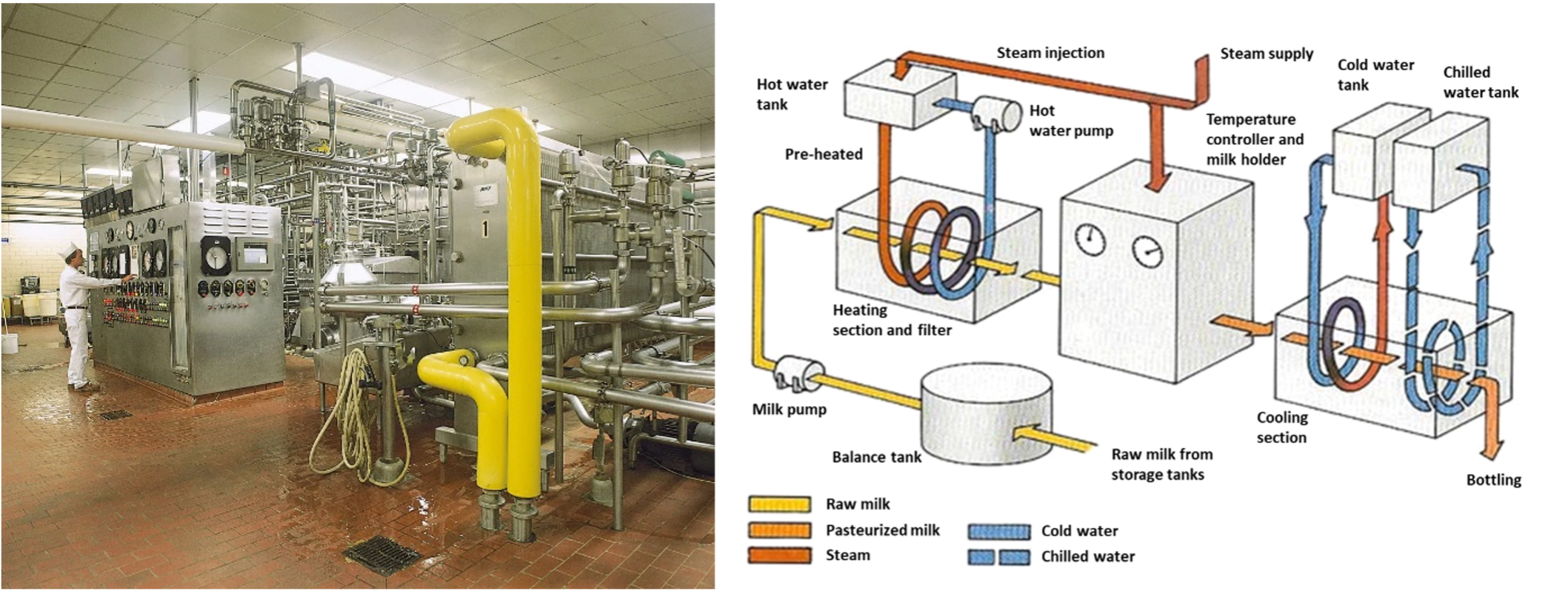
In the late 1800’s, commercial milk pasteurization came into practice and, over the decades, was optimized. The high-temperature, short-time (HTST) process, which heats milk to 161oF for 15 seconds followed by rapid cooling, would become the standard, as it effectively kills disease-causing pathogens without compromising flavor, texture, appearance, or nutrition (Fig. 3). After some skepticism, pasteurization was accepted by the general public and eventually became mandatory. In 1909, Chicago became the first city in the United States to enforce a compulsory pasteurization law. New York City did the same in 1914 following a typhoid epidemic linked to raw milk; seven years later, the infant mortality rate dropped from 240 deaths per 1,000 live births to only 71 deaths. Recognizing the indisputable life-saving benefits of pasteurization, local, state, and federal legislators continued to pass legislation to ensure the safety and health of Americans.
Raw Milk
Despite the clear benefits of pasteurization, there is still a demand for raw milk. Thankfully, the Food and Drug Administration (FDA) has banned interstate sale but does not regulate intrastate sale or distribution, the laws of which vary by state (Fig. 4). For example, Pennsylvania allows retail sale but requires dairies to have a raw milk permit, which requires disease-free cows, regular sampling and testing, and sanitary facilities.
Unfortunately, not everybody has complied. In January 2024, in Bird-in-Hand, PA, authorities searched the barn of an Amish farmer who did not have a raw milk permit after multi-state outbreaks of E. coli and Listeria had been linked to raw milk from his farm. During their search, the authorities found people bottling milk with their bare hands. In the same room where milk was being processed, they found mud and manure covered boots leaning against the wall. It was a scene reminiscent of The Jungle by Upton Sinclair, a harrowing 1905 exposé of the American meat-packing industry detailing grotesque food handling practices. The Jungle hit Americans hard in their stomachs, sparked change, and led to the 1906 Food and Drugs Act to protect consumers from harmful products. In the case of the Amish farmer, however, the local community was thoroughly convinced that the raw milk was safe and essential for their health. They were outraged, donated to the farmer’s legal fund, and showed overwhelming support. The issue became heavily politicized, and, in 2024, the Amish came out to vote in unprecedented numbers.

The FDA and the Centers for Disease Control (CDC) have repeatedly warned the public about the health risks of raw milk. It is particularly dangerous for children, the elderly, those with weakened immune systems, and pregnant women. The milk-borne pathogen Listeria can even cause miscarriage. Raw milk proponents will often grossly minimize these risks and claim benefits that are based on flawed data, purely anecdotal, grossly exaggerated, or overtly false. The FDA and CDC have thoroughly debunked raw milk misconceptions with rigorous scientific data.
Here’s the truth according to the FDA and CDC.
- Raw milk causes a greater rate of foodborne outbreaks than pasteurized milk.
- Raw milk does not contain antimicrobial components to prevent foodborne illness.
- Raw milk does not cure lactose intolerance and is not easier to digest.
- Raw milk does not cure or treat asthma and allergy.
- There are no beneficial bacteria in raw milk for gastrointestinal health.
- There are no immunoglobulins in raw milk that enhance the human immune system.
- Raw milk is not nutritionally superior to pasteurized milk.
- In March 2024, the FDA and the CDC detected H5N1 bird flu in dairy cattle and in samples of raw milk!!!!! The virus is continuing to spread through poultry farms and dairy herds, and pasteurization is highly effective in inactivating this deadly virus.
If raw milk has been scientifically proven to be risky and no more nutritious than pasteurized milk, what’s with all the hype? Why are people convinced that it’s better?
Near my hometown in rural North Texas there is a raw milk dairy. At their charming country store, you can buy not just raw milk, but also raw cheese, raw yogurt, raw honey, farm-fresh eggs, grass-fed beef, ice cream, and canned goods produced either locally or on the farm from start to finish.
This raw milk dairy truly has a stellar reputation, follows laws and regulations to the letter, and is licensed by Texas Health and Human Services (THHS). Per THHS regulations, raw milk can only be sold directly to the consumer at the farm or delivered to the consumer by the licensed processor. This law substantially reduces the time it takes for milk to reach the consumer and the risk of foodborne illness. It also makes it easier to trace the source in the event of an outbreak. While it’s certainly not a risk-free choice, the risk is significantly lower.
I can’t lie. The milk is AMAZING. It’s so fresh you can literally hear the cows mooing. The cows are well-fed and well-cared for. Since the milk is not homogenized, the cream floats to the top. The first sip of that densely caloric cold milk is like the first sip of a Starbucks drink but ten times better. It’s a luxury you can’t get in the city.
Why can’t milk be wholesome, fresh, and also pasteurized? Milk can be a nutritious part of a balanced diet. It is so wholesome that it is a calf’s sole form of nourishment during the first several weeks of life. However, because milk has nutrients necessary to sustain life, it is also an ideal environment for bacterial growth. Thanks to pasteurization, milk can be safe to drink and still retain its flavor, quality, and nutrition.

TL; DR
- Consuming raw milk puts you at risk of contracting serious, potentially life-threatening illnesses including H5N1 bird flu!!!!!
- The purported health benefits of raw milk are largely anecdotal and not backed up by scientific evidence.
- Pasteurization reduces the risk of milk-borne illness without compromising taste, quality, or nutrition.
Reference
- Currier RW, Widness JA. A Brief History of Milk Hygiene and Its Impact on Infant Mortality from 1875 to 1925 and Implications for Today: A Review. J Food Prot 2018;81:1713-1722.
- Brogren CH. Louis Pasteur-The life of a controversial scientist with a prepared mind, driven by curiosity, motivation, and competition. APMIS 2024;132:7-30.
- Smith KA. Louis pasteur, the father of immunology? Front Immunol 2012;3:68.
 Lions Talk Science
divine! Global Wine Industry Faces Climate Challenges 2025 incredible