By Alex Evans
If we did not start the fire – if it was already burning – then who set the infamous town Centralia ablaze?
Centralia, Pennsylvania, is home to an underground coal mine fire that has been burning since 1962. The U.S. Department of the Interior estimates that thousands of active coal mine fires burn throughout the world in countries such as the U.S. and China. As of 2015, Pennsylvania had approximately 40 active coal mine fires burning, but of those, it is Centralia’s decades-long blaze that continues to capture local and international attention, for one striking reason: since the burn began in 1962, Centralia has been – and remains – a ghost town.
Before learning more about the fire itself, it is important to first understand what local life was like in Centralia before the fire changed the town forever.
Centralia Town History: Before the Fire
Centralia is a former coal mining town nestled in the heart of the anthracite coal region in rural Columbia County, Pennsylvania, situated ~60 miles northeast of Hershey. The town was founded in 1866 and had an initial population of ~1,300 residents. Centralia’s population steadily increased through the following decades as people immigrated to work for the Locust Mountain Coal and Iron Company. Records paint a picture of a close-knit community in which residents enjoyed going to local theaters, saloons, churches, and hotels in their time off. The population peaked before the turn of 20th century – a prosperous time for the coal industry – at approximately 2,800 people, and declined as the demand for coal decreased in the mid-1900s. Though the coal mining operation in 1960s Centralia was far from its heyday, it remained a major occupation of the town’s residents – a scenario which weighed heavily on the looming fate of the once-booming industrial town.
The Beginning of the End: The Origin of the Centralia Coal Mine Fire
On May 25, 1962, firefighters were instructed to set fire to a local landfill in an attempt to rid the landfill of trash, a commonplace practice at the time. The well-intentioned action had unforeseen consequences when new information quickly came to light: the landfill was located within a pit situated atop an old coal mine. What was supposed to be a controlled burn erupted into deep-rooted, unquenchable coal mine fire. According to an informative resource written by the Pennsylvania Department of Environmental Protection, the disaster was predicated by the fact that the pit was left open without any construction of a non-combustible barrier, leaving the coal vulnerable to being ignited by the fire.
Over subsequent years, few attempts were made to extinguish the fire due to an extreme lack of funding. Local authorities tried to douse visible flames with water and smother the fire by sealing the ground surface with clay. However, these attempts proved futile, and the fire continued to spread underground, its flames hidden but its progress evident by a growing web of cracks, fissures, thermal vents, and sinkholes (Figure 1). These structures threatened local residents as noxious gases, odors, and burning soot were released into the atmosphere.
How does a fire spread underground? What contributes to the complex dangers such fires pose? What are the environmental consequences of these events? Information gleaned from previous coal mine fires help us dig into the science behind these questions.

Thermal Cycle of a Coal Mine Fire
When firefighters ignite waste in a pit above a coal mine, flames are visible on the ground’s surface. The fire aboveground spreads into the ground below, traveling through soil until it reaches the coal mine and ignites available coal. In the case of Centralia, the spread was further enabled since precautionary measures to protect the area – such as the creation of non-combustible barriers or the addition of stone dusting and surface trenching – were not taken.
The first step of this cycle of ongoing, self-sustaining underground fire requires an open entryway into the coal mine, to act as a pathway for consistent oxygenated air flow to be pulled toward the fire. As the fire burns, it actively transfers high levels of heat to the air and rocks within the coal mine, producing negative air pressure. The hot air begins to rise throughout the different layers of soil due to the negative air pressure, resulting in the eventual release of noxious gases, odors, and burning soot into the air via vent formation. Cooler oxygenated air sitting above the surface is drawn back towards the fire from cracks and vent openings in the soil, creating a feedback loop where the thermal cycle can start again and continue to create an environmental nightmare (Figure 2).

There are additional factors that act as catalysts for the continuous burn, spread, and environmental damage of coal mine fires. Pre-existing rock fissures and microscopic pockets of air in soil provide more air to the fire, enabling its continuous burn and ongoing damage. Additionally, over time, the underground fire smolders to the point where chunks of coal turn into ash in a process known as subsidence. One consequence of subsidence is that the loss of coal results in the formation of huge voids underground, leading to collapses and sinkhole openings in the ground. Collectively, these additional factors lead to more severe environmental impacts.
Environmental Impact of Coal Mine Fires
The coal mine fire in Centralia is a prime example of an anthropogenic disturbance – as in, one that occurs due to (in this case, reckless) human activity. The Department of Environmental Protection has recorded local surface soil temperatures up to and beyond 80° C – a dramatic symptom of the fire, given that normal soil temperatures are typically between 16-20° C.
Beyond this, one of the most pressing environmental concerns pertaining to Centralia is the increase of air pollution. The fire has been burning since 1962, which has allowed for the recurring formation of sinkholes and thermal vents over decades. Ongoing formation of these structures has facilitated the release of noxious gases such as carbon monoxide and sulfur dioxide directly into homes.
Levels of arsenic – or rather, arsenate, one of the substance’s alternate forms – has also been observed in the region. Arsenic is an element commonly found in coal, and its concentration has been recorded to be increased in Centralia in areas marked by active thermal vents. Extreme temperatures increase mineralization of arsenate and toxic metal ion concentrations within the soil, altering soil microbial composition. But beyond the fire’s devastating, ongoing impacts on the surrounding environment, it left equally lasting impressions on the town and residents that once called it home.
Centralia: Abandoned Ghost Town
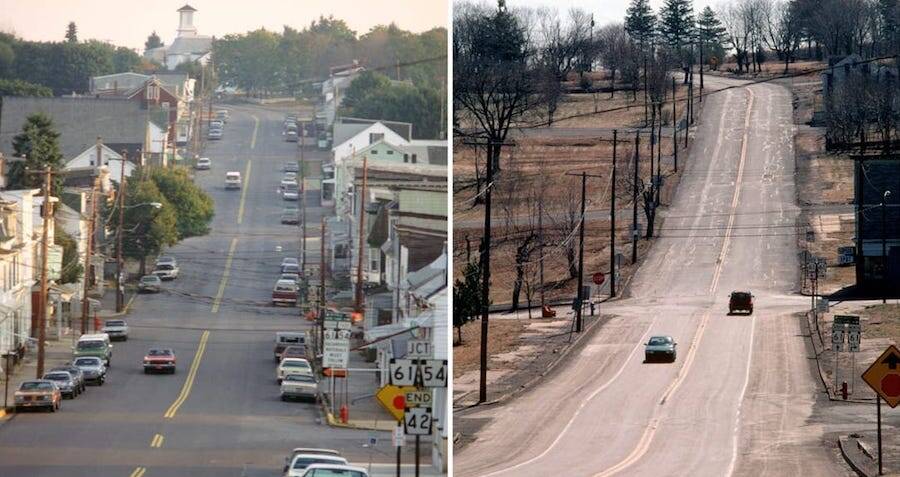
As touched on earlier, what sets Centralia apart from other coal mine fires is that the town above the still-burning fire remains completely abandoned, as it has been since 1962. The fire is currently projected to spread through an estimated 150+ acres worth of coal mines. At the fire’s inception, as environmental conditions worsened, residents voluntarily left their homes due to the growing health and safety concerns. Two decades later, in 1984, many residents accepted buyout offers from the government, as the town was deemed unfit for human life. Nearly a decade later, the Commonwealth of Pennsylvania implemented eminent domain to take over the remaining properties. Several years and a lengthy lawsuit later, 8 residents won back their right to stay in their Centralia properties, but as of 2018, Centralia’s population dwindled to just 4 residents, and the most recent data indicates that the town no longer has any recorded residents. Centralia sits, frozen in time above a fire below, as a ghost town.
To this day, the fire continues to spread at a rate of 3-7 meters per year throughout networks of underground coal seams deep below the surface. As long as there is coal available to fuel the flames, the town will remain abandoned. The coal mine fire below the ghost town of Centralia is projected to burn for hundreds of years (Figure 3).
TL;DR
- The town of Centralia, PA sits above a coal mine fire that has been burning since 1962.
- Extreme heat from the coal mine fire led to cracks, thermal vents, and sink holes, facilitating the emission of noxious gases.
- Currently, Centralia is a completely abandoned ghost town, and below, the fire still burns.
 Lions Talk Science
why hasn’t the federal government also helped Pennsylvania try harder to put the fire out, because coal mine fires really have to contribute to global warming.
Do You Know How Hard It Is To Extinguish Coal Fires, Burning In Miles Of Underground Tunnels And Cracks? They Tried Several Times Before The First Citizens Started To Leave.
@Ron Baer
As JFK once said: Ask not what your country can do for you – ask what you can do for your country.
It appears it will burn until all the coal is burnt. How long could that take? Its already been 62 years.