By: Habiba Abdelhalim
In crowds, concerts, and colonies, the behavior of one individual can quickly spread to others. This phenomenon, known as social contagion, is a powerful force that can lead to synchronized actions, like applause in an audience or collective movement in a school of fish. But it can also have dangerous consequences, such as mass panic or stampedes. So why do some highly social groups, like ant colonies, seem immune to these destructive outcomes? While this might seem counterintuitive, studying how ants avoid chaos in their densely packed societies could offer surprising insights into managing human crowds, and ourselves.
The Power and Danger of Social Contagion
Social contagion is the process by which behaviors spread from one individual to another through local interactions. It’s what makes flocks of birds swirl in unison and human crowds clap in sync1. But when left unchecked, this same process can lead to destructive mass behaviors, like stampedes.
Social insects, like ants and bees, live in highly integrated colonies often described as superorganisms; despite this, they rarely experience harmful mass behaviors. Instead, they exhibit remarkable stability. A recent study2 offers a fascinating answer: reverse social contagion. Researchers3 have hypothesized that this resilience comes from a form of behavioral deactivation: when two active ants meet, one is likely to stop its activity. They call this reverse social contagion. This mechanism helps regulate group behavior by slowing down activity rather than accelerating it. The researchers studied harvester ant colonies and found that interactions between active ants often leads to one of them stopping what it’s doing, a form of social braking that prevents the whole colony from overheating with activity. If the activity is left unchecked, too many ants might engage in foraging or task switching at once, wasting energy, disrupting coordination, and ultimately destabilizing the colony.
How the Study Worked
The researchers analyzed existing data4 from experiments on harvester ants. They used video recordings of 16 ant colonies, ranging from 40 to 400 workers, tracking individual movements and interactions over 30-second periods. They also measured the colonies’ metabolic rates using flow-through respirometry, a technique that quantifies energy expenditure. This step is important because it connects behavior to biology: by linking how ants interact with how much energy the whole colony consumes; the researchers could test whether patterns of stopping and starting really help prevent wasteful overexertion. In other words, measuring metabolic rate shows whether social “braking” keeps the colony running efficiently, much like checking a car’s fuel gauge while watching how it’s being driven.
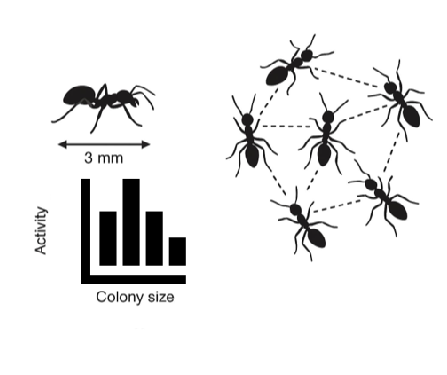
Ants were considered “active” if they moved more than 3 mm during the recording. An “interaction” was defined as two ants coming within 6 mm of each other, about one body length (Figure 1). Using these definitions, the team built interaction networks and studied how activity and energy use scaled with colony size.
Surprising Findings: More Ants, Not More Activity
One might expect that in larger colonies, with more ants and more interactions, individual ants would be more active, but that’s not what the researchers found! The average distance traveled by each ant did not increase with colony size, instead, ants in larger colonies had more interactions. The study showed that as colony size increased, so did the number of interactions between active ants. But rather than fueling more activity, these encounters often led to deactivation. This makes sense when you consider how ants occupy space. They don’t spread out evenly. Instead, they cluster around key locations, like food sources, so that the space used by the colony grows more slowly than the number of ants. This clustering increases encounter rates and sets the stage for reverse social contagion.
The researchers proposed a simple model: ants can spontaneously become active on their own, but this activation is counterbalanced by a social effect, where encounters between active ants often cause one of them to stop (Figure 2). This process is not standard social contagion, where activity spreads, but rather reverse social contagion, where social interactions act as a brake to keep overall activity in check. This mechanism helps explain why only a fraction of workers are active at any given time, and why that fraction decreases as the colony grows5. It’s an elegant form of self-regulation that prevents the colony from wasting energy on unnecessary or synchronized over-activity.

Linking Behavior to Metabolism
Perhaps the most striking finding was the connection between social interactions and metabolism. The researchers measured the metabolic rate of the entire colony, and how much energy it burns was scaled with colony mass according to Kleiber’s law. This biological rule states that metabolic rate scales with body mass to the ¾ power. The researchers also used a Cobb-Douglas function, a tool from economics, to model how active and inactive ants contribute to the colony’s energy use. They found that active ants have nearly three times the metabolic impact of inactive ones. Thanks to reverse social contagion, colonies maintain an optimal ratio of active to inactive workers, enabling hypometric metabolic scaling, meaning energy use grows more slowly than colony size.
Ant Colonies vs. Human Cities
The study draws a compelling contrast between ant colonies and human cities. In cities, social and economic outputs, like income or innovation, scale at an even greater-than-exponential rate with population size. More people lead to more interactions, which fuel growth and efficiency. But this comes at a cost: urban energy consumption also scales in a similar fashion, meaning that as cities grow, they become disproportionately more expensive to run in terms of energy use. Larger cities don’t just use more resources because they have more people, they use far more than you would expect from size alone. Ant colonies, on the other hand, show the opposite pattern. Their metabolic scaling is hypometric, larger colonies are more energy-efficient per capita. This difference may stem from a fundamental distinction in how individuals prioritize their goals: humans often act for personal benefit, while ants act for the good of the colony. Rather than maximizing their own speed or output, individual ants adjust their behavior, sometimes slowing down or yielding in high-traffic areas, in ways that enhance the coordination and efficiency of the group.
The Power of Collective Pause
This research into ant behavior is far more than an insect-related curiosity, it offers a profound lesson in resilience and efficiency that is deeply relevant to our own lives. In an era where human systems, from online networks to urban centers, are increasingly prone to viral trends, misinformation, and volatile crowd dynamics, the ants’ model of reverse social contagion presents a blueprint for stability. By understanding how biological systems naturally dampen dangerous feedback loops, we can begin to design smarter, more sustainable human technologies and policies. Imagine social media platforms that subtly slow the spread of inflammatory content, or emergency evacuation protocols that use crowd-sensing to prevent panic rather than fuel it. The humble ant teaches us that sometimes, the most powerful action is a collective pause. By looking to nature’s solutions, we can learn to build societies that are not only more connected and efficient, but also more resilient and safer for everyone.
TL;DR
- Ant colonies avoid destructive crowd behaviors through reverse social contagion, where interactions between active ants often cause one to stop.
- This self-regulation optimizes activity, conserves energy, and maintains colony stability, offering lessons for human systems and crowd management.
Reference
- Néda, Z., Ravasz, E., Brechet, Y., Vicsek, T., & Barabási, A. L. (2000). The sound of many hands clapping. Nature, 403(6772), 849–850.
- Porfiri, M., De Lellis, P., Aung, E., Meneses, S., Abaid, N., Waters, J. S., & Garnier, S. (2024). Reverse social contagion as a mechanism for regulating mass behaviors in highly integrated social systems. PNAS nexus, 3(7), pgae246. https://doi.org/10.1093/pnasnexus/pgae246
- Reina, A., & Marshall, J. A. R. (2022). Negative feedback may suppress variation to improve collective foraging performance. PloS computational biology, 18(5), e1010090.
- Waters, J. S., Ochs, A., Fewell, J. H., & Harrison, J. F. (2017). Differentiating causality and correlation in allometric scaling: ant colony size drives metabolic hypometry. Proceedings. Biological sciences, 284(1849), 20162582.
- Waters, J. S., Holbrook, C. T., Fewell, J. H., & Harrison, J. F. (2010). Allometric scaling of metabolism, growth, and activity in whole colonies of the seed-harvester ant Pogonomyrmex californicus. The American naturalist, 176(4), 501–510.
 Lions Talk Science