By Chris Pallés
As we work our way into the fall semester and feel the chill of the changing season settling in, many of us are preparing for the start of the holiday season – Halloween. This beloved holiday is known for its use of scary creatures, which often includes spiders. As a spider-lover myself, I feel it is only right that we take a moment, then, to appreciate these tiny, fuzzy explorers.
I know some people would rather scream at the thought of spiders and any creepy-crawlies – especially my own mother. Arachnophobia, or the fear of spiders, has been around since the ancient Greeks spun the first cautionary tale about the weaver Arachne. In this tale, a skilled weaver named Arachne challenges the goddess Athena to a weaving contest. When Arachne beats Athena, Athena is outraged and vows to take revenge. Arachne is then turned into the first spider, forced to forever weave her creations as cobwebs in dark corners – some stories say it is out of pity, while others say it was her punishment. Either way, Arachne is condemned to an eternity of weaving. It is from this story that we derive the term arachnid to mean spider.
In modern times, jumping spiders have seemingly worked their way into many people’s hearts through their adorable, shining eyes, and even my mother has fallen in love with an animated jumping spider named Lucas (Figure 1). Animator Joshua Slice started Lucas the Spider as animated shorts on YouTube as a challenge to himself to see “just how cute [he] could make a spider in 3D.” The animations have even helped others to face their negative views on jumping spiders, especially helped by the fact that Lucas is voiced by Slice’s own nephew. Eventually, Lucas and his gang of little creatures garnered such a following that it became a TV show on a few different platforms. Lucas even has a real-life species named after him: Salticus lucasi! Clearly, some people are warming up to jumping spiders, and you can, too, even as the days get cooler!

As the name suggests, jumping spiders can rapidly jump far distances which, paired with their sharp eyesight, makes for deadly predators of the bug world. One species of jumping spider is said to be able to jump “10 to 50 times its body length.” For comparison, that would be like us jumping almost the entire length of a football field, or the length of about 20 cars. In addition to jumping spiders’ impressive mobility, their visual acuity and ability to perceive the entire world surrounding them also gives them a competitive edge in their natural habitats. These traits distinguish jumping spiders as more active hunters, compared to most other spider species that act as passive trappers.
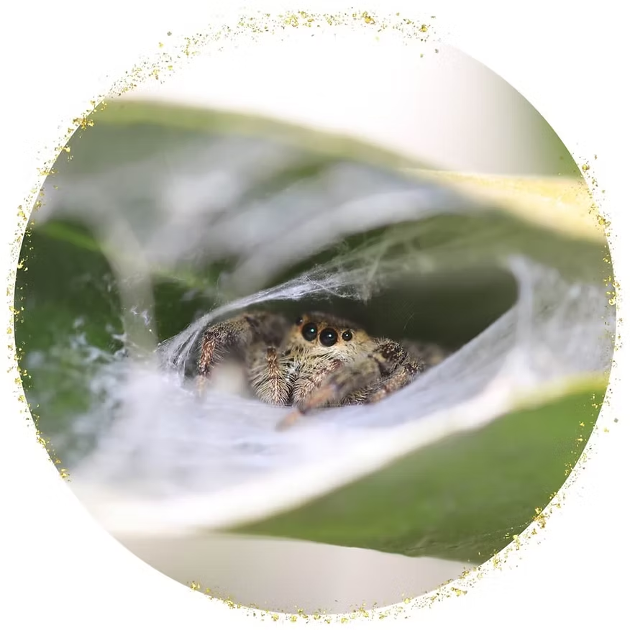
Although jumping spiders are great hunters, they will not try to hurt people or pets, since they recognize that we are quite a bit larger than they can handle. Commonly found inside, jumping spiders tend to prefer being in a high corner and thrive in mostly vertical environments. They aren’t even prolific web-weavers, due to their hunting nature. For example, they are great at hunting those pesky fruit flies or drain flies that you can never see to get rid of. Their diet consists of a variety of insects and invertebrates, depending on what is available in their environment. Altogether, jumping spiders are free, harmless pest control. By going out to search for food, they only need a small web hammock to sleep in, safely tucked away in the corner (Figure 2).
Also, jumping spiders are not bugs, since they have eight legs instead of six; rather, they are arachnids of the family Salticidae, and they are often considered cute by humans for two reasons: firstly, their expressive mating dances. In fact, there’s a whole field of study called kinetic salticidology devoted to researching those dances! Jumping spiders’ mating dances can actually be quite elaborate, involving a variety of stomping, shaking, and waving moves. They often rely on a mixture of visual appeal and physical sensations felt through the vibrations in the ground. One music artist, Jason Scardamalia, even used the sounds and movements of spiders converted to electrical signals to make an EDM track!
Another common reason people find jumping spiders adorable is their two prominent, front-facing eyes. Jumping spiders, like all spiders, have eight eyes – two primary ones in the front, with three pairs circling around to the back of their head (Figure 3). A concept coined by Austrian zoologist and ethologist Konrad Lorenz in 1943 termed “baby schema” could be the reason why we find those primary eyes so endearing.1,2 The baby schema refers to a set of characteristics that includes a “large head and a round face,…[and] large eyes” which induce a natural caretaking instinct in humans by having facial or other features that resemble human infants.1 These characteristics are often why we find kittens and puppies particularly cute compared to their adult counterparts.

Interestingly, jumping spiders’ eyes have remarkable similarities to human eyes. Like human eyes, the spider eyes have a fovea, or pit, in their retina. They are the only invertebrates known to have this feature.3 The retina is the membrane on the back of the eyeball that receives light signals that come in through the pupil; the fovea, meanwhile, is where the light signals get focused for us to really process what we’re seeing. In jumping spiders, the fovea is only present in the primary and secondary pairs of eyes, and they function to allow the spiders to see very fine details and in color. In fact, these primary eyes can see in such a high resolution that it is almost comparable to our own – a truly extraordinary feat, considering their tiny size.
As for color vision in their primary eyes, jumping spiders mainly see the world from the spectrum of green to ultraviolet (UV). This means that jumping spiders see the world mainly as greens, blues, and ultraviolet, but new research is showing that some spiders might be able to see colors like reds, yellows, and oranges, as well.4 For reference, humans can see three main colors on what we have titled the visible light spectrum: red, green, and blue. The ability to see the vast range of colors could be an important feature in the evolution of jumping spider coloring and how they attract mates. It’s hard to dazzle a potential mate if they can’t see you very well!
Jumping spiders are much smaller than most vertebrates with comparable vision, like ourselves, but interestingly, they cannot move their eyes! As a result, other eye functions that we have in our one singular set of human eyes are delegated to the rest of the spiders’ sets of eyes around the circumference of their head. These other pairs of eyes are much smaller than the primary eyes, so they are not as capable of fine detail and color, but they do allow the spider to sense the world as a kind of grayscale motion detector in 360 degrees. We, on the other hand, only have a mere 210 degree-wide field of vision. Though jumping spiders can sense their environment in 360 degrees, they will often orient themselves to face their primary eyes towards whatever has caught their interest and tend to track moving objects in their vicinity.
How do we know what is important enough to make jumping spiders turn and face something from their periphery? Researchers have sought to answer this question by gently gluing jumping spiders to a stick by their heads and giving them a small ball on which to walk.5 First, they place an image of a delicious cricket in the spiders’ main field of vision. Then, different images are placed in view of their primary eyes or secondary eyes, and the jumping spider’s movement on the ball shows scientists where the spider wants to face. In this way, they were able to determine that an innocuous black oval that is normally ignored drew the spiders’ attention when it started increasing in size. This reaction was likely because the enlarging object in spiders’ periphery was perceived to be a potential threat.5 Jumping spiders’ continuous orientation to objects in their environment and desire to explore gives many people the impression that they are curious creatures and further contributes to why many people find them cute.
From the days of Arachne, many people have feared spiders; however, with their flair for dramatic dances, curious nature, and cleverly designed eyes that appeal to our natural instincts, it is clear to see how these little spooky, but adorable, spiderlings can sneak their way into our hearts this season. Maybe, the next time you come across a jumping spider, you might try to see the world through their eyes.
TL; DR
- Jumping spiders’ physical characteristics appeal to humans through “cuteness”.
- Jumping spiders have two large eyes for color and details, and six small eyes for motion detection.
- Go forth and have less arachnophobia this spooky season!
No artificial intelligence, generative or otherwise, was used in the development or writing of this article.
Reference
- Borgi M, Cogliati-Dezza I, Brelsford V, Meints K, Cirulli F. Baby schema in human and animal faces induces cuteness perception and gaze allocation in children. Front Psychol. 2014;5:411. Published 2014 May 7. doi:10.3389/fpsyg.2014.00411
- Kawaguchi Yi and Waller, BM. Lorenz’s classic ‘baby schema’: a useful biological concept? Proc. R. Soc. B. 2024;291:20240570. Published 2024 June 19. doi:10.1098/rspb.2024.0570
- Shepeleva IP. A comparative analysis of the camera-like eyes of jumping spiders and humans. Vision (Basel). 2021;6(1):2. Published 2021 Dec 31. doi:10.3390/vision6010002
- Zurek DB, Cronin TW, Taylor LA, Byrne K, Sullivan MLG, and Morehouse NI. Spectral filtering enables trichromatic vision in colorful jumping spiders. Curr Bio. 25;10:R403. Published 2015 May 18. doi:10.1016/j.cub.2015.03.033
- Bruce M, Daye D, Long SM, Winsor AM, Menda G, Hoy RR, and Jakob EM. Attention and distraction in the modular visual system of a jumping spider. J Exp Biol. 2021;224(8):jeb231035. Published 2021 April 16. doi:10.1242/jeb.231035
 Lions Talk Science