By Louis Betz

In the United States, approximately 93% of Americans consume caffeine. Of that 93%, 75% consume caffeine daily, and 25% report consuming it three or more times a day. Though I haven’t done the research, I’d make an educated guess that the stats for graduate students are even higher! But how much do we really know about what exactly we’re consuming when we seek out caffeine? Can too much caffeine be a problem? How much is safe to consume in a day? What else is in my caffeinated drinks?
Regulation of caffeinated drinks
Caffeine can be consumed in many forms, including coffee, tea, soft drinks, and energy drinks. These beverages are regulated by the Federal Food and Drug Administration (FDA) as food products. According to the FDA Food Labeling Guide, unbrewed coffee and tea, such as grounds or leaves, fall under the classification of food with limited nutritional value, allowing exemption from the traditional Nutrition Facts Panel on those foods. Naturally occurring caffeine is not required to be listed on the label as it is inherent to specific ingredients such as tea leaves.
Brewed coffee, tea, soft drinks, and some energy drinks are classified as beverages and are thus required to have a Nutrition Facts Panel on their labels, displaying the serving size, calories, and nutrients. Furthermore, according to the FDA Guidance for Industry: Distinguishing Liquid Dietary Supplements from Beverages, in these beverages, all added caffeine is required to be visible on the label; however, there is no limit to the amount of caffeine that can be added. The recommended upper limit of daily caffeine intake is 400 milligrams (mg) (~4 cups of coffee), however the recommended amount is closer to 200 mg (~2 cups of coffee) [1]. If the caffeine content in an energy drink can is 300 mg for example, if someone drinks 2 cans, they have exceeded their upper limit by 200 mg and may not even know it!
Most energy drinks are marketed as dietary supplements and are not overseen by the FDA, according to the Dietary Supplement Health and Education Act of 1994. Under this act, the FDA must approve any new dietary ingredients for the market. However, if companies want to get around this hassle, they can produce energy drinks that utilize previously approved ingredients, and therefore, will not require additional FDA approval.
Once on the market, the FDA can monitor energy drinks. Energy drinks advertised as dietary supplements are still subject to regulation; they must not be marketed as beverages or a meal replacement, and they must provide a Supplement Facts panel, listing the ingredients. One of the most famous examples of an energy drink being taken off the market is that of Four Loko, which was removed from the market, in its former state, as this product contained high amounts of both caffeine and alcohol. The danger of this drink comes from the combination of caffeine and alcohol; the caffeine masks the effects of the alcohol, leading to overconsumption. This led to severe cases of alcohol poisoning and heart damage. This product is still on the market, but contains no caffeine and is not marketed as an energy drink.
Other countries have taken the liberty of regulating energy drink availability much more than the United States currently does. For example, the European Food safety authority requires a high caffeine content warning on any drinks with more than 150 mg of caffeine. Sweden added to this regulation, prohibiting the sale of energy drinks to people under the age of 15, and additional warning labels are present warning against mixing energy drinks with alcohol or consuming large amounts after exercise, as both exercise and energy drinks increase heart rate and can contribute to the development of heart palpitations or arrhythmia (irregular heartbeat) [1]. In the United States, popular energy drinks such as Bang, Reign, GFuel, and Bucked Up have upwards of 300 mg of caffeine per can! With the popularity of energy drinks and the lack of strict regulation by the FDA compared to other countries, their safety has been called into question by scientists [2].
Safety Concerns with Energy Drink Consumption
High energy drink consumption has been associated with numerous negative effects on the brain[2] including an increased risk of having insomnia, anxiety, and seizures [3, 4]. These same effects have been demonstrated to arise in response to high consumption of coffee as well. Therefore, the neurological effects of energy drinks may not be due to the composition of the supplement, but rather the large caffeine content [5]. Though adverse effects on the brain have been investigated, even more worrisome is the effect of overconsumption of caffeine on the heart.
The effect of energy drink consumption on the heart has been extensively studied. High energy drink consumption, especially in adolescents (ages 10 to 19), increases the risk for cardiovascular dysfunction. Specifically, the development of arrhythmia, cardiomyopathy (a disease which affects heart function), and myocardial infarction (heart attack) [1, 2, 7, 8]. These effects are not associated with other caffeinated beverages. Coffee, for example, is associated with a decreased risk for many cardiovascular ailments, such as those induced by energy drinks [9]. Energy drinks have been demonstrated to increase heart rate and blood pressure in a manner independent of caffeine content. Perhaps the supplements found in energy drinks that are not present in natural sources of caffeine may cause these effects or cause adverse effects when combined with the high caffeine content [6]. This leads to the big question… What exactly is in these energy drinks compared to natural caffeine sources?
Common Ingredients Found in Energy Drinks
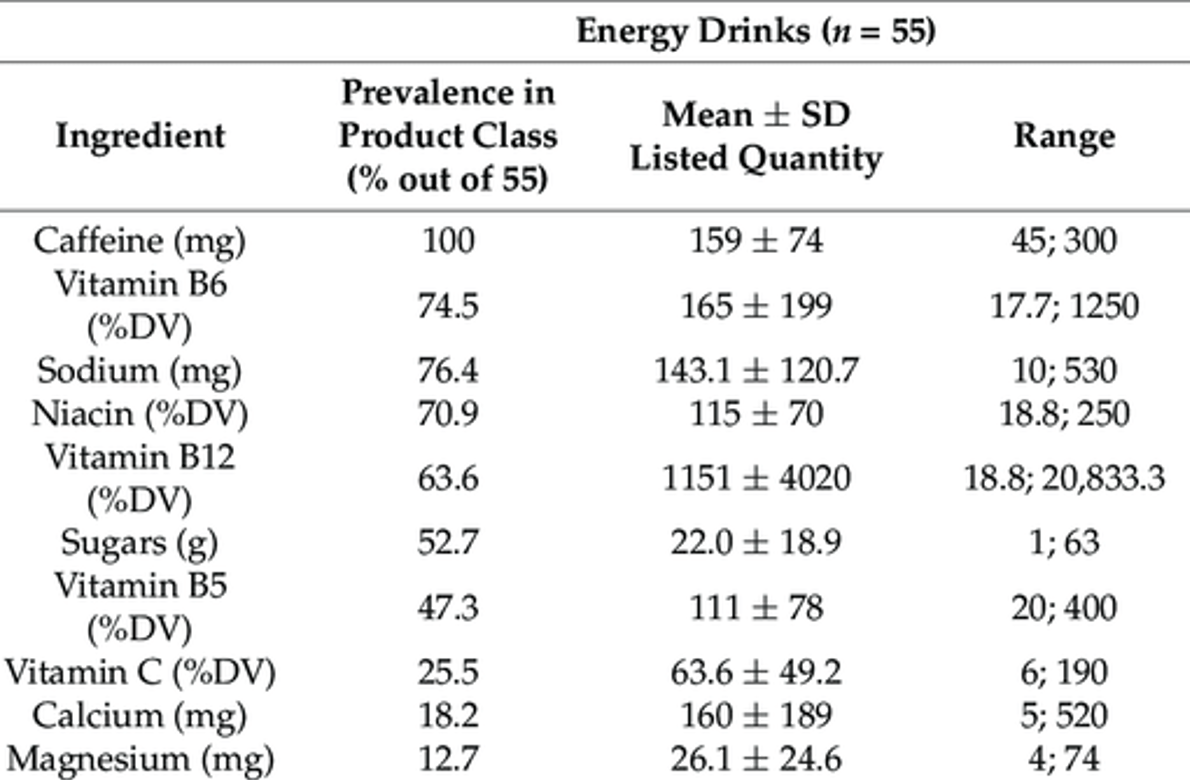
Different energy drinks have different compositions depending on the manufacturer and the supposed purpose of the energy drink. The most common ingredients are seen in Table 1 [10]. Of the ingredients other than caffeine, Niacin (vitamin B3) is one that stands out. Overconsumption of Niacin supplements can contribute to the development of arrhythmias and other complications such as hypertension (high blood pressure) [11]. Another common additive is vitamin B6, which can cause neurotoxic effects such as numbness in the extremities [12]. While overdoses of these vitamins alone can cause these adverse effects, little is known about their interaction with caffeine. Research into the overconsumption of and long-term interaction between these supplements is necessary to ensure the safety of energy drink consumers.
Safety concerns regarding the use of energy drinks have been rising, especially in cases of excessive consumption. As there is currently limited regulation on energy drinks – both caffeine and ingredient content – it is imperative to be an informed, and responsible consumer to avoid the development of these adverse effects. My recommendation is that if you need a caffeine fix, coffee (in moderation) appears to be a safer, natural alternative with health benefits rather than detriments.
TL;DR
- Energy drinks are not regulated by the FDA
- Energy drinks may increase the risk of neurological and cardiovascular diseases
- Little is known about the added ingredients and supplements within energy drinks and the combined effects they have with caffeine
Reference
- Seifert, S.M., et al., Health effects of energy drinks on children, adolescents, and young adults. Pediatrics, 2011. 127(3): p. 511-28.
- Costantino, A., et al., The Dark Side of Energy Drinks: A Comprehensive Review of Their Impact on the Human Body. Nutrients, 2023. 15(18).
- Iyadurai, S.J. and S.S. Chung, New-onset seizures in adults: possible association with consumption of popular energy drinks. Epilepsy Behav, 2007. 10(3): p. 504-8.
- Sanchez-Sanchez, E., et al., Attitudes and consumption habits of energy drinks among adolescents and young adults in a Spanish population. AIMS Public Health, 2025. 12(1): p. 16-32.
- Liu, C., et al., Caffeine intake and anxiety: a meta-analysis. Front Psychol, 2024. 15: p. 1270246.
- Schuttler, D., et al., Impact of energy drink versus coffee consumption on periodic repolarization dynamics: an interventional study. Eur J Nutr, 2022. 61(5): p. 2847-2851.
- Di Rocco, J.R., et al., Atrial fibrillation in healthy adolescents after highly caffeinated beverage consumption: two case reports. J Med Case Rep, 2011. 5: p. 18.
- Mangi, M.A., et al., Energy Drinks and the Risk of Cardiovascular Disease: A Review of Current Literature. Cureus, 2017. 9(6): p. e1322.
- Mendoza, M.F., et al., Impact of Coffee Consumption on Cardiovascular Health. Ochsner J, 2023. 23(2): p. 152-158.
- Jagim, A.R., et al., Prevalence and Amounts of Common Ingredients Found in Energy Drinks and Shots. Nutrients, 2022. 14(2).
- Habibe, M.N. and J.Z. Kellar, Niacin Toxicity, in StatPearls. 2025: Treasure Island (FL). 12. Hemminger, A. and B.K. Wills, Vitamin B6 Toxicity, in StatPearls. 2025: Treasure Island (FL).
 Lions Talk Science