By Jessenia Chavez
What if one of the most studied supplements in sports science… wasn’t just for athletes?
Creatine has long been associated with gym-goers and bodybuilders looking to pack on muscle. But a growing mound of research shows that its benefits extend far beyond the weight room. From improving brain energy metabolism to supporting muscle maintenance in aging adults, creatine is gaining attention as a supplement for overall wellness, not just performance.
In this article, we’ll explore what creatine is, how it works, and why it might be worth considering even if you’ve never picked up a dumbbell. Whether you’re a grad student, vegan, or just curious about optimizing your health, creatine might be the unexpected science-backed boost you didn’t know you needed.
What is creatine?
Creatine is a naturally occurring compound composed of amino acids, the building blocks of proteins. Creatine itself is the combination of three amino acids – arginine, glycine, and methionine. While red meats, eggs, and fish are dietary sources of creatine, the body can also generate about 1 gram of creatine per day. Creatine is primarily stored in muscles as phosphocreatine (or creatine phosphate), where it is used to rapidly generate adenosine triphosphate (ATP).
ATP is the energy source that powers nearly every process in the body, from blinking your eyes to lifting weights. To generate ATP, our bodies rely on three main energy systems: aerobic, anaerobic and phosphagen (Figure 1). The aerobic system produces ATP by breaking down carbohydrates and fats and is usually activated during low to moderate intensity activities. This system generates ATP relatively slowly compared to the anaerobic and phosphagen systems. The anaerobic system, the next fastest in generating ATP, does so by breaking down carbohydrates in the absence of oxygen. Although ATP is generated a bit faster, this energy source lasts only mere minutes. Lastly, we have the phosphagen system, the fastest of the three to generate ATP. The phosphagen system provides an immediate supply of ATP by metabolizing phosphocreatine, which is crucial for energy production during short, high intensity activity.

So, how is this relevant to working out? Well, our ATP storage is actually very limited, so our body is constantly working to meet our energy demands. When creatine is taken as a supplement, it increases the body’s stores of phosphocreatine. During a workout, this is especially beneficial. Imagine you’re doing a set of your favorite exercise. By the end of the set, you’ve used a good amount of your immediate energy stores, and your muscles feel fatigued due to the energy exertion. But while you’re resting between sets, your body immediately gets to work refueling. Thanks to the phosphagen system, your body uses phosphocreatine to rapidly replenish your ATP stores to prepare for the next set.
This isn’t just a theory; studies have shown that supplementing with creatine improves high-intensity exercise performance by 10-20% (2). Other benefits of coupling creatine supplementation and resistance training include an increase in lean body mass and overall strength (3–5). Many studies have investigated the effects of creatine on athletic performance across different sports. For example, creatine supplementation has been shown to improve muscle power output (6), enhance repetitive sprinting ability (7) and maintain leg strength and power (8) in soccer players. When given to swimmers, creatine has been shown to improve upper-body anaerobic power and endurance (9) and enhance sprint performance (10, 11). But the benefits of taking creatine don’t stop on the field. In the coming sections, we will discuss the benefits of creatine in cognitive health, women’s health, and individuals who consume little to no animal products.
The benefits of creatine outside of the gym
Cognitive function: In recent years, creatine has been appreciated for its potential effects on brain health and function. Although 95% of creatine is stored in skeletal muscle, creatine is also transported to the brain (12). Interestingly, neurons, and other brain cells, can produce creatine as well (13). Once in the brain, some studies have shown that creatine has positive effects on multiple aspects of memory including working memory (14), long term memory (15), and recognition memory (16). General intelligence, measured by timed puzzle-based tests called Raven’s Advanced Progressive Matrices, has also been shown to improve in those who supplemented with creatine (14). Additionally, many studies have found that supplementing with creatine can alleviate the effects of mental fatigue (17, 18). However, it must be noted that despite the many studies that support the cognitive benefits of creatine, there are a few studies that show creatine has little to no effect on brain function (19, 20). So, what’s causing this discrepancy? A recent meta-analysis suggests that the devil is in the details – specifically, these researchers suggest that the many studies investigating the effects of creatine on cognitive health widely differ in subject populations, sample size, cognitive tests, and supplementation regimens (21). Despite the inconsistencies within the literature, majority of studies do support positive cognitive effects of creatine, although additional studies will be needed to fully elucidate its effects.
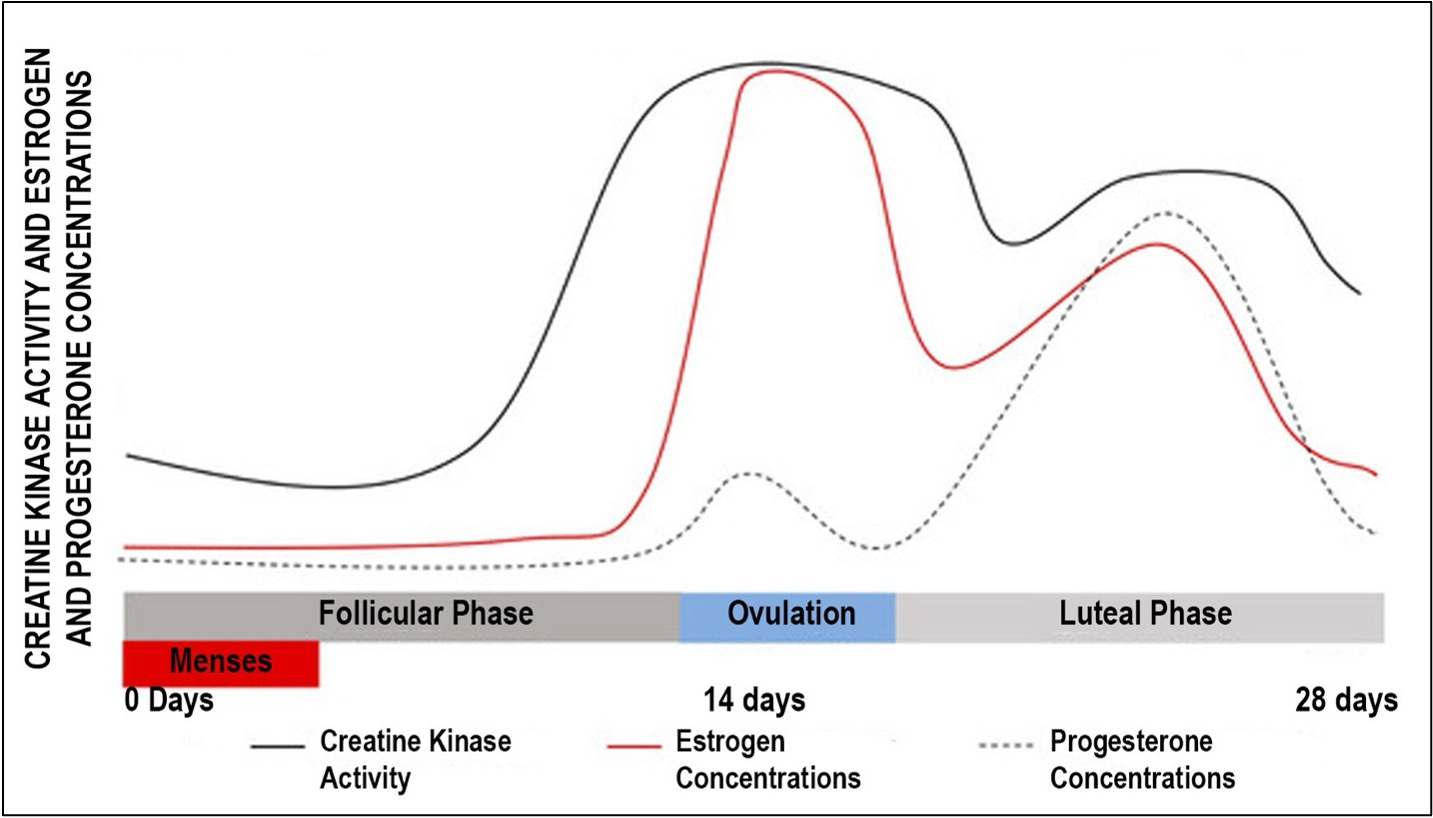
Women’s Health: Would you be surprised to hear that women harbor 70–80% lower endogenous creatine stores compared to men (22)? With these stats, women seem to have nothing to lose and everything to gain, but why is this the case? It has become evident that creatine synthesis is heavily influenced by hormonal fluctuations that occur throughout the menstrual cycle. While estrogen decreases the expression of a vital protein involved in the synthesis of creatine, arginine-glycine aminotransferase, it is also suggested to enhance creatine metabolism during the menstrual cycle by influencing the activity of creatine kinase, the enzyme that converts creatine phosphate into ATP (23) (Figure 2). Notably, this imbalance between creatine synthesis and utilization persists throughout many stages of a female’s life. For example, creatine levels are ~35% lower in pregnant women compared to non-pregnant women (24–26). Furthermore, studies have even suggested that natural creatine stores reduce with aging (27–29). Given this information, supplementing with creatine may be worth considering for its potential physical and cognitive benefits.
Diet restricted population: An often-overlooked consequence of plant-based diets are the need for supplementation of vital nutrients, creatine among them. Because plants contain very little creatine, those who maintain a vegan or vegetarian diet consume less creatine compared to those who consume animal products (30). Consuming eggs and other dairy products may improve creatine consumption somewhat, but not to the degree that eating animal-based foods would (30). Interestingly, vitamin B12 is another nutrient that is commonly deficient in vegans (31). This is significant as studies have shown that vitamin B12 deficiency impairs the synthesis of methionine, an amino acid that makes up part of creatine (32). This not only indicates that creatine consumption is nearly depleted in those following a vegan diet, but the natural synthesis of creatine is also impaired. Although one’s dietary choices may not be negotiable, supplementing with creatine, in addition to B12, can offer a simple and effective way to replenish internal phosphocreatine levels.
What’s the most effective way to take creatine?
Now that we’ve scratched the surface of creatine’s many benefits, let’s talk about how to “creatine”. Given that creatine monohydrate is currently the most studied form, it may be the best form for those looking to try (33–35). When first starting a creatine regimen, it is often suggested to go through a loading phase. To be exact, it is suggested to take 20 grams (g) of creatine for 5-7 days, followed by long-term consumption of 3-5g per day (36). The idea behind the loading phase is to rapidly increase and saturate creatine stores which will result in faster “gains”; however, the loading phase is completely optional and not necessary to benefit from creatine supplementation. Instead, consuming 5g of creatine, a more reasonable amount, per day will achieve the same benefits. In terms of timing, creatine supplementation has been shown to be more beneficial taken after workouts compared to before (37), but for most people, the key takeaway is to simply make creatine part of your daily routine. The long-term safety of creatine monohydrate has been established for the past few decades (36); however, as with any supplement, it’s best to consult with your healthcare provider before starting creatine, especially if you have any underlying health conditions or concerns.
TL; DR:
- Creatine is one of the most studied sport supplements but has many benefits for non-athletes as well.
- Naturally occurring in our bodies, it has been shown to improve exercise performance, muscle maintenance, and cognitive function.
- Creatine supplementation is especially beneficial for women and vegans
Sources for article banner image:
- Antipina, Rina. Dumbbells for fitness. Digital Image. Shutterstock. Shutterstock, Inc, 27 April 2021. Web. 7 May 2025.
- The Ability Clinic. How much Creatine Do I Need to Workout. Digital Image. Abilityclinic.ca. The Ability Clinic, Web. 7 May 2025.
- Created in BioRender. Chavez, J. (2025) https://BioRender.com/asuj0le
Reference
- Therapy, T. P. C. o. P. (2020) Cycling, Endurance Sports, Fitness, Running, Triathlon, Triathlon Seminars In Triathlon, Putneyclinic.co.uk
- Kreider, R. B. (2003) Effects of creatine supplementation on performance and training adaptations Mol Cell Biochem 244, 89-94
- Jówko, E., Ostaszewski, P., Jank, M., Sacharuk, J., Zieniewicz, A., Wilczak, J. et al. (2001) Creatine and beta-hydroxy-beta-methylbutyrate (HMB) additively increase lean body mass and muscle strength during a weight-training program Nutrition 17, 558-566
- Vandenberghe, K., Goris, M., Van Hecke, P., Van Leemputte, M., Vangerven, L., and Hespel, P. (1997) Long-term creatine intake is beneficial to muscle performance during resistance training J Appl Physiol (1985) 83, 2055-2063
- Kreider, R. B., Ferreira, M., Wilson, M., Grindstaff, P., Plisk, S., Reinardy, J. et al. (1998) Effects of creatine supplementation on body composition, strength, and sprint performance Med Sci Sports Exerc 30, 73-82
- Yáñez-Silva, A., Buzzachera, C. F., Piçarro, I. D. C., Januario, R. S. B., Ferreira, L. H. B., McAnulty, S. R. et al. (2017) Effect of low dose, short-term creatine supplementation on muscle power output in elite youth soccer players J Int Soc Sports Nutr 14, 5
- Zajac, A., Golas, A., Chycki, J., Halz, M., and Michalczyk, M. M. (2020) The Effects of Long-Term Magnesium Creatine Chelate Supplementation on Repeated Sprint Ability (RAST) in Elite Soccer Players Nutrients 12,
- Claudino, J. G., Mezêncio, B., Amaral, S., Zanetti, V., Benatti, F., Roschel, H. et al. (2014) Creatine monohydrate supplementation on lower-limb muscle power in Brazilian elite soccer players J Int Soc Sports Nutr 11, 32
- Dawson, B., Vladich, T., and Blanksby, B. A. (2002) Effects of 4 weeks of creatine supplementation in junior swimmers on freestyle sprint and swim bench performance J Strength Cond Res 16, 485-490
- Grindstaff, P. D., Kreider, R., Bishop, R., Wilson, M., Wood, L., Alexander, C. et al. (1997) Effects of creatine supplementation on repetitive sprint performance and body composition in competitive swimmers Int J Sport Nutr 7, 330-346
- Selsby, J. T., Beckett, K. D., Kern, M., and Devor, S. T. (2003) Swim performance following creatine supplementation in Division III athletes J Strength Cond Res 17, 421-424
- Ohtsuki, S., Tachikawa, M., Takanaga, H., Shimizu, H., Watanabe, M., Hosoya, K. et al. (2002) The blood-brain barrier creatine transporter is a major pathway for supplying creatine to the brain J Cereb Blood Flow Metab 22, 1327-1335
- Braissant, O., Henry, H., Loup, M., Eilers, B., and Bachmann, C. (2001) Endogenous synthesis and transport of creatine in the rat brain: an in situ hybridization study Brain Res Mol Brain Res 86, 193-201
- Rae, C., Digney, A. L., McEwan, S. R., and Bates, T. C. (2003) Oral creatine monohydrate supplementation improves brain performance: a double-blind, placebo-controlled, cross-over trial Proc Biol Sci 270, 2147-2150
- McMorris, T., Mielcarz, G., Harris, R. C., Swain, J. P., and Howard, A. (2007) Creatine supplementation and cognitive performance in elderly individuals Neuropsychol Dev Cogn B Aging Neuropsychol Cogn 14, 517-528
- Ferrier, C. H., Alarcón, G., Glover, A., Koutroumanidis, M., Morris, R. G., Simmons, A. et al. (2000) N-Acetylaspartate and creatine levels measured by (1)H MRS relate to recognition memory Neurology 55, 1874-1883
- Avgerinos, K. I., Spyrou, N., Bougioukas, K. I., and Kapogiannis, D. (2018) Effects of creatine supplementation on cognitive function of healthy individuals: A systematic review of randomized controlled trials Exp Gerontol 108, 166-173
- VAN Cutsem, J., Roelands, B., Pluym, B., Tassignon, B., Verschueren, J. O., DE Pauw, K. et al. (2020) Can Creatine Combat the Mental Fatigue-associated Decrease in Visuomotor Skills? Med Sci Sports Exerc 52, 120-130
- Merege-Filho, C. A., Otaduy, M. C., de Sá-Pinto, A. L., de Oliveira, M. O., de Souza Gonçalves, L., Hayashi, A. P. et al. (2017) Does brain creatine content rely on exogenous creatine in healthy youth? A proof-of-principle study Appl Physiol Nutr Metab 42, 128-134
- Rawson, E. S., Lieberman, H. R., Walsh, T. M., Zuber, S. M., Harhart, J. M., and Matthews, T. C. (2008) Creatine supplementation does not improve cognitive function in young adults Physiol Behav 95, 130-134
- Xu, C., Bi, S., Zhang, W., and Luo, L. (2024) The effects of creatine supplementation on cognitive function in adults: a systematic review and meta-analysis Front Nutr 11, 1424972
- Brosnan, J. T., and Brosnan, M. E. (2007) Creatine: endogenous metabolite, dietary, and therapeutic supplement Annu Rev Nutr 27, 241-261
- Wyss, M., and Kaddurah-Daouk, R. (2000) Creatine and creatinine metabolism Physiol Rev 80, 1107-1213
- Smith-Ryan, A. E., Cabre, H. E., Eckerson, J. M., and Candow, D. G. (2021) Creatine Supplementation in Women’s Health: A Lifespan Perspective Nutrients 13,
- Bahado-Singh, R. O., Akolekar, R., Chelliah, A., Mandal, R., Dong, E., Kruger, M. et al. (2013) Metabolomic analysis for first-trimester trisomy 18 detection Am J Obstet Gynecol 209, 65.e61-69
- Marescau, B., De Deyn, P. P., Holvoet, J., Possemiers, I., Nagels, G., Saxena, V. et al. (1995) Guanidino compounds in serum and urine of cirrhotic patients Metabolism 44, 584-588
- Ellery, S. J., Walker, D. W., and Dickinson, H. (2016) Creatine for women: a review of the relationship between creatine and the reproductive cycle and female-specific benefits of creatine therapy Amino Acids 48, 1807-1817
- Bundey, S., Crawley, J. M., Edwards, J. H., and Westhead, R. A. (1979) Serum creatine kinase levels in pubertal, mature, pregnant, and postmenopausal women J Med Genet 16, 117-121
- King, B., Spikesman, A., and Emery, A. E. (1972) The effect of pregnancy on serum levels of creatine kinase Clin Chim Acta 36, 267-269
- Kaviani, M., Shaw, K., and Chilibeck, P. D. (2020) Benefits of Creatine Supplementation for Vegetarians Compared to Omnivorous Athletes: A Systematic Review Int J Environ Res Public Health 17,
- Craig, W. J., Mangels, A. R., Fresán, U., Marsh, K., Miles, F. L., Saunders, A. V. et al. (2021) The Safe and Effective Use of Plant-Based Diets with Guidelines for Health Professionals Nutrients 13,
- Allen, L. H. (2008) Causes of vitamin B12 and folate deficiency Food Nutr Bull 29, S20-34; discussion S35-27
- Antonio, J., Candow, D. G., Forbes, S. C., Gualano, B., Jagim, A. R., Kreider, R. B. et al. (2021) Common questions and misconceptions about creatine supplementation: what does the scientific evidence really show? J Int Soc Sports Nutr 18, 13
- Kreider, R. B., Kalman, D. S., Antonio, J., Ziegenfuss, T. N., Wildman, R., Collins, R. et al. (2017) International Society of Sports Nutrition position stand: safety and efficacy of creatine supplementation in exercise, sport, and medicine J Int Soc Sports Nutr 14, 18
- Kerksick, C. M., Wilborn, C. D., Roberts, M. D., Smith-Ryan, A., Kleiner, S. M., Jäger, R. et al. (2018) ISSN exercise & sports nutrition review update: research & recommendations J Int Soc Sports Nutr 15, 38
- Naderi, A., de Oliveira, E. P., Ziegenfuss, T. N., and Willems, M. T. (2016) Timing, Optimal Dose and Intake Duration of Dietary Supplements with Evidence-Based Use in Sports Nutrition J Exerc Nutrition Biochem 20, 1-12
- Antonio, J., and Ciccone, V. (2013) The effects of pre versus post workout supplementation of creatine monohydrate on body composition and strength J Int Soc Sports Nutr 10, 36
 Lions Talk Science