By Vanshika A. Patel
Have you ever wondered how a favorite song can lift you up when you’re down or transport you back in time? Music has a remarkable power to engage emotions, evoke memories, and even affect our well-being. Recent studies in neuroscience investigate the complex relationship between music and the brain, showing how one song can have a significant effect. Here, we will explore two intriguing aspects of music’s potency: its amazing ability to revive memories and its power to heal mind and body.
Music and Memory: The Mysterious Power of Older Songs as Time Machines
There’s a special nostalgia in hearing an old song, a kind of conjuring of a moment from years past with incredible vividness. Perhaps it’s a high school smash hit or a summer jam that was on repeat during a road trip. Whatever it is, this association is no coincidence; it’s our brain functioning in sophisticated ways. The hippocampus, the part of the brain responsible for storing and retrieving memories, is at the forefront of all these sensations. (Figure 1). It is paired with the amygdala, the brain’s emotional processing center, forming a link between life experience and music (Šimić et al., 2021). The link between the amygdala and hippocampus is the reason a song can suddenly bring up forgotten memories and feelings as if one is in a time machine.
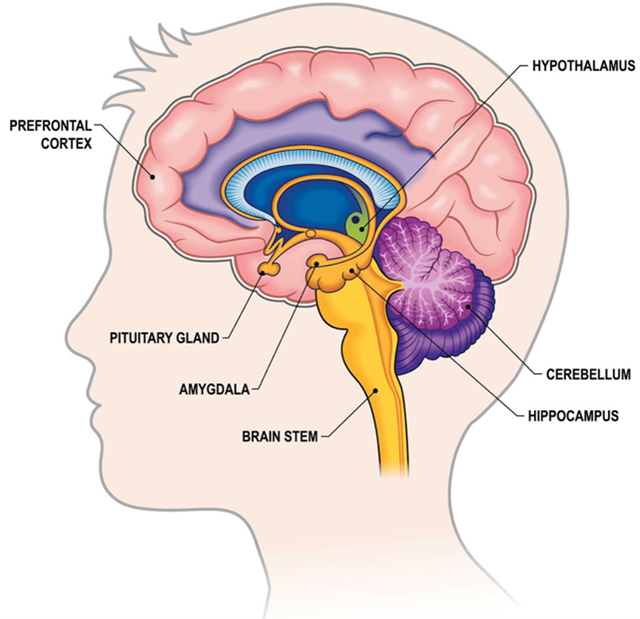
The bond linking music and memory holds immense importance, especially for those affected by Alzheimer’s disease and dementia. Studies have proven that even in the absence of speech, songs could bring a feeling of familiarity and elicit emotional reactions like happiness (Toader et al., 2023; Šimić et al., 2021). Most nursing homes and care facilities have incorporated music therapy as a medium through which patients are able to reconnect with their past and evoke previously forgotten memories. The ability to remember lyrics and melodies, even in the later phases of dementia, emphasizes the deep roots that music has in our long-term memory (Miendlarzewska & Trost, 2013).
The effect of music on memory extends beyond cognitive impairment. Many students use music as a learning aid, linking specific songs to key information to recall later. Research has confirmed that instrumental music while learning can enhance focus and aid in problem-solving (Miendlarzewska & Trost, 2013). Additionally, athletes can listen to music to build psychological associations with optimal performance, boosting their motivation and energy levels prior to competitions (Thoma et al., 2013).
Beyond the realm of personal memories, music plays a critical role in preserving cultural and historical narratives. National anthems, protest songs, and folk songs act as memory prompts for countries, establishing a link between citizens and their shared history. The songs evoke shared emotions, and in doing so, they remind us that songs not only preserve personal memories but also make history live for generations to come (Thoma et al., 2013).
Music as Medicine: Healing the Body and Mind
Music does not only entertain it also heals the body and mind. Research has indicated that music therapy has the potential to notably reduce stress and lower blood pressure (Thoma et al., 2013). Increasingly, hospitals are incorporating music to bring relaxation and aid in the healing process. Perhaps music’s deepest contribution is toward pain management. Studies have shown that soothing music can provoke the release of endorphins—those natural chemicals in our bodies increasing pain tolerance and promote feelings of comfort (Tamer et al., 2024). This observation explains why medical professionals often recommend the use of music for post-operative patients, such as chemotherapy patients (Stanczyk MM, 2011). These soothing rhythms are also said to have a soothing impact on the nervous system that slows down the heart rate and creates a sense of relaxation (Miendlarzewska & Trost, 2013) (Figure 2).

Music therapy is also proving its value in neurological rehabilitation. Stroke patients who lose their ability to speak can utilize rhythm and melody to help them regain their speaking skills. This approach, called Melodic Intonation Therapy, encourages patients to sing their thoughts instead of speaking to them, using the healthiest parts of the brain to substitute for those that are damaged (Miendlarzewska & Trost, 2013). Likewise, patients who are afflicted with Parkinson’s disease often seek out music therapy to increase the level of control they have over movement. The music rhythm of a song acts as an extrinsic rhythm, guiding the patients through an easier decline in physical ability (Machado et al, 2021).
Other than physical management and tolerance, music also holds a tremendous influence over the mind. Engagement with music, either listening or performing, has been shown to alleviate depression, anxiety, and symptoms of PTSD and acts as an open gateway for emotional release (Tamer et al., 2024; Thoma et al., 2013). Therapists have been leveraging the power of music as a key component of cognitive behavior therapy to allow patients to convey thoughts and feelings via non-verbal communication. Music’s order and repetition has the power to stabilize emotions, giving a sense of balance to the people suffering from mental illness.
Sleep is also affected by music. Slow, relaxing tunes—within 60-80 beats per minute—are demonstrated to slow down breathing and heartbeat, making people relax before they sleep (Tamer et al., 2024). Research has indicated that the listening of soothing music before bedtime lowers cortisol levels, the hormone associated with stress, which helps to make falling asleep smoother and improve sleep quality (Thoma et al., 2013). Consequently, most relaxation and meditation apps integrate music to encourage restful sleep.
What we listen to also has the power to influence our mental wellbeing. Upbeat and cheerful melodies have the amazing ability to enhance motivation and energy, making them perfect workout or productivity companions. Alternatively, slow and soothing harmonies bring about a sense of relaxation and emotional relief decreasing stress and enhancing mindfulness (Miendlarzewska & Trost, 2013).
Having music that resonates with our emotions and our needs can tap into its rich power to make our everyday life richer. In short, when a song that is personal to you plays, you’re not merely listening; you’re awakening your mind, reliving great memories, and even nurturing your sense of well-being. Whether music reminds us of good times or is a catalyst for healing, music repeatedly shows its enormous impact on the human experience. So go ahead—crank up the volume, allow the rhythm to surround you, and get lost in the incredible science of your favorite music.
Reference
- BhardwajMusicAcademy. (2023, January 31). The powerful effect of music on brain. BMA. https://www.bhardwajmusicacademy.com/the-powerful-effect-of-music-on-brain
- Brain anatomy and how the brain works. Johns Hopkins Medicine. (2021, July 14). https://www.hopkinsmedicine.org/health/conditions-and-diseases/anatomy-of-the-brain
- Machado Sotomayor MJ, Arufe-Giráldez V, Ruíz-Rico G, Navarro-Patón R. Music Therapy and Parkinson’s Disease: A Systematic Review from 2015-2020. Int J Environ Res Public Health. 2021 Nov 4;18(21):11618. doi: 10.3390/ijerph182111618. PMID: 34770129; PMCID: PMC8582661.
- Miendlarzewska EA, Trost WJ. How musical training affects cognitive development: rhythm, reward and other modulating variables. Front Neurosci. 2013;7:279. doi: 10.3389/fnins.2013.00279.
- Šimić G, Tkalčić M, Vukić V, Mulc D, Španić E, Šagud M, Olucha-Bordonau FE, Vukšić M, P RH. Understanding Emotions: Origins and Roles of the Amygdala. Biomolecules. 2021;11(6). doi: 10.3390/biom11060823.
- Stanczyk MM. Music therapy in supportive cancer care. Rep Pract Oncol Radiother. 2011 Jun 8;16(5):170-2. doi: 10.1016/j.rpor.2011.04.005. PMID: 24376975; PMCID: PMC3863265.
- Thoma MV, La Marca R, Brönnimann R, Finkel L, Ehlert U, Nater UM. The effect of music on the human stress response. PLoS One. 2013;8(8):e70156. doi: 10.1371/journal.pone.0070156.
- Toader C, Tataru CP, Florian IA, Covache-Busuioc RA, Bratu BG, Glavan LA, Bordeianu A, Dumitrascu DI, Ciurea AV. Cognitive Crescendo: How Music Shapes the Brain’s Structure and Function. Brain Sci. 2023;13(10). doi: 10.3390/brainsci13101390.
- Tamer R, Alhakim K, Enayeh M, M TZ. The transformative power of music: Insights into neuroplasticity, health, and disease. Brain Behav Immun Health. 2024;35:100716. doi: 10.1016/j.bbih.2023.100716.
 Lions Talk Science
Pingback: Why Music Played During Sleep Becomes Part Of Our Dreams - ROSANA