By Christina McAninch

Modern medicine is truly a miracle. Today, we have vaccines, antibiotics, and treatments for cancer, diabetes, and HIV, resulting in longer-than-ever lifespans. However, for most of human history, medicine was often more likely to cause harm than cure you. In medieval Europe, bloodletting was the standard of care for everything. Whether you had smallpox, the plague, or even a stroke, you were bled.1
Then along came German physician Samuel Hahnemann (Figure 2). Like most people living in the nineteenth century, Hahnemann was perturbed by bloodletting and leeches, and he wanted to find an alternative. In 1790, he was translating William Cullen’s Materia Medica from Latin to German. Cullen correctly stated that cinchona bark treated malaria (cinchona bark contains quinine, an anti-parasitic compound),2 but did not give a satisfactory explanation, and that piqued Hahnemann’s curiosity. So, he decided to self-experiment and, after taking a few doses himself, developed a fever. That’s when Hahnemann had an epiphany: cinchona bark and malaria both cause fever, and cinchona cures malaria. Surely there had to be a connection.3

Hahnemann believed that if someone had an illness, they could be cured by administering a substance that causes similar symptoms – in other words, “like cures like.” Thus, for instance, Hahnemann would treat nausea with mild nausea-causing substances.3 However, he recognized that some substances, such as Atropa belladonna (a.k.a. deadly nightshade), which Hahnemann used to treat scarlet fever, could cause death at high doses.4 To prevent this, he would dilute his remedies 1:100 (1 part remedy added to 99 parts of water) and then repeat this dilution process again and again and again. After four dilutions, the solution would be 1:100,000,000. Hahnemann referred to this process as “potentization” (Figure 3) and believed that with each dilution the curative power of the medicine increased – a concept known as “the law of infinitesimals.”3 This system was dubbed “homeopathy,” which means “similar suffering” in Greek; it became highly successful due to the placebo effect, a phenomenon in which a person perceives a benefit after receiving a treatment with no therapeutic properties.5, 6

Homeopathic remedies are prepared and marketed as follows: substances are diluted either 1:10 (1 part remedy in 9 parts of water) or 1:100 in water and shaken vigorously. The solution (a mixture of two or more substances) is diluted again 1:10 or 1:100 in succession until the desired “dilution” or “potency” is reached (Figure 3). 1:10 dilutions are designated by the Roman numeral X, while 1:100 dilutions are designated by the Roman number C.
According to the laws of chemistry, however, a solution can only be diluted so much before losing the original substance. The limit that a substance can be diluted is 1:6.02 x 10²³, also known as “Avogadro’s number”; in homeopathic terms, that translates to a dilution of 12C or 24X. In simpler terms, this is one part in 1024, or one septillion, which contains one trillion-trillion molecules (a group of atoms that form the smallest particle of a substance)! For a 30X solution to contain even one molecule of a substance, one would have to dilute 3,000 liters (L) of substance in 30,000 L (almost 8,000 gallons!) of water.7
Take Oscillococcinum (Figure 4), a patented (and entirely worthless) homeopathic cold and flu “remedy” that was invented by French physician Joseph Roy.8 It’s made by preparing a 1% solution of the heart and liver of a wild duck (Anas barbariae, used because it is said to be a reservoir [animals that are infected but do not have actively replicating virus] for the influenza virus).9 10 milliliters (mL) of the first 1% solution is added to 990 mL of water to make 1 L. The process is repeated a total of 200 times, and the final concentration is 200C – or one part in 10400 (1 with 400 zeros after it)!!!9 For perspective, there are fewer than 10100 particles in the universe.10 In short, the duck is gone and forgotten. The final solution (at this point, pure water) is used to moisten 5-milligram balls of sugar which are then sold for $3 apiece.

People often do feel genuine relief from homeopathic products due to the power of the placebo effect. For the common cold, it is much better to do nothing or take a placebo than it is to take antibiotics (medications used to treat bacterial infections), which are ineffective against viral infections. So, what’s the harm?
Deterrence from evidence-based treatments. Misinformation has led to an increased mistrust of health experts, and many erroneously view alternative medicine as safer, free of side effects, natural, and more effective. If homeopathy is being used as a substitute for clinically-proven treatments for serious medical conditions, it has definitely crossed a line and can have grave consequences. In 1994, a tourist traveled to West Africa, a region rampant with mosquito-borne illnesses like malaria, and had chosen to take a homeopathic preparation of cinchona bark in lieu of the recommended chemoprophylaxis (medication used to prevent malaria, i.e. mefloquine); four days after his return to Sweden, he developed drug-resistant malaria.11 Cancer patients who choose alternative remedies such as homeopathy are more likely to refuse conventional cancer therapies and twice as likely to die.12 In 2005, an Australian woman died of treatable bowel cancer after she chose pursue homeopathy instead of chemotherapy and surgery.
Homeopathic products are potentially dangerous. Before a drug makes it to your medicine cabinet, it is subjected to rigorous oversight by the Food and Drug Administration (FDA) to ensure that it is of high quality, safe, and effective. Homeopathic products, however, play by a different set of rules – the FDA does not review them for safety and efficacy, which means that there are ineffective and potentially dangerous “all-natural” products sitting on pharmacy shelves.
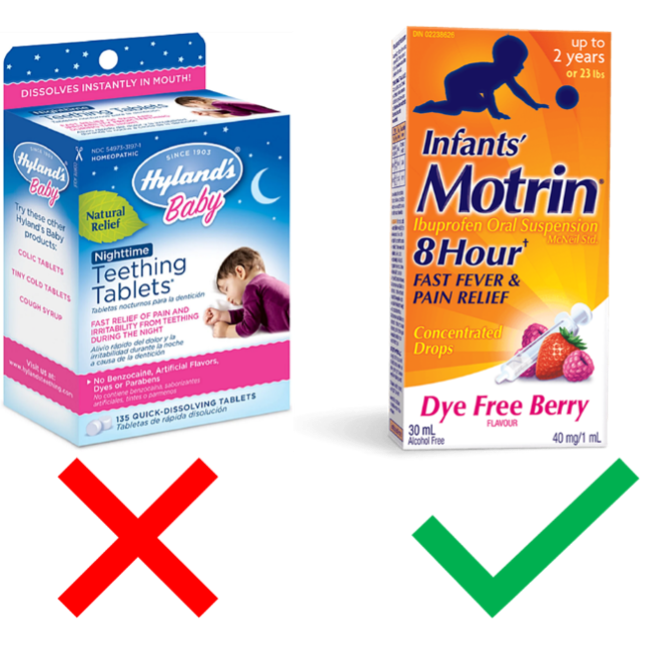
On August 1, 2010, a toddler was given three Hyland’s Teething Tablets (Figure 5). Minutes later, she began to have a seizure, lost consciousness, stopped breathing, and had to be resuscitated. She was not the only toddler adversely and dangerously affected by Hyland teething products – more than 370 children over a ten-year time span were put in harm’s way. These “natural” homeopathic teething tablets were later found to contain belladonna, a deadly nightshade. At least eight infants have died after taking Hyland’s products. In 2017 (seven years later!!!), the FDA recalled the tablets.
Financial harm. According to a 2012 National Health Interview Survey conducted by the National Center for Complementary and Integrative Health and the Centers for Disease Control, about 59 million Americans spend a total of $30.2 billion out-of-pocket per year on “complementary health approaches,” including homeopathy. Today, half of all Americans struggle to afford healthcare and 9% of Americans owe over $250 in unpaid medical bills.13 We can barely afford life-saving medicine and certainly not snake oil, as written about in a previous LTS article (Figure 6). At Walgreens, a box of 6 Oscillococcinum sugar pellets costs a whopping $17.99!

Homeopathy is inherently deceptive, confusing, and misleading and undermines consumer trust. In 2019, the Center for Inquiry conducted a survey (Figure 7) to gauge consumer views before and after being exposed to the truth about homeopathy. Initially, most adults said they trusted pharmacies like Walmart and CVS to sell over the counter drugs that were safe and effective. Half of respondents believed that Oscillococcinum was, based on the packaging, an effective treatment for the cold or flu. After receiving information on homeopathy, respondents had a far less favorable view of homeopathic products and less trust in the pharmacies that sell them.
The full survey report can be found here.

Is there a better way to harness the power of the placebo effect without deception, without wasting money, but while utilizing science-based medicine? Can we learn something from homeopathy? In 2012, Dr. Joe Schwarcz, Director of McGill University’s Office for Science and Society was invited to debate Dr. André Saine, Dean of the Canadian Academy of Homeopathy, to a debate entitled, “Homeopathy: Mere Placebo or Great Medicine?”. Dr. Schwarcz pointed out that that a placebo can be effective medicine and, after eloquently refuting the purported benefits of homeopathy, praised the placebo effect and its remarkable potential. It turns out that a placebo can still work even if the patient knows that it’s a placebo. A clinical study found that “open-label” placebos effectively relieved symptoms in patients with irritable bowel syndrome – no concealment or deception needed.14
That said, research has also shown that context, environment, and the patient-provider relationship significantly impacts how a patient will respond to a placebo.15 For maximum efficacy, it is important that a placebo or any treatment for that matter is administered by a provider who is empathetic, attentive, and caring. In short, don’t be a Sheldon (Figure 8).

TL; DR
- Homeopathy, which means “similar suffering,” is an ineffective, scientifically unsupported system of alternative medicine.
- The success of homeopathy is largely due to the placebo effect.
- Homeopathy is inherently deceptive and harmful; homeopathic products are unregulated and can contain dangerous substances such as deadly nightshade.
Reference
- Parapia LA. History of bloodletting by phlebotomy. Br J Haematol 2008;143:490-5.
- Achan J, Talisuna AO, Erhart A, et al. Quinine, an old anti-malarial drug in a modern world: role in the treatment of malaria. Malar J 2011;10:144.
- Loudon I. A brief history of homeopathy. J R Soc Med 2006;99:607-10.
- Jacobs J. Homeopathic Prevention and Management of Epidemic Diseases. Homeopathy 2018;107:157-160.
- Tavel ME. The placebo effect: the good, the bad, and the ugly. Am J Med 2014;127:484-8.
- Wilhelm M, Hermann C, Rief W, et al. Working with patients’ treatment expectations – what we can learn from homeopathy. Front Psychol 2024;15:1398865.
- Sagar SM. Homeopathy: does a teaspoon of honey help the medicine go down? Curr Oncol 2007;14:126-7.
- Mathie RT, Frye J, Fisher P. Homeopathic Oscillococcinum(R) for preventing and treating influenza and influenza-like illness. Cochrane Database Syst Rev 2015;1:CD001957.
- Vickers AJ, Smith C. Homoeopathic Oscillococcinum for preventing and treating influenza and influenza-like syndromes. Cochrane Database Syst Rev 2004:CD001957.
- Vopson MM. Estimation of the information contained in the visible matter of the universe. Aip Advances 2021;11.
- Carlsson T, Bergqvist L, Hellgren U. Homeopathic Resistant Malaria. J Travel Med 1996;3:62.
- Johnson SB, Park HS, Gross CP, et al. Complementary Medicine, Refusal of Conventional Cancer Therapy, and Survival Among Patients With Curable Cancers. JAMA Oncol 2018;4:1375-1381.
- Aborode AT, Oginni O, Abacheng M, et al. Healthcare debts in the United States: a silent fight. Ann Med Surg (Lond) 2025;87:663-672.
- Kaptchuk TJ, Friedlander E, Kelley JM, et al. Placebos without deception: a randomized controlled trial in irritable bowel syndrome. PLoS One 2010;5:e15591.
- Blasini M, Peiris N, Wright T, et al. The Role of Patient-Practitioner Relationships in Placebo and Nocebo Phenomena. Int Rev Neurobiol 2018;139:211-231.
 Lions Talk Science