By Victoria Vernail
We are nearing the arrival of springtime. Flowers blooming, birds chirping, and – wait – one less hour of sleep? Thanks, Daylight Saving Time.
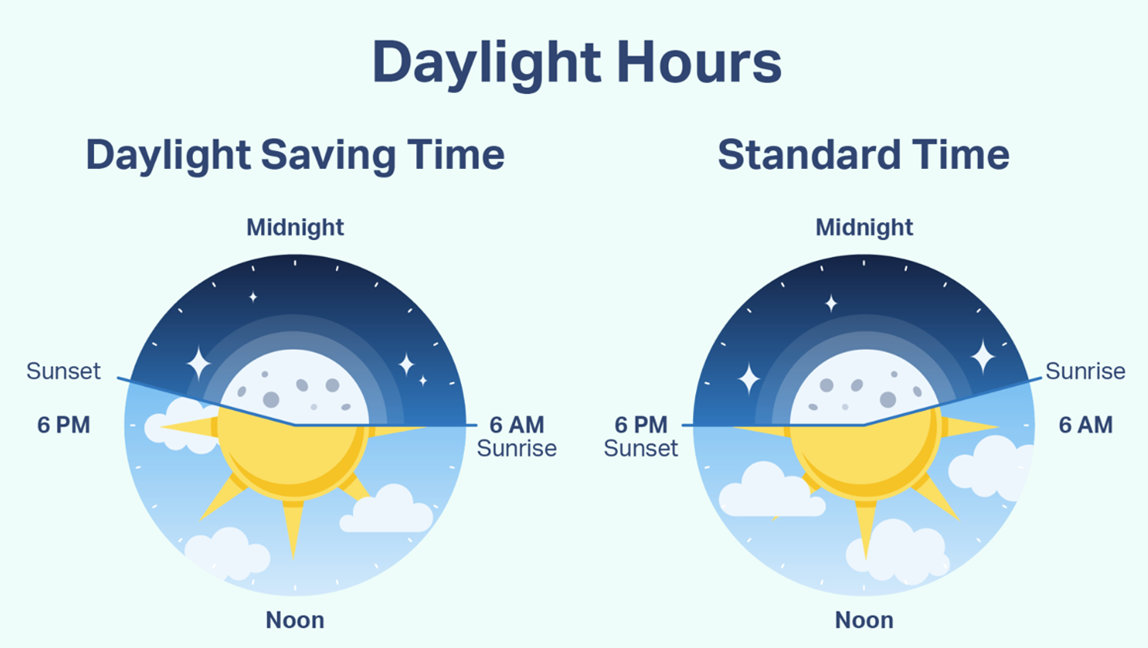
Daylight Saving Time (DST) is the period from March to November where most of the United States turns the clocks forward one hour ahead of Standard Time (ST). During DST, there is more sunlight available during the evening hours (Figure 1). “Springing forward” is thought to align waking time with sunrise during the brightest months of the year and helps us to maximize sunlight throughout the day. But is changing the clocks twice a year more of a burden than a benefit?
History
It is a myth that DST was created to improve working conditions for farmers. DST was established in 1918 through the Standard Time Act, which, in addition to creating the major US time zones, introduced DST to save on cost of energy during World War I. After World War I, DST was abolished in the United States. DST was reestablished during World War II where it was referred to as “War Time” (Figure 2). The US government again abolished DST in favor of year-round ST following the end of World War II, but this time change was not well enforced.
After World War II, the United States experienced an enormous economic expansion. Instead of mass-producing war supplies, companies could manufacture goods such as cars and televisions for American consumers. Despite increasingly widespread transportation and broadcast networks creating a more connected nation, states determined their own “standard time” at a local level. The lack of federal guidelines led to national confusion when trying to coordinate things like transcontinental travel. To alleviate the confusion, the Uniform Time Act of 1966 established national regulations for the use of ST and DST.

Despite the Uniform Time Act, there are still some states that do not recognize DST, including Arizona and Hawaii, both of which remain in ST year-round. Arizona chooses not to observe DST because the extra hour of daylight occurs during the hottest part of the year, and therefore it is dangerous for people to be outside. Hawaii does not observe DST due to its proximity to the equator, where there is enough sunlight throughout the day that an extra hour of evening sunlight in the summer months doesn’t make a difference. Indiana did not recognize DST until 2006, and many Indianians still oppose its implementation. In fact, Indiana farmers heavily opposed DST because it meant they had to start their day when it was even darker/earlier than during ST.
So, what is the purpose of DST?
While the amount of total sunlight in a day doesn’t change during DST, the intended purpose of DST is to make more sunlight available during the evening hours.
Supporters of DST argue that DST increases energy conservation, economic activity, time spent outdoors, and reduces crime. But moving the clock ahead one hour can have negative impacts, especially during the morning hours. Many people do not appreciate waking up at 6 AM during DST only for it to still be dark outside. Additionally, arguments against DST include sleep disruptions, increases in the number of traffic accidents, less safety for school children, and links to increased risk of heart attack.
Changing the clocks twice a year from DST to ST is a source of dread and confusion for many people. In 2024 alone, at least 63 bills were proposed in state legislatures across the United States to change DST, ST, or both. Some of those bills propose getting rid of DST for year-round ST. Other bills suggest the opposite- a permanent DST. Currently, the Uniform Time Act permits states to remain in ST year-round, but states cannot currently choose to observe DST year-round.
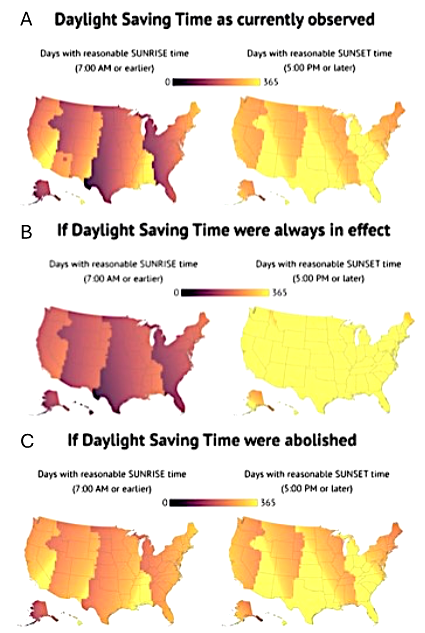
In recent years, the Sunshine Protection Act (Figure 2) has been introduced to the Senate to override the Uniform Time Act make DST permanent, abolishing ST. This would impact sunrise and sunset times throughout the year, such that in permanent DST people would wake up in darkness for most of the year but have more sunlight in the evening (Figure 3B). According to a CBS News Poll, 46% of Americans would support the change to DST year-round. But experts are concerned about the potential long-term consequences of permanent DST on public health.
DST does not drastically impact energy conservation
To test the claim that DST increases energy conservation, several studies have attempted to analyze energy consumption during ST and DST.
Researchers Kotchen and Grant (2011) used Indiana from 2004-2006 as a model to compare counties in the state that did not observe DST prior to 2006 and then after 2006 when Indiana mandated following DST. The different modes of energy consumption studied highlighted that consumption could be driven largely by heating and cooling as opposed to energy used for lighting. Kotchen and Grant (2011) found that observing DST may increase energy consumption by 1%, with higher usage in later months like October.1
Another study by the US Department of Energy (DOE) measured the effects of the Energy Policy Act of 2005, which extended DST by three weeks from March-November. The DOE reported that in 2008, energy conservation across the country after extending DST led to a 0.03% reduction in electricity compared to previous years where DST was three weeks shorter.2 When attempting to analyze the impact of motor vehicles on energy consumption, the DOE concluded the impact was not significant. Research on the impact of DST on energy conservation in other countries has also yielded variable results.3
The major takeaway is this: across these studies, there is no consistent, measured benefit of DST on energy conservation.
DST promotes lower quality sleep and worsens cardiovascular health
In 2020, the American Academy of Sleep Medicine (AASM) put out a statement that its doctors are not in favor of DST and prefer ST for numerous health reasons, including that sleep quality is reduced under DST.4 The switch from ST to DST has been shown to acutely reduce sleep duration and efficiency in the days following the switch.5
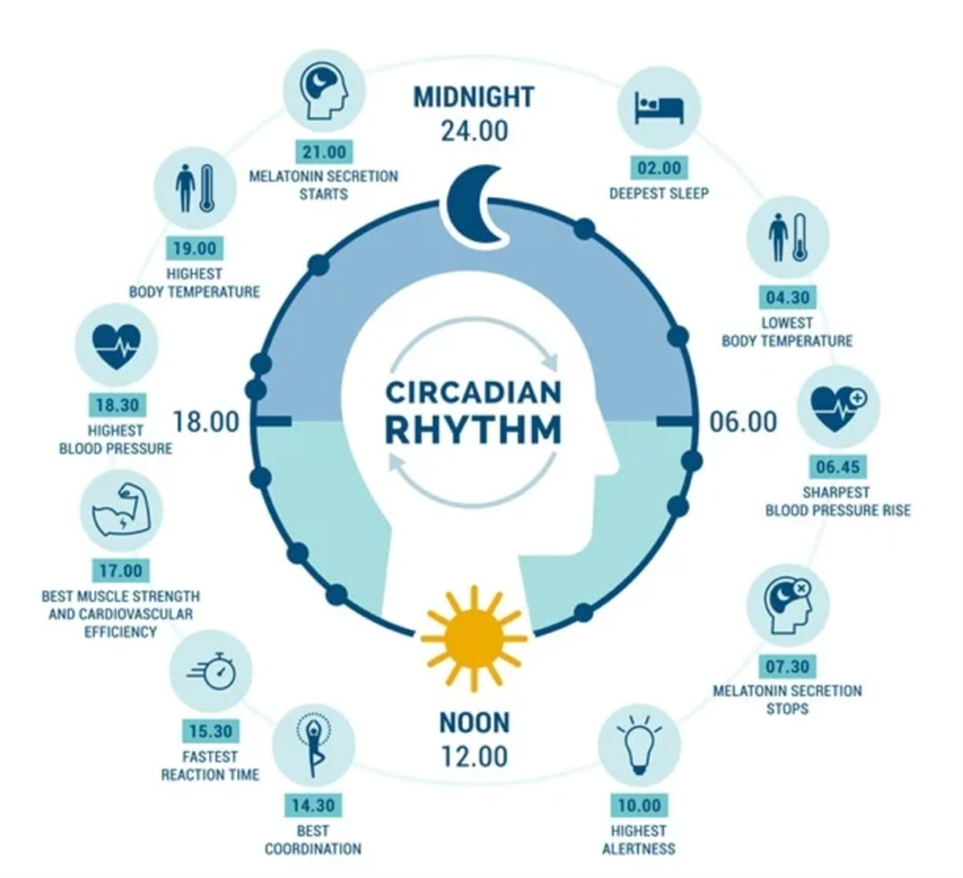
The long term effects of switching to DST are more difficult to study. Chronically, DST may disrupt the human body’s circadian rhythm because of the shift in daylight hours from being more morning-heavy to more evening-heavy. Circadian rhythm, the natural 24-hour cycle of our biological processes, is driven largely by light and dark stimuli. Therefore, morning sunlight is important for stimulating important processes regulated by circadian rhythms including sleep and arousal, hunger, hormone release, blood pressure, body temperature, and even cognitive function (Figure 4). Neuroscientist Andrew Huberman often discusses the importance of morning sunlight for overall health and wellness on his podcast.
In the days immediately following the switch to DST, one study found that incidence of heart attack across the state of Michigan increased by 24%.6 The increase may be due to disruption of circadian rhythm, which is linked to various health problems such as heart attack, stroke, and exacerbated mental conditions.7 In animal models, mice with circadian disruption had worsened heart function that was reversed by restoring circadian rhythm.8 Studies in humans have demonstrated similar effects on circadian misalignment on heart function.9 These studies suggest that there are acute negative outcomes associated with switching to DST and that year-round DST may promote lasting disruptions in circadian rhythm which increases risk of disease.
DST has diverse impacts on safety
Switching between ST and DST may influence accidents, crime, and the safety of schoolchildren. The immediate change to DST is associated with a 6% increase of US fatal traffic accidents throughout the day, not just in the morning.10 More accidents could be attributed to disruptions that come with losing an hour of sleep.
In 1974, there was an energy crises that stemmed from an oil embargo imposed by members of the Organization of Petroleum to Exporting Countries, and this prompted the US to implement a year-round DST to conserve fuel for energy (Figure 2). In 1975 after the embargo had ended, a Department of Transportation study determined that there were significantly more fatalities involving school age children between 6 am – 9 am than previous years without year-round DST.11 In addition to more fatal traffic accidents, DST may have more negative impacts on children, since changes in sleep and circadian rhythm may also be particularly disruptive during development.12
Although DST increases the number of traffic incidents, pushing the clock forward may help decrease crime. Vivint, a smart home security system, analyzed FBI crime data and found that crime decreased by approximately 11% during DST in 2021. Robberies may be especially reduced during DST, which is estimated to save $59 million.13 Crime may be reduced during DST because of the extra hour of light in the evening hours. It is unknown whether year-round DST will have a similar impact on annual crime rates.
Conclusions
The public and scientists alike tend to agree that the practice of changing the clocks twice a year is not fun and likely not optimal for our health. While permanent DST and “more sunshine” sound nice, scientists warn against potential adverse health effects, and the unknown effects on society. In 2023, Greenland introduced permanent DST, a decision which will over time provide interesting evidence as to whether this change is helpful or harmful. In the meantime, you can decide for yourself! Check out this interactive tool to explore how changing DST may affect you.
TL;DR
- Daylight Saving Time (DST) was first implemented during World War I to conserve energy.
- Recently, legislation has been proposed to make DST permanent.
- Year-round DST may significantly impact public health.
Reference
- Kotchen, MJ and Grant, LE (2011). Does Daylight Saving Time Save Energy? Evidence From a Natural Experiment in Indiana. The Review of Economics and Statistics. https://resources.environment.yale.edu/kotchen/pubs/revDSTpaper.pdf
- Belzer, DB, Hadley, SW, Chin, SM (2008). Impact of Extended Daylight Saving Time on National Energy Consumption. U.S. Department of Energy Office of Energy Efficiency and Renewable Energy https://www1.eere.energy.gov/ba/pba/pdfs/edst_national_energy_consumption.pdf
- Küfeoğlu, S, Üçler, Ş, Eskicioğlu, F, Öztürk, EB, Chen, H (2021) Daylight Saving Time policy and energy consumption. Energy Reports 7:5013-5025 https://www.sciencedirect.com/science/article/pii/S2352484721006272
- Rishi MA, Ahmed O, Barrantes Perez JH, et al. Daylight saving time: an American Academy of Sleep Medicine position statement. J Clin Sleep Med. 2020;16(10):1781–1784. https://jcsm.aasm.org/doi/10.5664/jcsm.8780
- Lahti, T., Leppämäki, S., Lönnqvist, J., & Partonen, T. (2006a). Transition to daylight saving time reduces sleep duration plus sleep efficiency of the deprived sleep. Neuroscience Letters, 406(3), 174–177. https://doi.org/10.1016/j.neulet.2006.07.024
- Jiddou MR, Pica M, Boura J, Qu L, Franklin BA. Incidence of myocardial infarction with shifts to and from daylight savings time. Am J Cardiol. 2013 Mar 1;111(5):631-5. doi: 10.1016/j.amjcard.2012.11.010. Epub 2012 Dec 8. PMID: 23228926.
- Zhang H, Dahlén T, Khan A, Edgren G, Rzhetsky A. Measurable health effects associated with the daylight saving time shift. PLoS Comput Biol. 2020 Jun 8;16(6):e1007927. doi: 10.1371/journal.pcbi.1007927. PMID: 32511231; PMCID: PMC7302868.
- Martino TA, Tata N, Belsham DD, Chalmers J, Straume M, Lee P, Pribiag H, Khaper N, Liu PP, Dawood F, Backx PH, Ralph MR, Sole MJ. Disturbed diurnal rhythm alters gene expression and exacerbates cardiovascular disease with rescue by resynchronization. Hypertension. 2007 May;49(5):1104-13. doi: 10.1161/HYPERTENSIONAHA.106.083568. Epub 2007 Mar 5. PMID: 17339537.
- Grimaldi D, Carter JR, Van Cauter E, Leproult R. Adverse Impact of Sleep Restriction and Circadian Misalignment on Autonomic Function in Healthy Young Adults. Hypertension. 2016 Jul;68(1):243-50. doi: 10.1161/HYPERTENSIONAHA.115.06847. Epub 2016 Jun 6. PMID: 27271308; PMCID: PMC4902172.
- Fritz J, VoPham T, Wright KP Jr, Vetter C. A Chronobiological Evaluation of the Acute Effects of Daylight Saving Time on Traffic Accident Risk. Curr Biol. 2020 Feb 24;30(4):729-735.e2. doi: 10.1016/j.cub.2019.12.045. Epub 2020 Jan 30. PMID: 32008905.
- DOT, The Daylight Saving Time Study: A Report to Congress from the Secretary of Transportation (Final Report), Washington, DC, September 1975.
- Skeldon AC, Dijk DJ. School start times and daylight saving time confuse California lawmakers. Curr Biol. 2019 Apr 22;29(8):R278-R279. doi: 10.1016/j.cub.2019.03.014. PMID: 31014483.
- Doleac, JL, Sander, NJ. Under the cover of darkness: How ambient light influences criminal activity. The Review of Economics and Statistics 2015; 97(5): 1093-1103 doi: https://doi.org/10.1162/REST_a_00547
 Lions Talk Science