By: Peter C. Forstmeier
The massive smokestacks of the Three Mile Island Nuclear Generating Plant stand, imposing and sentinel-like, in the Susquehanna River just downstream of Harrisburg, Pennsylvania. More imposing than their stature, however, is their history: the memory of the nuclear meltdown that occurred there almost half a century ago. Despite the event’s significance, details of what exactly happened, how it unfolded, and the incident’s long-term aftermath may not be known to new residents of the area. So, to the students just beginning their academic journeys here at the College of Medicine, and any others who may not have heard: read on, to learn what almost happened to your current home.
How Nuclear Plants Work:
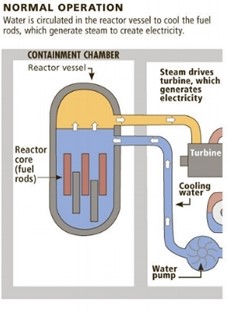
At their most basic level, nuclear powerplants are fancy steam engines (Figure 1).
For the historic steam engines, the water is heated by coal fires; for a nuclear reactor, the water is heated by a reactor core containing radioactive material. In many reactors, this material is specific type of uranium called enriched uranium or U-253. The atoms of enriched uranium are unstable and split apart. This process, called nuclear fission, sends out a lot of invisible energy called radiation. The radiation is so high-energy that it actually heats up the water.
Water is pumped into the chamber with the reactor core, is heated, and subsequently boils into steam. This steam, hot and highly pressurized, is piped through a tube to spin a turbine, which generates electricity. This is a very effective and efficient way to generate electricity – in the last year that Three Mile Island was fully active, it alone generated 4% of all the electricity Pennsylvania generated. However, because of the dangers of radiation and radioactive material, generating electricity via nuclear reactor is a highly controlled and contained process.
What Went Wrong:
Three Mile Island originally had only one reactor, TMI Unit 1. TMI Unit 1 was and continued to be one of the best nuclear reactors in the US until its recent decommission due to unprofitability. TMI Unit 2 was added a few years later in December of 1978, directly adjacent to Unit 1.
Just a few months later, at around 4:00am on March 28, 1979, TMI Unit 2 experienced a nuclear meltdown.
The reactor was running at near 100% power when a minor problem occurred in the cooling circuit, triggering a slight temperature rise. This caused an automatic reactor shutdown for safety, a measure which consisted of a valve opening to depressurize water in the reactor. This whole response took about 1 second. Per protocol, the valve was meant to close in 10 seconds. It didn’t, and this failure went undetected.
This valve failure allowed water to be drained from the chamber, which caused the reactor core to overheat. An automatic safety system pumped more water into the chamber – making the operators think that the chamber was overfilling with water, becoming highly pressurized, and was about to rupture. At this time, they still did not know the drainage valve failed to close. The operators turned off the pumps, and the water in the chamber either drained or was boiled away.
Rendered suddenly and unintentionally dry, the core overheated, started melting, and released radioactive material into both the water draining away as well as into the highly pressurized steam (Figure 2).

At 6:22 am, about 2.5 hours later, the operators closed the valve after realizing that it had been open the entire time and stopped the drainage of water. However, the damage was done, and no additional water could be added to the system as radioactive, superheated steam and gases had damaged the pipes. That evening, after working repairs all day, the dozens of workers were finally able get some cool water into the system. These efforts were especially heroic because, though their actions were necessary to prevent a devastating nuclear accident, they believed that the this necessary coolant was creating the conditions for a hydrogen explosion that could kill them all.
On March 29th and 30th, the operators attempted to remove the radioactive gas into proper waste tanks, but these leaked and released radioactive gases into the air in the facility. Fortunately, air filters removed most radioactive particles except for those which were biologically inactive. The biologically inactive gases that were not removed by the air filters escaped into the environment. These gases are inactive because the body doesn’t use them and they don’t cause any types of reactions. It wasn’t until April 27th, almost one month after the initial meltdown, that operators were able to fully cool the system.
Years later, an examination of the core revealed that almost all the melted core had remained in its location and hadn’t been released. It was a narrowly-averted disaster that could have lead to serious radiation poisoning – involving dangerous cancer risks and widespread wildlife deaths – for the surrounding environment.
How Does Radiation Cause Cancer?:
The nuclear accident at Three Mile Island was a cause for great concern because of the radioactive gases that were released into the air – despite the fact that in the end, only a small amount of radioactive gases that don’t normally impact your body escaped. Why the concern over release radiation? Because radiation exposure can cause cancer.
The energy from radiation can damage DNA in the cells of our body. Sometimes, this damages the DNA that controls parts of the cell that keep growth and cell replication in check. When this occurs, those cells grow and proliferate uncontrollably and become tumors (Figure 3).

The central question after the Three Mile Island incident was, and remains: did the incident cause cancer in people who lived near the reactors?
Ultimately, as a result of the incident, residents within 10 miles of Three Mile Island received less radiation than a standard chest X-ray and less than a third of what a normal person experiences annually from background radiation. Furthermore, many studies have been conducted over the years investigating the question of cancer in potentially impacted populations. The Pennsylvania Department of Health followed more than 30,000 people who lived within 5 miles of Three Mile Island for 18 years and concluded that there was no increase in cancer or other health effects as a result of the incident. Studies on Thyroid cancer1, all cancers2,3, and all diseases4 indicate that the Three Mile Island reactor failure radiation exposure did not cause increases in cancer or death, or there was no consistent link to the incident.
Other studies are ongoing that do convey some conflicting results. One study did note some elevations in particular types of cancers, but decreases in other types of cancer3. Other studies that have found cancer increases cannot link these increases to the incident due to the presence of other factors, like increased surveillance after the incident, biological stress of poverty that may increase rates of cancer, and inconsistent relationships to the distance to the reactor (neighboring counties showed some increases in certain cancers, but none in the county where the accident took place)2,4,5. So, while studies continue to be ongoing and some contain conflicting results, the fact remains that there is no definite link between the incident at Three Mile Island and cancer. While it’s always true in science that new information that comes to light may change our interpretation of events, the bottom line as it stands now is that the incident does not seem to have harmed the health of the community.
Three Mile Island Today:
What many people don’t know is that TMI-1, the first nuclear reactor on the island – the one that didn’t melt down – was active until 2019. TMI Unit 1 was one of the most consistent and productive nuclear reactors in the US until it started to lose money due to increased costs of regulation and loss of federal subsidies and was eventually shut down. However, this year, there has been talk of reopening the reactor as the increasing price of energy may allow the plant to generate clean energy at a financial gain.
TL;DR
- Nuclear reactors use radiation to power a steam turbine to generate energy
- At Three Mile Island, a dangerous equipment malfunction that was eventually brought under control led to the release of a small amount of radioactive gas into the environment
- None of the many follow-up studies of surrounding populations have found a consistent link between the incident and these populations’ risk of cancer
Reference
- Levin, R. Incidence of Thyroid Cancer in Residents Surrounding the Three Mile Island Nuclear Facility. The Laryngoscope. 2008. DOI: 10.1097/MLG.0B013E3181613AD2
- Hatch, M. C., Wallenstein, S., Beyea, J., Nieves, J. W., and Susser, M. Cancer rates after the Three Mile Island nuclear accident and proximity of residence to the plant. American Journal of Public Health. 1991. DOI: 10.2105/AJPH.81.6.719
- Talbott, Evelyn O., Youk, Ada O., McHugh-Pemu, Kathleen P., Zborowski, Jeanne V. Long-term follow-up of the residents of the Three Mile Island accident area: 1979-1998. Environmental Health Perspectives. 2003. DOI: 10.1289/EHP.5662
- Talbott, Evelyn O., Youk, Ada O., McHugh, Kathleen P., Shire, Jeffrey D., Zhang, Aimin, Murphy, Brian P., Engberg, Richard A. Mortality among the residents of the Three Mile Island accident area: 1979-1992. Environmental Health Perspectives. 2000. DOI: 10.1289/EHP.00108545
- Levin, Roger J., De Simone, Nicole F., Slotkin, Jaime F., Henson, Baker L. Incidence of thyroid cancer surrounding three mile island nuclear facility: The 30-year follow-up. The Laryngoscope. 2013. DOI: 10.1002/LARY.23953
 Lions Talk Science