By: Jenny Lausch
Consumption of the standard Western diet, which is characterized by high quantities of processed foods, refined carbohydrates, and saturated fats, is quickly becoming the norm. The prevalence of the Western diet, combined with higher prices for whole foods (non-processed foods1) and social media crazes about protein, means people are eating fewer plants every day. Despite countless studies citing the cardiovascular, neurological, and environmental benefits of a plant-based diet, many are reluctant to change their ways.2–5 Those most resistant to adopting a plant-based diet are often athletes worried about not getting enough protein.6 Many people believe that plants are not a complete source of protein, but is that really true?
Debunking the plant protein myth
The building blocks of proteins are called amino acids, which, like Legos, can be joined in different combinations to form the final protein. Out of the twenty total amino acids, the human body cannot synthesize nine on its own. Thus, these “essential” amino acids must be obtained from a person’s diet. Recent studies have disproven the theory that adequate protein cannot be obtained from a plant-based diet.7,8 To delve into this, it is essential to first define two important aspects of protein composition: limiting amino acids and protein quality. The limiting amino acid within a protein source is the essential amino acid present in the lowest quantity compared to the human need for that amino acid.8 Protein quality is defined as the diversity of amino acids and the amount of limiting amino acids present within the protein.8 So, the body is limited not only by what amino acids are present in the protein source but also by the quantity of the limiting amino acid within the protein source.
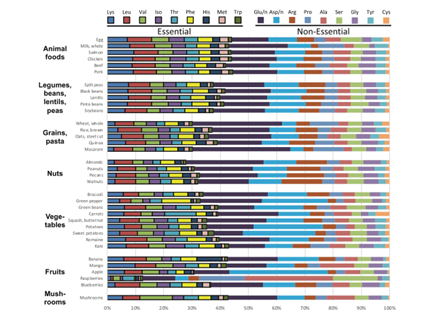
Interestingly, ALL plants contain ALL nine essential amino acids! 8 However, some plants contain an amino acid in a lower quantity than what humans require (Figure 1).8 For example, legumes contain a low quantity of methionine compared to the human need, making it a limiting amino acid.9 This may seem problematic, but simply eating two different plant sources that do not have the same deficiency, such as eating rice with beans, can ensure that all amino acids are being provided in the necessary amount. Therefore, by consuming a variety of whole foods, athletes can avoid experiencing protein deficiencies that may hinder performance.
Americans eat more protein than the recommended amount
Due to the rising popularity of high-protein diets and high animal protein consumption, Americans consume more protein than people in other countries, often exceeding the recommended daily amount of 0.66- 0.80 g/kg of body weight.8 While athletes may require upwards of 1.7g/kg of protein daily to gain muscle, increasing protein supplementation higher than 2g/kg per day can actually decrease performance, likely due to a decrease in carbohydrate consumption leading to a lack of glycogen stores.10
Plant-based diets are put to the test in both strength and endurance training
To test if recreational athletes who ate a plant-based diet showed decreased athletic performance compared to those who consumed an animal-based diet, a recent study examined both endurance and strength athletes who were previously accustomed to omnivore diets.11 Athletes were assigned to both a whole food plant-based diet (WFPB) or an animal-based diet for one month at a time. Performance was assessed as a change from baseline in one of two activities based on athlete type: a 12-minute run for endurance athletes or a combination of three different machine strength scores (chest press, leg press, and lat pulldown) for strength athletes. At the end of the trial, the researchers found no statistically significant difference in performance between the two diets for endurance or strength athletes (Table 1).11
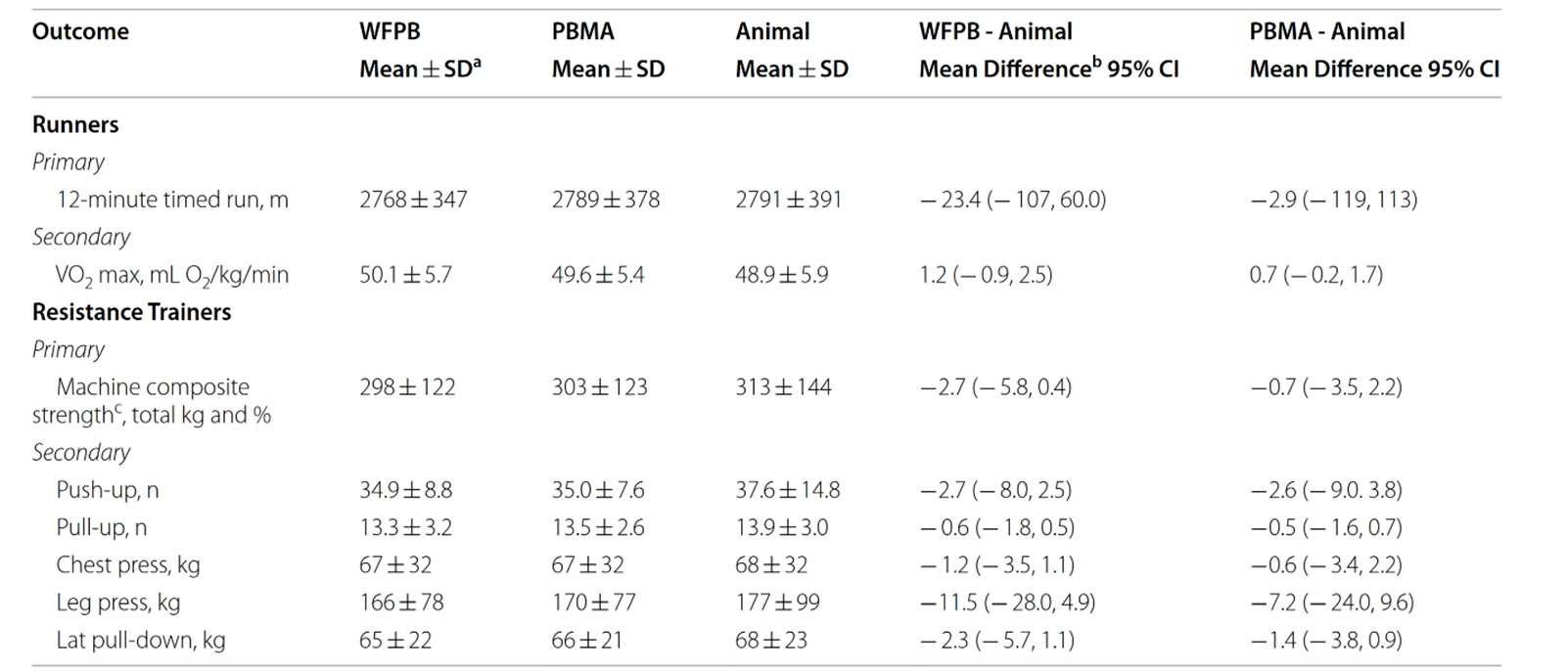
In this study, there were no caloric or macronutrient requirements for each athlete, other than restricting the source of protein, allowing participants the freedom to eat to contentment – if they didn’t stray from the food types allowed in their diet. On average, all athletes met the recommended protein intake, with those on the animal-based diet consuming the most protein. However, the study had some limitations. Reporting data as an average makes it difficult to determine individual protein intake per kilogram of body weight. Additionally, the study lasted only four weeks per diet without a washout period (a period where the participants would not have a controlled diet) which is challenging to interpret because adaptations in cardiovascular endurance and physical strength can vary greatly based on genetics, training time, and current fitness levels. Another limitation was athletes on the WFPB diet were asked to minimize fish, egg, and dairy consumption, which are typically part of a vegetarian diet. Finally, it is impossible to keep athletes blind to their diet conditions, which could influence their strength and endurance outcomes.
Other studies have shown similar results about the merits of plant-based nutrition for athletic performance. A study on elite football players found that plant-based diets can be scaled to meet the caloric needs of athletes and do not display deficiencies in vitamins or minerals, which is a concern in some populations.7,12 If a plant-based diet can support a demanding 6,000-calorie intake, it’s certainly feasible for other athletes to make the switch!
Are small differences the biggest difference?
Considering the studies on athletes and their diets, an important question in athletic performance arises: are statistical tests a valid way to measure valuable improvements for athletes? In other words, do non-statistically significant differences between diets translate into significant advantages in competitive sports?11 Slight improvements can make the world of difference in sports such as running, swimming, and lifting where winners are determined by razor-thin margins. Thus, the critical question remains: can plant-based diets truly support athletic performance? Ultimately, the answer lies with the individual person.
TL;DR
- Plants contain all nine essential amino acids
- Don’t skip plant-based diets for fear of protein inadequacy
- Studies show athletes perform similarly on well-balanced plant-based diets as animal diets
Reference
- Whole Foods – NYC Health. https://www.nyc.gov/site/doh/health/health-topics/whole-foods.page (accessed 2024-08-21).
- van den Brink, A. C.; Brouwer-Brolsma, E. M.; Berendsen, A. A. M.; van de Rest, O. The Mediterranean, Dietary Approaches to Stop Hypertension (DASH), and Mediterranean-DASH Intervention for Neurodegenerative Delay (MIND) Diets Are Associated with Less Cognitive Decline and a Lower Risk of Alzheimer’s Disease-A Review. Adv. Nutr. Bethesda Md 2019, 10 (6), 1040–1065. https://doi.org/10.1093/advances/nmz054.
- Menni, C.; Louca, P.; Berry, S. E.; Vijay, A.; Astbury, S.; Leeming, E. R.; Gibson, R.; Asnicar, F.; Piccinno, G.; Wolf, J.; Davies, R.; Mangino, M.; Segata, N.; Spector, T. D.; Valdes, A. M. High Intake of Vegetables Is Linked to Lower White Blood Cell Profile and the Effect Is Mediated by the Gut Microbiome. BMC Med. 2021, 19 (1), 37. https://doi.org/10.1186/s12916-021-01913-w.
- Salas-Salvadó, J.; Becerra-Tomás, N.; García-Gavilán, J. F.; Bulló, M.; Barrubés, L. Mediterranean Diet and Cardiovascular Disease Prevention: What Do We Know? Prog. Cardiovasc. Dis. 2018, 61 (1), 62–67. https://doi.org/10.1016/j.pcad.2018.04.006.
- Environmental impacts of alternative proteins | GFI. https://gfi.org/resource/environmental-impacts-of-alternative-proteins/ (accessed 2024-07-30).
- Rogerson, D. Vegan Diets: Practical Advice for Athletes and Exercisers. J. Int. Soc. Sports Nutr. 2017, 14, 36. https://doi.org/10.1186/s12970-017-0192-9.
- Goldman, D. M.; Warbeck, C. B.; Karlsen, M. C. Protein Requirements for Maximal Muscle Mass and Athletic Performance Are Achieved with Completely Plant-Based Diets Scaled to Meet Energy Needs: A Modeling Study in Professional American Football Players. Nutrients 2024, 16 (12), 1903. https://doi.org/10.3390/nu16121903.
- Gardner, C. D.; Hartle, J. C.; Garrett, R. D.; Offringa, L. C.; Wasserman, A. S. Maximizing the Intersection of Human Health and the Health of the Environment with Regard to the Amount and Type of Protein Produced and Consumed in the United States. Nutr. Rev. 2019, 77 (4), 197–215. https://doi.org/10.1093/nutrit/nuy073.
- Trovato, M.; Funck, D.; Forlani, G.; Okumoto, S.; Amir, R. Editorial: Amino Acids in Plants: Regulation and Functions in Development and Stress Defense. Front. Plant Sci. 2021, 12, 772810. https://doi.org/10.3389/fpls.2021.772810.
- Coleman, E. Protein Requirements for Athletes. Clin. Nutr. Insight 2012, 38 (9), 1. https://doi.org/10.1097/01.NMD.0000419625.20449.2c.
- Roberts, A. K.; Busque, V.; Robinson, J. L.; Landry, M. J.; Gardner, C. D. SWAP-MEAT Athlete (Study with Appetizing Plant-Food, Meat Eating Alternatives Trial) – Investigating the Impact of Three Different Diets on Recreational Athletic Performance: A Randomized Crossover Trial. Nutr. J. 2022, 21 (1), 69. https://doi.org/10.1186/s12937-022-00820-x.
- Morton, R. W.; Murphy, K. T.; McKellar, S. R.; Schoenfeld, B. J.; Henselmans, M.; Helms, E.; Aragon, A. A.; Devries, M. C.; Banfield, L.; Krieger, J. W.; Phillips, S. M. A Systematic Review, Meta-Analysis and Meta-Regression of the Effect of Protein Supplementation on Resistance Training-Induced Gains in Muscle Mass and Strength in Healthy Adults. Br. J. Sports Med. 2018, 52 (6), 376–384. https://doi.org/10.1136/bjsports-2017-097608.
 Lions Talk Science