By Alex Pham
Introduction
You may have heard that astronauts in space age slower than people on earth. But how is that possible? This phenomenon can be explained by time dilation, a theory in physics that has gained traction in pop culture due to the Academy Award winning science fiction movie, Interstellar (note: the idea of time dilation was also brought to the masses in Queen’s 1976 sci-fi love song ’39, which we delved into in this 2020 article).
Spoiler alert for Interstellar ahead! In Interstellar, the flight crew of a spacecraft travel to Gargantua, a supermassive black hole, to investigate three potential habitable refuge planets outside of the Solar System. One of the most promising planets closely orbits Gargantua; this makes landing risky, since time dilation due to proximity to the black hole equates 1 hour on the planet to 7 years on Earth. A major emotional touchpoint of the movie comes when some of the flight crew chooses to investigate the planet’s surface for suitability for human life while one stays aboard the ship. The away-team returns to find their colleague on the ship 23 years older.
Time Dilation
Time dilation stems from the theory of relativity, which states that energy and mass can bend the fabric of time and space (Fig. 1). The more mass an object has, the more it can warp time and space. Therefore, the stronger the gravitational force acting upon an object, the slower time moves for that object.
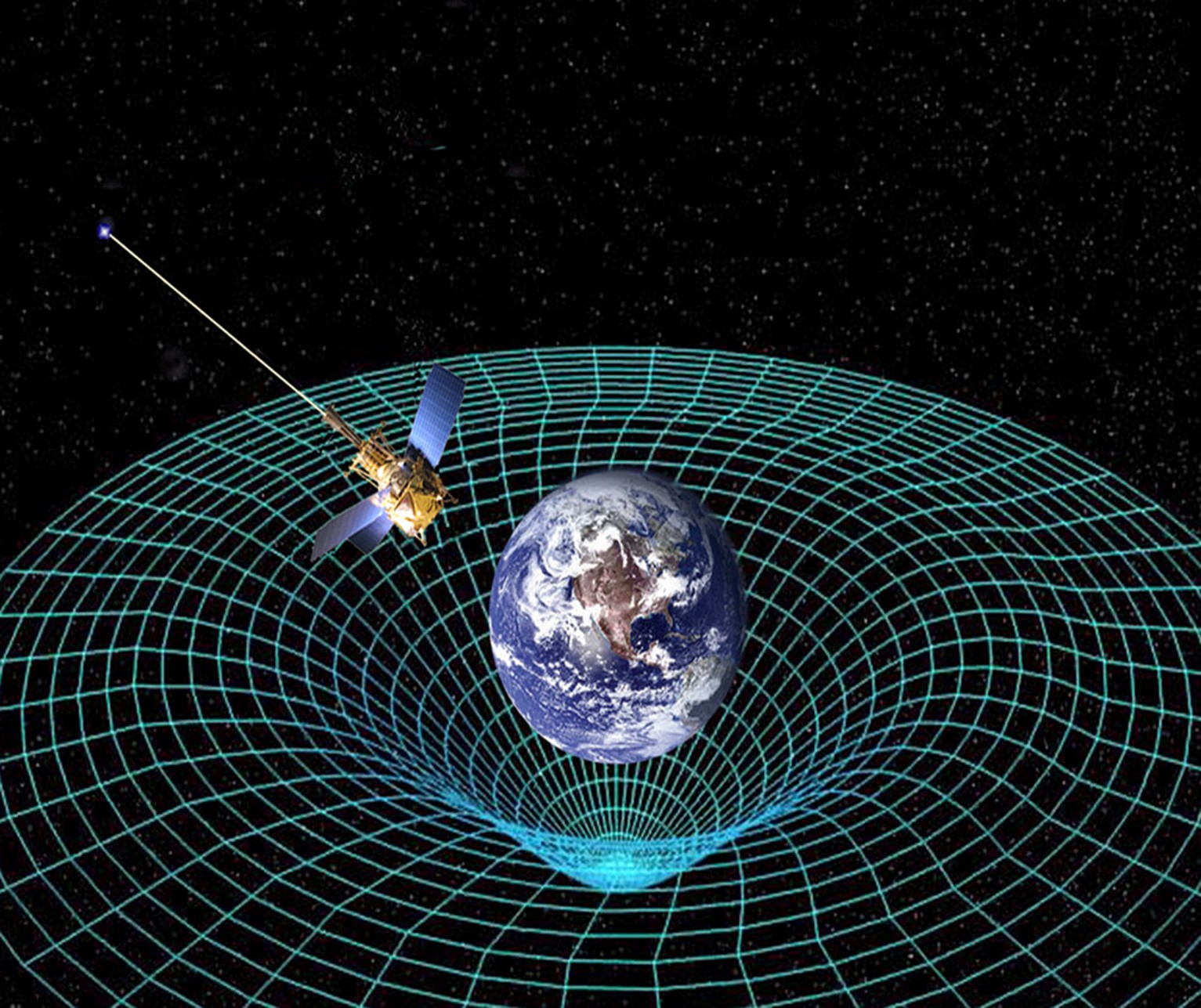
Gravity is stronger closer to the center of the Earth, so time technically moves slower underground compared to Earth’s surface. To prove that time ticks slower at different elevations, a study published in Science measured the time of two identical atomic clocks, differing only in that one clock was positioned 33 centimeters above the other.1 The higher clock ticked faster (though “faster” here equates to 90 billionths of a second over a 79-year period). Thus, the geographic elevation you’ve lived at has affected your age (at least, at the scale of seconds)! If you’ve been following along, you might think this observation suggests that astronauts age faster in space – but there are additional factors in this equation.
Astronauts actually age slower in space because time dilation is governed by two variables: the gravitational force acting on the object and the relative velocity of the object. The faster an object moves, the slower time moves for it, according to the theory of relativity. When both gravitational force and velocity act on something, the two variables battle in terms of magnitude.
The gravity acting on astronauts is ~10% weaker than the gravity on Earth, making astronauts slightly older. However, the crew aboard the ISS are traveling much faster – the ISS travels at ~17,500 mph, while Earth rotates at ~1040 mph – and, in the battle of time dilation, this outweighs the weaker gravitational force. The result? For every 6 months astronauts spend on the ISS, they are 5 milliseconds younger than people on Earth. For twins Scott and Mark Kelly, this makes a difference – Scott Kelly spent one year aboard the ISS, technically making him 10 milliseconds younger than his twin brother!
How does being in space otherwise affect astronauts? Unique stressors that astronauts face in space and exposure to space radiation can result in detrimental impacts on human health that are like those seen in aging.
Some Super Fun Background on Space Radiation
Radiation is everywhere in space and therefore poses a larger risk to astronauts than humans on Earth. Exposure to radiation above 100 millisieverts (mSv) greatly increases the odds of cancer. Astronauts absorb >0.5 mSv/day in space; in comparison, people on Earth only take in ~3.5 mSv/year.
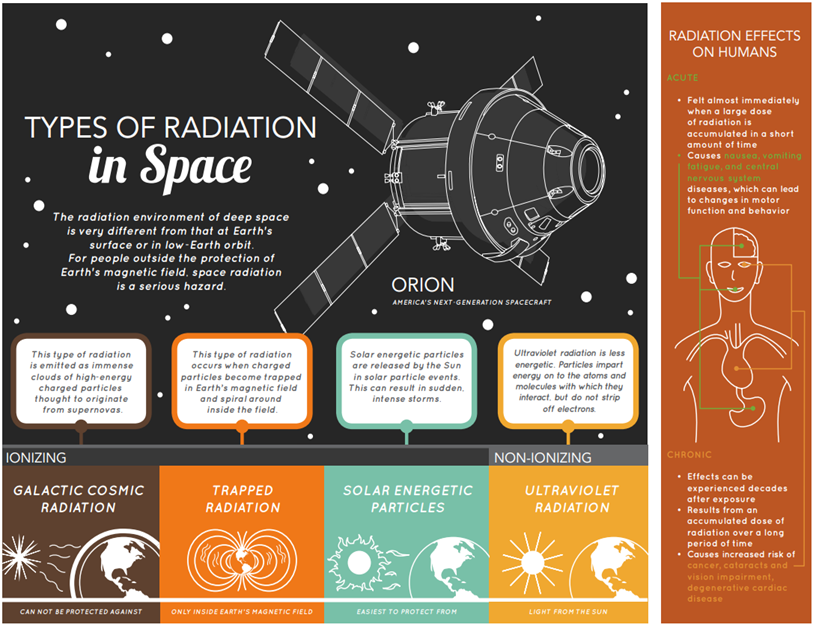
There are three main sources of space radiation (Fig. 2). The majority of radiation that reaches Earth is emitted from the Sun. This radiation can come in the form of ultraviolet (UV) radiation or solar flares that release massive energy blasts called solar particles events (SPEs). SPEs are much more dangerous than UV rays and can take the form of gamma rays or charged high-energy particles.
The other main source of space radiation is galactic cosmic rays (GCRs). GCRs are thought to originate from supernovas, the collapse of giant stars that release tremendous amounts of energy. Radiation from GCRs consists of high-energy and high-atomic-number particles (HZE), similar to SPEs; however, GCRs in cosmic rays are more dangerous and difficult to shield against.2 The last source of space radiation comes from charged particles that are trapped in the magnetic field that surrounds Earth.
So, what makes radiation deadly to humans?
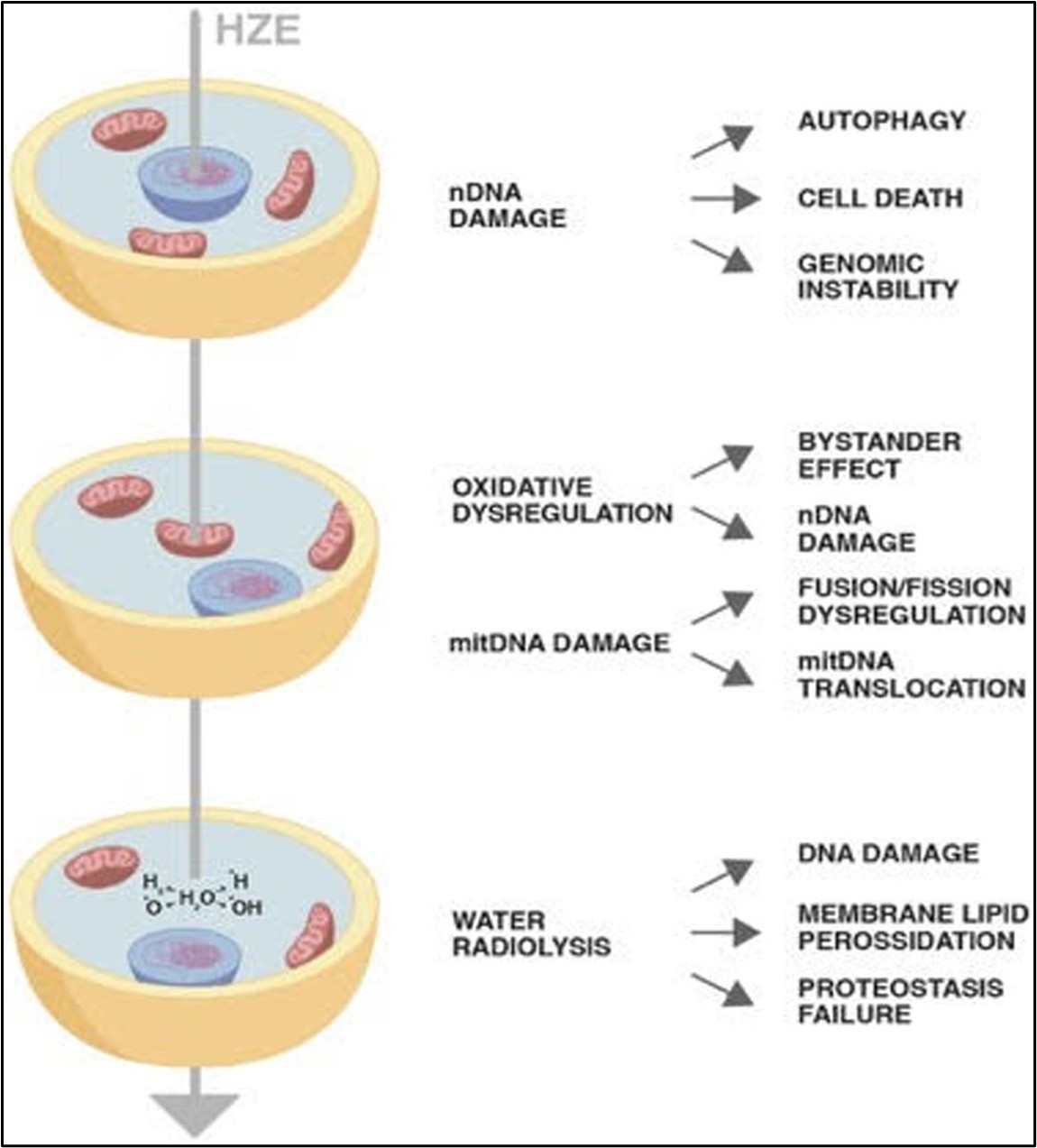
There are two types of radiation: non-ionizing and ionizing. Non-ionizing radiation – for example, UV radiation – is less energetic than ionizing radiation, and therefore is easier to protect against. Ionizing radiation (like SPEs and GCRs), on the other hand, travels near the speed of light; high velocity and polarization allow these particles to penetrate deep into objects. Since the particles are charged, HZEs ionize (strip electrons from) objects as they move through them. This means that exposure to HZEs could alter and kill the cells in our bodies, resulting in bodily damage (Fig. 3)!
Luckily, Earth’s atmosphere and magnetic field protect us from cosmic rays and space radiation. In fact, high energy particles from SPEs that interact with Earth’s atmosphere are what results in the formation of the aurora borealis! However, for astronauts, there is minimal protection in space that can shield against HZEs.
How Space Radiation Affects the Human Body
Numerous studies have reported that exposure to ionizing radiation from space can impose long-term detriments on cardiovascular health and cognitive ability.2, 3 In addition to increased cancer risk, these pathologies are usually associated with natural aging – so, space radiation is thought to mimic aging.
Radiation can cause cellular damage, such as causing DNA to break or undergo mutations. If the damage persists, the cell can undergo apoptosis (programmed cell death) or cellular senescence (a stable state of growth arrest – like limbo). Though senescence can sometimes be beneficial, the buildup of senescent cells can be harmful to the body. The accumulation of senescent cells is associated with aging, and these cells often secrete signaling molecules that can reprogram nearby cells to undergo accelerated aging themselves or become pro-inflammatory, causing tissue dysfunction.4 One study showed that mice exposed to HZEs acquired DNA damage, senescence, and tumors.3
Space radiation can also disrupt the function of the mitochondria – the powerhouse of the cell. Ionizing radiation can cause mitochondrial DNA damage and lead to increased formation of reactive oxygen species (ROS),2 which can cause more DNA damage, cell death, or senescence – a positive feedback loop. Of note, mitochondrial DNA damage is associated with many aging-related diseases, including heart and brain diseases.
One shocking study examined astronauts from Apollo moon missions that either went beyond or stayed within Earth’s magnetic field.5 Astronauts who left the magnetosphere had a higher incidence rate of death due to heart attacks and cardiovascular disease. Another study showed that low doses of HZEs lead to deficiencies in learning and memory.6
A remarkable large-scale study was conducted on the astronaut twins Scott and Mark Kelly to determine the different facets of human health that are impacted in space. Some of the biometrics that were examined include brain cognition, immune system function, and bone/muscle mass.7 Scott – who was aboard the ISS for a year – had shortened telomeres (an indicator of aging), increased DNA damage, and impaired cognitive function 6 months after returning to Earth! Check out these summaries of the groundbreaking NASA Twin Study written by TIME or the Smithsonian.
Conclusion
Outer space is beautiful – with the images we see of nebulas, black holes, or just the twinkling of stars in the night sky, it makes sense that people are tempted to explore its expanses. However, space poses an imminent threat to humans who decide to leave Earth. With renewed interest in human spaceflight missions to the Moon or to Mars, more research must be conducted to ensure the safety of astronauts. Luckily, NASA and its partners are currently conducting rodent research studies and the SPACE AGE Research Mission, which includes sending specially designed tissue chips containing human cells to space to determine the effect of microgravity on immune and musculoskeletal health. Scientists have even engineered a cosmic ray gun simulator to better observe the effects of GCRs on human health!8 Though the work is only just beginning, it is an exciting time to learn more about the mysteries of space because there is just so much more for us to discover!
TL;DR
- Astronauts in space are younger than humans on Earth due to time dilation
- Ionized space radiation from the Sun or supernovas can cause DNA and/or mitochondrial damage to cells and lead to cell death, cellular senescence, and tissue damage
- Space radiation can induce brain or cardiovascular diseases that mimic aging
- NASA twin study reveals acute and long-term effects from space on human health
Reference
1. Chou CW, Hume DB, Rosenband T, Wineland DJ. Optical clocks and relativity. Science. 2010;329(5999):1630-3. doi: 10.1126/science.1192720. PubMed PMID: 20929843.
2. Giovanetti A, Tortolici F, Rufini S. Why Do the Cosmic Rays Induce Aging? Front Physiol. 2020;11:955. Epub 20200812. doi: 10.3389/fphys.2020.00955. PubMed PMID: 32903447; PMCID: PMC7434975.
3. Kumar S, Suman S, Fornace AJ, Datta K. Space radiation triggers persistent stress response, Increases senescent signaling, and decreases cell migration in mouse intestine. Proc Natl Acad Sci U S A. 2018;115(42):E9832-E41. Epub 20181001. doi: 10.1073/pnas.1807522115. PubMed PMID: 30275302; PMCID: PMC6196540.
4. McHugh D, Gil J. Senescence and aging: Causes, consequences, and therapeutic avenues. J Cell Biol. 2018;217(1):65-77. Epub 20171107. doi: 10.1083/jcb.201708092. PubMed PMID: 29114066; PMCID:
PMC5748990.
5. Delp MD, Charvat JM, Limoli CL, Globus RK, Ghosh P. Apollo Lunar Astronauts Show Higher Cardiovascular Disease Mortality: Possible Deep Space Radiation Effects on the Vascular Endothelium. Sci Rep. 2016;6:29901. Epub 20160728. doi: 10.1038/srep29901. PubMed PMID: 27467019; PMCID: PMC4964660.
6. Britten RA, Jewell JS, Davis LK, Miller VD, Hadley MM, Semmes OJ, Lonart G, Dutta SM. Changes in the Hippocampal Proteome Associated with Spatial Memory Impairment after Exposure to Low (20cGy) Doses of 1 GeV/n. Radiat Res. 2017;187(3):287-97. Epub 20170203. doi: 10.1667/RR14067.1. PubMed PMID: 28156212.
7. Garrett-Bakelman FE, Darshi M, Green SJ, Gur RC, Lin L, Macias BR, McKenna MJ, Meydan C, Mishra T, Nasrini J, Piening BD, Rizzardi LF, Sharma K, Siamwala JH, Taylor L, Vitaterna MH, Afkarian M, Afshinnekoo E, Ahadi S, Ambati A, Arya M, Bezdan D, Callahan CM, Chen S, Choi AMK, Chlipala GE, Contrepois K, Covington M, Crucian BE, De Vivo I, Dinges DF, Ebert DJ, Feinberg JI, Gandara JA, George KA, Goutsias J, Grills GS, Hargens AR, Heer M, Hillary RP, Hoofnagle AN, Hook VYH, Jenkinson G, Jiang P, Keshavarzian A, Laurie SS, Lee-McMullen B, Lumpkins SB, MacKay M, Maienschein-Cline MG, Melnick AM, Moore TM, Nakahira K, Patel HH, Pietrzyk R, Rao V, Saito R, Salins DN, Schilling JM, Sears DD, Sheridan CK, Stenger MB, Tryggvadottir R, Urban AE, Vaisar T, Van Espen B, Zhang J, Ziegler MG, Zwart SR, Charles JB, Kundrot CE, Scott GBI, Bailey SM, Basner M, Feinberg AP, Lee SMC, Mason CE, Mignot E, Rana BK, Smith SM, Snyder MP, Turek FW. The NASA Twins Study: A multidimensional analysis of a year-long human spaceflight. Science. 2019;364(6436). doi: 10.1126/science.aau8650. PubMed PMID: 30975860; PMCID: PMC7580864.
8. Simonsen LC, Slaba TC, Guida P, Rusek A. NASA’s first ground-based Galactic Cosmic Ray Simulator: Enabling a new era in space radiobiology research. PLoS Biol. 2020;18(5):e3000669. Epub 20200519. doi: 10.1371/journal.pbio.3000669. PubMed PMID: 32428004; PMCID: PMC7236977.
 Lions Talk Science