By Kalynn Alexander
What’s smaller than a grain of salt, thrives at extreme temperatures, and is the only animal able to survive exposure to the cold vacuum of outer space – and how is this creature now propelling new developments in biomedical research? The tardigrade has already spiked the interest of many people worldwide with its science-fiction-like abilities. Let’s take a closer at look at these microscopic superstars of the animal kingdom.
Tardigrades, also commonly called water bears or moss piglets, are tiny animals first discovered in 1773 in Germany. There are over 1,300 known species of tardigrades, and more are still being discovered. The most recent new tardigrade species was identified in 2021, after being found in a piece of 16-million-year-old amber.5 Tardigrades are round, with eight legs and no respiratory organs (gas exchange takes place all over their body). Behavioral studies have revealed that they perform courting behaviors before mating.8
The daily life of a typical backyard tardigrade would mostly involve lumbering around a moist habitat of soil, a puddle, or a plant leaf, and munching on moss – like little microscopic cows (Fig.1). They seem innocuous when pictured like that – however, there’s a lot more to these animals than what meets the eye: impressively, tardigrades have survived all of the Big Five mass extinction events on Earth.
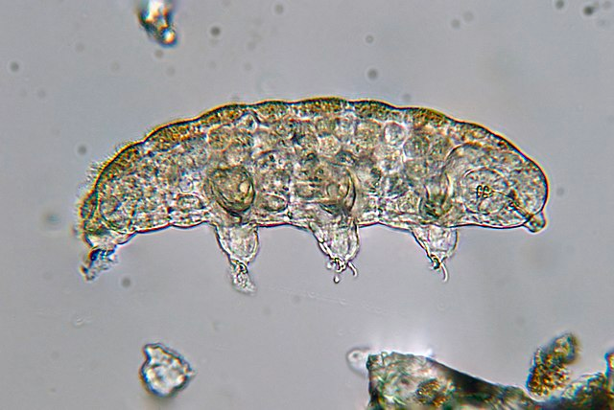
Tardigrades are found in all corners of the globe, from deep sea trenches to the tops of Himalayan mountains. They can survive temperatures of -200°C up to 82°C, (-392°F up to 180°F) as well as up to 5000 Grays (Gy) of radiation (for comparison, a human would be killed almost instantly by 1000 Gy2). And, as teased briefly above, tardigrades can even survive exposure to the cold vacuum of space – after one 10-day exposure experiment, they returned not only alive, but still reproduction-capable, beginning to reproduce once returned to a more suitable environment.9 This makes tardigrades the only animal currently known to be able to survive prolonged exposure to outer space. So – what’s their secret?
The answer: cryptobiosis, or the extreme slowing of metabolism, plus a few special tardigrade-specific, survival-promoting proteins. Tardigrades are able to enter a gel-like “tun state” by forcing most of the water from their cells, a process known as vitrification (Fig. 2). This protects them from extreme conditions by preventing crystal formation in their cells, which would damage their bodies (this is what causes frostbite in humans). Because of all these amazing abilities, it has been speculated that tardigrades could outlive humans on this planet, as centuries turn to millennia, millennia turn to ages, and the planet transforms with time – but in the meantime, these animals may be able to help save human lives.

Advances in Stabilization and Preservation Technology
Hemophilia A is a clotting disorder caused by a mutation or deletion of factor VIII (FVIII), a protein that is necessary for the blood coagulation cascade. Hemophilia A can be treated by administering a drug called FVIII, but FVIII products are unstable and need to be kept cold, making transportation and storage a logistical challenge. This instability is especially detrimental because it has direct, on-the-ground impacts for patients in isolated and underdeveloped parts of the world. Here’s where tardigrades come in: tardigrades’ vitrification-associated proteins – the ones involved with dehydrating the organism to promote survival in harsh environments – could be used to help stabilize FVIII products to prevent degradation from high heat and changes in water concentration. Preliminary research is underway at the University of Wyoming, where researchers have shown that by adding tardigrade vitrification protein CAHS D to FVIII products, the products can remain viable without refrigeration and are more resilient to degradation amid higher temperatures.6 Their work also shows that because of the tardigrade protein, the entire treatment can be dehydrated and rehydrated for later use.
Another class of proteins essential to tardigrades’ vitrification process is called Tardigrade Disordered Proteins (TDPs), and these are gaining attention for their potential to improve vaccine preservation. Some types of vaccines, such as mRNA vaccines (the COVID-19 vaccine is a recent example), must be kept at extremely low temperatures, making them costly and – like with FVIII – less accessible due to storage and transportation logistics. TDPs could help to preserve these vaccines at warmer temperatures, lessening their stringent storage requirements. TDPs may also lead to a new type of vaccine altogether called a “dry vaccine.” The concept is centered around the vaccine components being kept in a dehydrated and dormant state which would become reactivated once injected.4 The first attempts at dehydrating biomolecules have been successfully done with a protein called trehalose that helps to protect plants and fungi from the damaging effects of drying out, other researchers have pointed out that theoretically the next steps could involve similar experiments with TDPs.1
Tardigrades as Possible Chemotherapy Partners
Another tardigrade protein called Dsup (for damage suppressor) has the potential to be used as a protective agent during chemotherapy. The radiation during chemotherapy treatment can cause breaks in the DNA of healthy cells, and therefore it would be beneficial to be able to include a companion drug to help reduce the harmful effects of the chemotherapy while still being able to treat the cancer. Dsup has been shown to increase oxidative stress resistance in human cell lines and therefore could help to prevent damage to healthy tissues.3 This protein is only found in one species of tardigrade, and works by binding directly to DNA to block damage from radiation and oxidative stress (Fig. 3).

There is a lot of research that still needs to be done to bridge the gap between the abilities of tardigrades and how they could benefit human health, but so far the ongoing research efforts seem like steps in the right direction. While tardigrades often remain out of sight and tend to have little effect on the day-to-day endeavors of humanity, to borrow a quote from Shakespeare, “though [they] be but little, [they are] fierce.”7 On top of their abilities to survive outer space and five mass extinctions, as well as their Hulk-rivaling radiation endurance capacities, the not-so-humble tardigrades may soon be adding “human life-savers” to that list as well, helping us become a little more resilient just like them.
TL:DR
- Tardigrades are microscopic animals that can survive extreme conditions, including outer space.
- The special proteins that allow for vitrification and give tardigrades their resilience may have biomedical applications including stabilizing temperature-sensitive treatments and vaccines.
References
1. Colaço C, Sen S, Thangavelu M, Pinder S, Roser B. Extraordinary stability of enzymes dried in trehalose: simplified molecular biology. Biotechnology (N Y). 1992 Sep;10(9):1007-11. doi: 10.1038/nbt0992-1007. PMID: 1369408.
2. Horikawa, Daiki D., et al. “Radiation tolerance in the tardigrade Milnesium tardigradum.” International journal of radiation biology 82.12 (2006): 843-848.
3. Jönsson, K.I. Radiation Tolerance in Tardigrades: Current Knowledge and Potential Applications in Medicine. Cancers 2019, 11, 1333. https://doi.org/10.3390/cancers11091333
4. Kasianchuk N, Rzymski P, Kaczmarek Ł. The biomedical potential of tardigrade proteins: A review. Biomed Pharmacother. 2023 Feb;158:114063. doi: 10.1016/j.biopha.2022.114063. Epub 2022 Dec 7. PMID: 36495665.
5. Mapalo, Marc A., et al. “A tardigrade in Dominican amber.” Proceedings of the Royal Society B 288.1960 (2021): 20211760
6. Packebush, Maxwell H., Sanchez-Martinez, Silvia, Biswas, Sourav, KC, Shraddha, Nguyen, Kenny H., Ramirez, John F., Nicholson, Vincent, & Boothby, Thomas C.. Natural and engineered mediators of desiccation tolerance stabilize Human Blood Clotting Factor VIII in a dry state. Scientific Reports, 13 (1). Retrieved from https://par.nsf.gov/biblio/10416527. https://doi.org/10.1038/s41598-023-31586-9
7. Shakespeare, William, 1564-1616. (1998). A midsummer night’s dream. New York :Signet Classic.
8. Sugiura, Kenta, and Midori Matsumoto. “Sexual reproductive behaviors of tardigrades: a review.” Invertebrate Reproduction & Development 65.4 (2021): 279-287.
9. Weronika E, Łukasz K. Tardigrades in Space Research – Past and Future. Orig Life Evol Biosph. 2017 Dec;47(4):545-553. doi: 10.1007/s11084-016-9522-1. Epub 2016 Oct 20. PMID: 27766455; PMCID: PMC5705745.
 Lions Talk Science