By: Natale Hall
mRNA vaccines, while based on a decades-old theory, were first brought into the limelight nearly six years ago, when the Pfizer-BioNTech COVID-19 vaccine was approved for emergency use1. Now, a second mRNA vaccine is hitting the shelves just in time for the season— the flu season, that is! Indeed, the world’s first mRNA flu vaccine, mFLUVISA (or mRNA-1010), was granted approval from the Food and Drug Administration (FDA) on August 5th, 2026, for use in adults aged 50 and up, following the completion of several successful clinical trials involving more than 70,000 participants2–4. But with flu vaccines already widely available, what does this new vaccine bring to the table?
The Amazing Annual Race Against the Flu
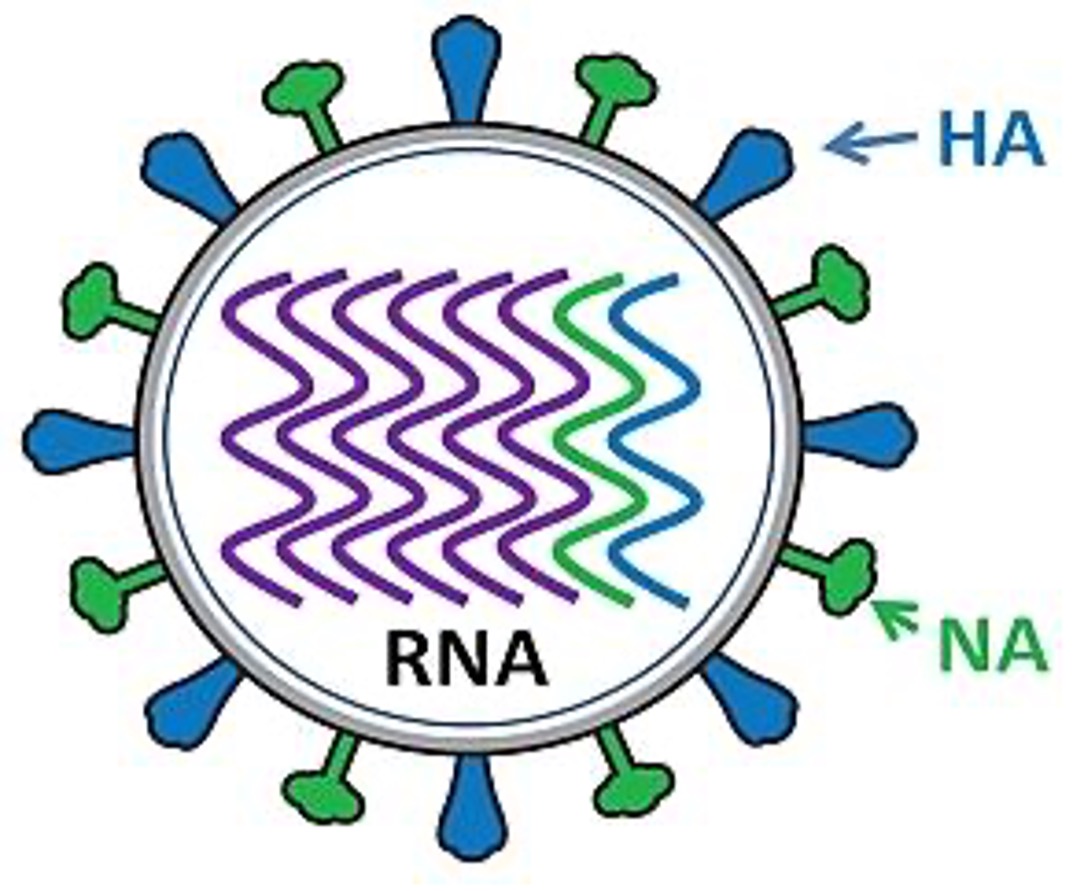
Influenza, more commonly called the flu, is a respiratory illness caused by a group of influenza viruses. While there are four strains, or types, of influenza viruses—A, B, C, and D —IAV (IAV) and B (IBV) are the main causes of human illness and are thus prioritized for vaccine development5. IAV and IBV have a similar overall structure: an outer layer covered with several surface proteins, including hemagglutinin (HA) and neuraminidase (NA), surrounding the virus’s genetic material, RNA (Figure 1). The HA protein helps the virus attach to and enter our cells, allowing an infection to begin. Once inside, the virus uses its genetic material to make more copies of itself. The NA protein then helps newly made viruses leave the infected cell and spread to other cells. Flu viruses are constantly changing, which gives rise to many different versions of IAV and IBV. IAV is known to infect a wide variety of birds and mammals, resulting in very rapid changes in the viral structure, specifically in the composition of HA and NA. These changes result in many possible subtype classifications for IAV depending on which versions of HA and NA it carries. Scientists have identified 18 versions of HA and 11 of NA, and each subtype is named for its unique combination, which is where names like H1N1 and H3N2 come from. IBV, by contrast, almost exclusively infects humans, resulting in a slower rate of change. In effect, IBV is divided into two lineages, B/Victoria and B/Yamagata, which split from a common ancestor in the 1980s6–8. The two have been evolving separately ever since, and each now has its own distinct versions of HA and NA.
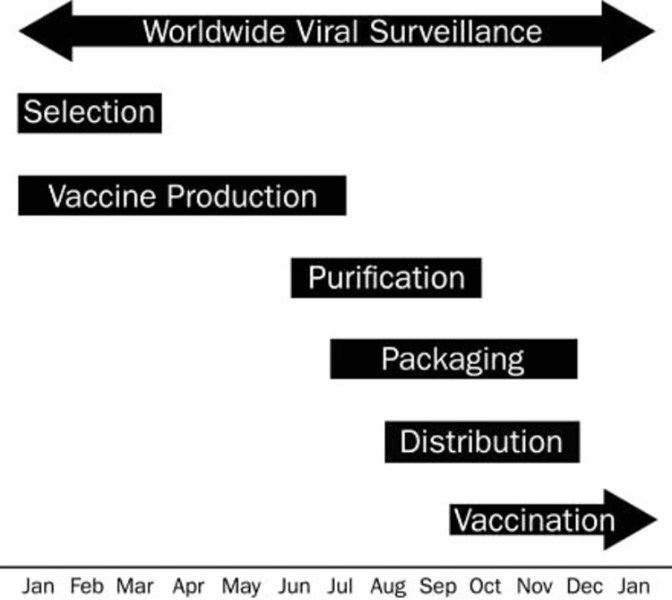
The seasonal flu epidemics caused by IAV and IBV place a significant burden on global health. The World Health Organization (WHO) estimates that around 1 billion seasonal flu cases occur globally each year, including 3-5 million cases of severe illness and 290,000 – 650,000 deaths. To help relieve this burden, people around the world are encouraged to receive an annual flu vaccine. Producing the vaccine is a massive, coordinated, year-round effort involving 152 national influenza centers in 129 different countries that conduct constant surveillance on the flu, receiving and testing thousands of samples from flu patients (Figure 2). Using these virus samples, scientists analyze which strains of IAV and IBV are prominently circulating, how rapidly the viruses are evolving, and how effective the previous years’ vaccine was in preventing severe illness and death. Then, the WHO organizes a biannual advisory meeting in which experts review the surveillance data. Typically, this occurs sometime in February and then again in September, aptly positioned just after peak flu season in the Northern and Southern Hemisphere, respectively. The advisory meeting culminates in the selection of candidate vaccine viruses, which they believe to be the most likely strains to circulate in the upcoming flu season, and an official recommendation for the composition of the next flu vaccine9.
Shot or Spray? Influenza Vaccine Platforms
Vaccines work by exposing the immune system to an antigen, or a part of a pathogen that the immune system can recognize and remember. For the flu virus, this can be the virus itself, or a component of the virus, like the HA or NA proteins. When the viral antigen enters the body, the immune cells recognize it as a foreign invader and generate antibodies, or protective proteins that can recognize the virus and help stop it from infecting cells, a process described in further detail in Niesha’s recent Lions Talk Science Article, “Reprogramming your defenses— autoimmune disease and a “small” potential therapy.” These antibodies remain in the body after vaccination, ready to recognize and prevent infection from the virus if a person encounters it later. For this reason, a strong antibody response — producing a high volume of long-lasting and effective antibodies — following vaccination is vital for protecting against infection11.
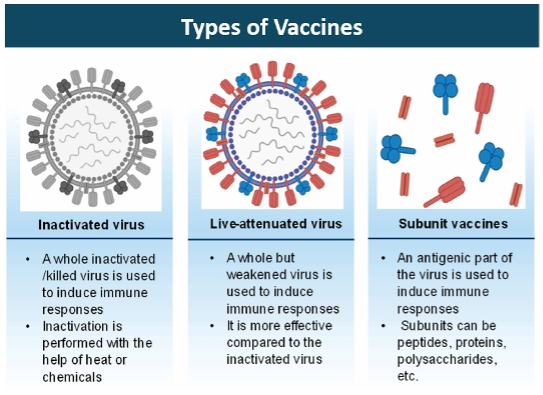
There are three main types of the flu vaccine, and each uses a slightly different strategy to train the immune system to recognize and fight off flu viruses (Figure 3)9,10,12. The nasal spray vaccine is a live attenuated vaccine, containing a weakened form of the virus that can still replicate to some extent but cannot cause the flu. Although studies have shown that the nasal spray is more effective at preventing illness in children, because it contains a live virus, it is not recommended for people who are pregnant or immunocompromised and is approved only for ages 2 to 4913. Another type is the subunit vaccine, which does not contain a whole flu virus, only pieces of it, such as HA, that are needed to trigger an immune response. The most common flu vaccine, accounting for over 90% of the vaccines administered each year, is called the inactivated flu vaccine14. To generate the inactivated flu vaccine, the selected candidate vaccine viruses are injected into fertilized chicken eggs, which act as incubators, giving the virus all of the necessary nutrients to replicate without immune interference9. After several days, the virus-containing fluid is extracted from the eggs, and the virus is isolated, inactivated (or killed), and purified to then be used as the main antigenic component of the flu shot. While there are some differences in the production process, the nasal spray and most subunit vaccines begin the same way, with viruses grown in eggs. This complex production process is scaled up to mass-produce and distribute the vaccine across the world, from chicken eggs to CVS.
The Sequel We Didn’t Know We Needed
While this egg-based process seems like a well-oiled vaccine machine, there are several major pitfalls that limit its success. First, one egg produces only enough virus for one to three standard-dose inactivated flu vaccines. With a total of around 1.53 billion doses made annually, this means that hundreds of millions of eggs (and chickens to lay those eggs) are required each year to make the flu vaccine15. Additionally, due to the lengthy process of the egg-based method, candidate vaccine viruses need to be selected 9-12 months ahead of the next vaccine rollout, which leaves a lot of room for error16. In that time, a different strain could begin to circulate more prominently, or the selected strain could evolve, leading to a mismatch between the virus in the vaccine and the one we need protection from. A mismatched flu vaccine can have devastating consequences across the globe by reducing the effectiveness of the vaccine and increasing the likelihood of severe flu epidemics and pandemics17. A faster, more flexible flu vaccine could therefore significantly reduce the health burden of the flu and prevent large-scale outbreaks. To this end, an mRNA-based flu vaccine may offer a tantalizing solution.
Building a Better Flu Vaccine with mRNA
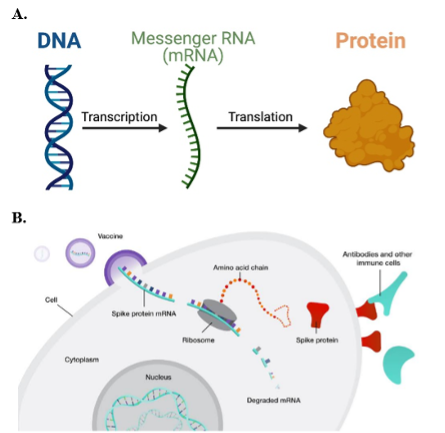
mRNA vaccine technology relies on one of the foundational concepts in molecular biology: the central dogma, or the flow of genetic information in our cells. The central dogma describes how DNA is first transcribed into messenger RNA (mRNA), a molecule that carries the instructions for making proteins (Figure 4A). mRNA vaccines take advantage of this process by providing cells with a piece of mRNA that provides a blueprint for a virus-specific protein. The body’s own cellular machinery then reads this mRNA and produces the protein, which is recognized by the immune system and triggers the production of protective antibodies (Figure 4B). To create the mRNA flu vaccine, scientists designed mRNA carrying the instructions for the HA protein. When the vaccine is delivered, this mRNA enters cells, which use it to produce HA proteins matching the selected flu strains. The immune system then recognizes these HA proteins and mounts a response that prepares the body to fight the real virus.
The first version of mRNA-1010, the mRNA flu vaccine, contained four HA-coding mRNA sequences: two targeting IAV strains and two targeting IBV strains. Early Phase 1/2 clinical trials found that the vaccine was safe and produced a strong antibody response that lasted up to six months, consistent with the antibody response from traditional flu vaccines2,18. To expand on these promising results, mRNA-1010 was tested in over 28,000 adults in two Phase 3 trials, P301 and P30219. P301 evaluated the vaccine’s safety and immune response in a larger population, while P302 compared its efficacy with that of the standard inactivated flu vaccine. Although P301 confirmed that mRNA-1010 was safe, P302 revealed a weakness in its protection against IBV. Adults who received mRNA-1010 experienced roughly 7% fewer IAV infections overall but were 62.7% more likely to develop IBV than those who received the standard flu vaccine. These findings prompted researchers to redesign mRNA-1010 to improve its protection against IBV.
The updated mRNA-1010, a formula with two mRNA sequences specific to IAV and one targeting IBV, was tested in a large Phase 3 clinical trial involving more than 40,000 adults aged 50 and older across 11 countries during the 2024–2025 flu season3. This age group was selected in part because older adults are at greater risk of serious complications, hospitalization, and death from the flu20. Of these participants, 20,353 received the updated mRNA vaccine, and 20,350 received the standard inactivated flu vaccine. Researchers followed participants throughout the flu season and compared how often people in each group developed laboratory-confirmed illness. The results showed that the updated mRNA vaccine provided improved protection against both IAV and IBV compared to the first version, and greater protection against the flu than the traditional inactivated vaccine. Specifically, about 2.0% of people who received mRNA-1010 contracted the flu, compared with 2.8% of those who received the standard vaccine. Put another way, people vaccinated with mRNA-1010 had about 26.6% fewer cases of the flu than those who received the inactivated vaccine. Compared with the standard flu shot, mRNA-1010 also reduced flu cases that required medical care by about 34% and flu cases that required urgent care, an emergency room visit, or hospitalization by about 50%.
The trial also assessed participants for adverse reactions. Short-term side effects, including fatigue, headache, muscle aches, and injection-site pain, were more common with mRNA-1010 than with the standard flu vaccine. However, most reactions were mild to moderate and resolved within a few days. Serious adverse events were uncommon and occurred at similar rates in both groups, with three cases in the mRNA-1010 group and two cases with the inactivated vaccine. Following the success of this trial, mRNA-1010, now called mFLUVISA, was approved for the 2026-2027 flu season in adults aged 50 and older, which was the patient population utilized in the Phase 3 studies. While the clinical trial results suggest that mFLUVISA may offer improved protection against the flu compared to the inactivated flu vaccine, its safety and effectiveness will continue to be monitored over the next several months. Additional clinical trials are also underway to test the safety and efficacy of the vaccine in younger age groups.
From COVID-19 to the Flu and Beyond
The approval of mFLUVISA marks an important milestone in vaccine development and flu prevention. Because mRNA vaccines are produced using a fully synthetic (and egg-free) process, manufacturers can potentially produce and adjust the vaccine more quickly than traditional flu vaccines21. This flexibility could make it easier to adjust the vaccine closer to, or even during, the flu season to ensure that it matches the circulating flu strains. Additionally, current clinical trial data suggest that mFLUVISA provides greater protection against the flu than a standard-dose flu vaccine, raising the possibility that it could also help reduce flu-related illness and its complications. Whether mFLUVISA ultimately delivers on that promise will depend on how it performs across future flu seasons, but its approval opens the door to a faster and potentially more adaptable approach to flu vaccination, representing a new approach to an annual challenge.
TL; DR:
- There are over one billion flu cases each year, placing a significant burden on global health.
- Producing the annual flu vaccine relies on a massive, complex, and time-sensitive supply chain spanning 9-12 months.
- The recently FDA-approved mRNA flu vaccine could offer a more efficient, effective, and flexible approach to producing seasonal flu vaccines.
References
- Fortner, A. & Schumacher, D. First COVID-19 Vaccines Receiving the US FDA and EMA Emergency Use Authorization. Discoveries 9, e122.
- Ananworanich, J. et al. Safety and Immunogenicity of mRNA-1010, an Investigational Seasonal Influenza Vaccine, in Healthy Adults: Final Results From a Phase 1/2 Randomized Trial. J. Infect. Dis. 231, e113–e122 (2025).
- Leroux-Roels, I. et al. Efficacy and Safety of an mRNA Seasonal Influenza Vaccine in Adults. N. Engl. J. Med.394, 1803–1813 (2026).
- Kandinov, B. et al. An mRNA-based seasonal influenza vaccine in adults: Results of two phase 3 randomized clinical trials and correlate of protection analysis of hemagglutination inhibition titers. Hum. Vaccines Immunother. 21, 2484088 (2025).
- Wu, N. C. & Wilson, I. A. Influenza Hemagglutinin Structures and Antibody Recognition. Cold Spring Harb. Perspect. Med. 10, a038778 (2020).
- Wilson, J. L. et al. The Influenza B Virus Victoria and Yamagata Lineages Display Distinct Cell Tropism and Infection-Induced Host Gene Expression in Human Nasal Epithelial Cell Cultures. Viruses 15, 1956 (2023).
- Virk, R. K. et al. Divergent evolutionary trajectories of influenza B viruses underlie their contemporaneous epidemic activity. Proc. Natl. Acad. Sci. U. S. A. 117, 619–628 (2020).
- Jackson, D., Elderfield, R. A. & Barclay, W. S. Molecular studies of influenza B virus in the reverse genetics era. J. Gen. Virol. 92, 1–17 (2011).
- Nuwarda, R. F., Alharbi, A. A. & Kayser, V. An Overview of Influenza Viruses and Vaccines. Vaccines 9, 1032 (2021).
- Tosh, P. K., Jacobson, R. M. & Poland, G. A. Influenza Vaccines: From Surveillance Through Production to Protection. Mayo Clin. Proc. 85, 257–273 (2010).
- Freund, N. T. Antibodies: what makes us stronger. Hum. Vaccines Immunother. 17, 3551–3553.
- Sugandhi, V. V. et al. Exploring natural components in vaccine delivery systems: Types, routes of administration, in-vitro and in-vivo quantification techniques. J. Drug Deliv. Sci. Technol. 108, 106960 (2025).
- Rhorer, J. et al. Efficacy of live attenuated influenza vaccine in children: A meta-analysis of nine randomized clinical trials. Vaccine 27, 1101–1110 (2009).
- Bender, E. Accelerating flu protection. Nature 573, S60–S61 (2019).
- Brauer, R. & Chen, P. Influenza Virus Propagation in Embryonated Chicken Eggs. J. Vis. Exp. JoVE e52421 (2015) doi:10.3791/52421.
- Morris, D. H. et al. Predictive modeling of influenza shows the promise of applied evolutionary biology. Trends Microbiol. 26, 102–118 (2018).
- Tricco, A. C. et al. Comparing influenza vaccine efficacy against mismatched and matched strains: a systematic review and meta-analysis. BMC Med. 11, 153 (2013).
- Sanz-Muñoz, I. et al. Long-term influenza antibodies profiles in previously vaccinated and non-vaccinated adults. Hum. Vaccines Immunother. 19, 2236537.
- Kandinov, B. et al. An mRNA-based seasonal influenza vaccine in adults: Results of two phase 3 randomized clinical trials and correlate of protection analysis of hemagglutination inhibition titers. Hum. Vaccines Immunother. 21, 2484088.
- Langer, J. et al. High Clinical Burden of Influenza Disease in Adults Aged ≥ 65 Years: Can We Do Better? A Systematic Literature Review. Adv. Ther. 40, 1601–1627 (2023).
- Pawar, B. et al. A Comprehensive Review of Vaccine Development: From Traditional Platforms to Messenger RNA (mRNA) Technologies. Cureus 18, e100608.

