By: Habiba Abdelhalim
Picture an ant trapped in the sand, pinned down and unable to move. A nestmate approaches, and although it could easily walk away and keep foraging, it stops to help. Digging out a trapped comrade takes time, burns energy, and offers no immediate reward, and yet the ant starts to dig, biting at whatever is restraining its neighbor, and doesn’t stop until the trapped ant is free. This display of altruism is not a one-off fluke. It’s a real, repeatable phenomenon called rescue behavior, and it has quietly become one of the most surprising discoveries in animal behavior research over the past two decades1. A recent study dug into the brains of desert ants to investigate what makes one ant a rescuer and another a bystander2. The answer, it turns out, lives in gene activity inside the brain, and it connects rescue behavior to some surprising biological systems, including the immune system.
Helping Behavior Isn’t Just a Human (or Mammal) Trait
Rescue behavior has now been documented in roughly two dozen ant species, including desert ants in the genus Cataglyphis and termite-hunting Megaponera analis colonies2,4. Researchers define true rescue behavior using four strict criteria: (1) the individual in trouble must be in real danger, (2) the helper’s response must fit the situation, (3) the helper must take on some cost or risk, and (4) the helper must gain no direct personal benefit from doing it. These criteria set a high bar for rescue behavior, and yet, ants clear it3, 4.
Historically, altruism was mostly studied in mammals3. Primates pulling a juvenile away from a predator, dolphins supporting an injured pod member, humans running into danger for a stranger: these stories reflect our intuitive understanding of empathy and social bonds that characterize mammalian species with long lives and complex brains. In contrast, ants have tiny brains, short individual lifespans within a much longer-lived colony, and behavior that is shaped as much by genetics and colony-level organization as by individual learning5. If insects with brains the size of a poppy seed can evolve something that looks like altruism, it raises new, complex questions about what’s required biologically to produce helping behavior. These questions are particularly timely, as research on the connections between the immune system, gut microbes, and brain function, the so-called immune-brain or gut-brain axis, has exploded across biology and medicine within the past few years6. This study lands squarely at that intersection, offering a comparative window into questions that are also being asked about human neurological and psychiatric conditions.
Who Rescues, and Who Doesn’t?
The research team behind this study, published in the Journal of Experimental Biology, worked with Cataglyphis nigra, a desert ant species found in parts of Africa and the Middle East2. They collected seven whole colonies, representing well over a thousand ants in total. In the lab, researchers staged a simple scenario: a nestmate was gently tied down in the middle of a sandy arena, and the researchers watched to identify which ants of forty individually marked workers would exhibit rescue behavior and come to help. Ants that entered a small circle around the trapped nestmate and bit, pulled, or dug at it for at least five seconds were classified as “rescuers” (Figure 1). Ants that entered a larger surrounding circle, close enough to perceive the trapped individual, but did not intervene were classified as “non-rescuers.” This distinction matters because non-rescuers weren’t simply ants that failed to notice their trapped nestmate: they got just as close as the rescuers did yet did not stop to help. In other words, proximity alone didn’t predict who would step in.
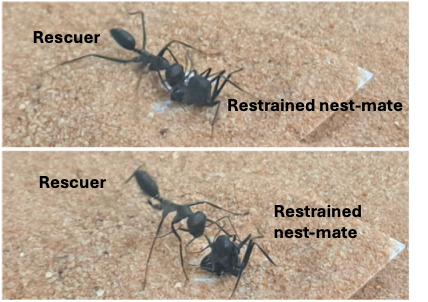
The researchers began by asking if rescuers possessed distinct physical attributes that made them bigger, faster, or better resourced. To answer this question, they first weighed, measured body parts, and quantified fat reserves in the ants. The results showed that rescuers and non-rescuers didn’t differ body size, brain size, body mass, or fat content. The team then moved on to analyzing the movement and behavioral patterns of the ants. Using video tracking software, they measured how fast the ants moved, how much of the arena they explored, and how quickly they reached the trapped individual. This revealed some clear behavioral differences between rescuers and non-rescuers. First, rescuers were found to reach the trapped nestmate sooner than non-rescuers, despite no difference in overall speed. However, once rescuers came into proximity to the nest mate, they moved more slowly and explored the area more thoroughly. Taken together, this pattern suggests rescuers may have picked up on the trapped nestmate’s distress cues (whether visual, chemical, or vibrational) sooner or more accurately than their non-rescuer counterparts, letting them head toward the right spot more directly, then slow down to investigate carefully once they arrived.
Reading the Brain’s Chemistry: A Crash Course in RNA-seq
After eliminating physical attributes as contributory factors to rescue behavior, the researchers turned to the brain, where decision making, sensory processing, and behavioral responses occur. Specifically, the team looked at which genes were active inside the brains of rescuers compared to non-rescuers. Although every cell in the body carries the same DNA, not every gene encoded in that DNA is expressed at the same level. Gene expression refers to how much a particular gene is being read and converted into a functional product, usually a protein. Genes that are expressed more strongly in one group of animals than another, in this case, rescuers versus non-rescuers, are called differentially expressed genes.
To measure gene expression, the researchers utilized RNA sequencing (RNA-seq). In this technique, RNA molecules, which are the molecular messages that cells produce when reading genes, are extracted and converted into a format that is read to determine the genetic identity of each RNA. Then, a machine is used to quantify each of these individual fragments (Figure 2). The more copies of a particular RNA are present, the higher the expression level of that gene, or the more strongly that gene is presumed to be active. Comparing these counts between two groups, such as rescuers and non-rescuers, reveals which genes are more or less active in association with a particular trait, like rescue behavior.
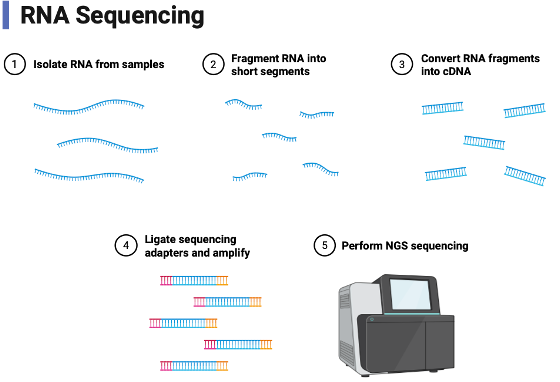
To assess gene expression across areas of the brain, the team dissected four separate regions from the ants’ heads: (1) the mushroom bodies, which are central to learning, memory, and decision-making in insects and are the hub for conversion of sensory information into actions, (2) the optic lobes, which process visual information, (3) the rest of the central brain, which is involved in movement and processing of smells, and (4) the antennae, which are the ants’ primary sensory organs for smell and touch. Sequencing and comparing gene activity across all four tissues in twenty-eight ants allowed the investigators to pinpoint where rescue-related differences occurred in the nervous system.
The Immune Connection: What the Genes Revealed
Across all brain and antennal tissue combined, nine differentially expressed genes were identified as significantly associated with rescue behavior. Interestingly, many of these genes were identified to be involved with immune system functioning. One was defensin, a gene that produces an antimicrobial gene7. Another coded for a peptidoglycan-recognition protein, a receptor that detects bacterial cell-wall material8. A third was linked to maintaining the blood-brain barrier, which is the protective boundary that keeps the nervous system chemically separate from the rest of the body. All of these genes were more highly expressed in rescuers. This finding is particularly notable because immune signaling molecules, originally understood mainly as infection-fighting tools, are increasingly recognized as also shaping brain function and behavior. This connection is not specific to insects, but is also found in mammals, where similar pathways have been tied to social behavior and neurodevelopmental differences9. The results also indicated arginase, an enzyme that helps produce polyamines, which are small molecules known to influence how insects respond to smells and pheromones, as a player in rescue behavior2. Rescuers showed elevated arginase RNA, which implies higher enzymatic activity and thus increased polyamine production. Higher amounts of polyamines in the rescuers’ brains suggests that their nervous systems may be primed to process chemical or scent-based distress signals more readily, giving these ants a head start in responding to nestmates in peril. This offers one explanation as to how rescuers reached trapped nestmates faster than non-rescuers did, even though they did not move faster overall.
Although the investigators observed changes across all brain regions they examined, the mushroom bodies carried the strongest signal of all, showing fifteen genes with elevated activity in rescuers. Among these was a gene called JHAMT, which is involved in producing juvenile hormone, a hormone that shapes behavior and how insects perceive pheromones10. Other elevated genes were linked to odor-binding, a function typically associated with the antennae, suggesting these genes may be doing something new or additional inside the mushroom bodies themselves in rescuer ants.
A Pattern Across Ant Colonies: The Case for Specialization
A growing body of research on Cataglyphis ants has shown that rescue behavior is not randomly distributed across a colony2, 12. Instead, it resembles specialization, similar to how some workers specialize in foraging while others tend the brood. Related work has found that rescue tendencies can run in paternal lines within a colony, appear early in an ant’s adult life, and stay stable as the ant ages, suggesting altruism has a heritable component and is not something learned purely through experience13. Other recent studies have expanded on these ideas, some of which have shown that ants living longer lives tend to invest more in helping behavior, presumably because a longer expected lifespan makes protecting the colony’s existing workforce more valuable14. Separate behavioral work on C. nigra specifically found that, when given a choice, most ants prioritize foraging over rescuing a trapped nestmate, reinforcing the idea that rescue is carried out by a responsive subset of the colony rather than by everyone equally15. Put together, ant colonies appear to maintain a small cadre of workers who are, for reasons potentially rooted in brain gene activity, more responsive to the cues signaling that a nestmate is in trouble. That division of labor may make colonies more efficient overall, letting most workers focus on food-gathering while a specialized minority stands ready to respond to emergencies.
Beyond the Anthill
It’s tempting to file this phenomenon away as a curiosity about insects, but the implications reach further. First, it’s a striking demonstration that helping behavior, which we tend to associate with complex social cognition, can arise from simple genetic and neurochemical differences. Secondly, the immune-brain connection uncovered here fits into a much bigger, very timely scientific story. Researchers across many fields are increasingly providing evidence that the immune system doesn’t just fight off infections, but also helps shape mood, social behavior, and cognitive function through pathways connecting the gut, the immune system, and the brain. Finding hints of this same connection in a desert ant, an organism evolutionarily distant from mammals, suggests these links may be a conserved feature of nervous systems. Finally, this kind of research is a reminder of how much complexity hides behind behaviors that look simple from the outside. A worker ant walking toward a trapped nestmate stems from a distinct neurochemical program involving immune signaling, hormone production, and complex genetic processes. The next time an ant colony seems like a simple, almost robotic collective, it’s worth remembering that individual differences are quietly shaping who steps up when a nestmate needs help!
TL; DR:
- Desert ants display rescue behavior toward trapped nestmates.
- Rescuers and non-rescuers don’t differ physically, but their brain gene activity does.
- Immune-related and polyamine-related genes are elevated in rescuers, especially in the mushroom bodies.
- These findings link ant altruism to broader immune-brain connections.
References
1. Nowbahari, E., & Hollis, K. L. (2010). Rescue behavior: Distinguishing between rescue, cooperation and other forms of altruistic behavior. Communicative & integrative biology, 3(2), 77–79.
2. Jaimes-Nino, L. M., Bar, A., Scharf, I., & Foitzik, S. (2026). Transcriptional predictors of rescue behaviour in ants. The Journal of experimental biology, 229(14), jeb252086.
3. Chen, Y. Q., Han, S., & Yin, B. (2023). Why help others? Insights from rodent to human early childhood research. Frontiers in behavioral neuroscience, 17, 1058352.
4. Frank, E. T., Schmitt, T., Hovestadt, T., Mitesser, O., Stiegler, J., & Linsenmair, K. E. (2017). Saving the injured: Rescue behavior in the termite-hunting ant Megaponera analis. Science advances, 3(4), e1602187.
5. D’Andrea, R., Kocher, C. D., Skiena, B., & Futcher, B. (2026). Eusocial reproduction selects for longevity. bioRxiv : the preprint server for biology, 2025.03.25.645350.
6. O’Riordan, K. J., Moloney, G. M., Keane, L., Clarke, G., & Cryan, J. F. (2025). The gut microbiota-immune-brain axis: Therapeutic implications. Cell reports. Medicine, 6(3), 101982.
7. Klotman, M. E., & Chang, T. L. (2006). Defensins in innate antiviral immunity. Nature reviews. Immunology, 6(6), 447–456.
8. Royet, J., Gupta, D., & Dziarski, R. (2011). Peptidoglycan recognition proteins: modulators of the microbiome and inflammation. Nature reviews. Immunology, 11(12), 837–851.
9. Lee, B., Kwon, J. T., Jeong, Y., Caris, H., Oh, D., Feng, M., Davila Mejia, I., Zhang, X., Ishikawa, T., Watson, B. R., Moffitt, J. R., Chung, K., Huh, J. R., & Choi, G. B. (2025). Inflammatory and anti-inflammatory cytokines bidirectionally modulate amygdala circuits regulating anxiety. Cell, 188(8), 2190–2202.e15.
10. Shinoda, T., & Itoyama, K. (2003). Juvenile hormone acid methyltransferase: a key regulatory enzyme for insect metamorphosis. Proceedings of the National Academy of Sciences of the United States of America, 100(21), 11986–11991.
11. Zawalska, M., & Tarnowski, M. (2025). piRNA-Mediated Maintenance of Genome Stability in Gametogenesis and Cancer. Genes, 16(7), 722.
12. Nowbahari, E., Hollis, K. L., Bey, M., Demora, L., & Durand, J. L. (2022). Rescue specialists in Cataglyphis piliscapa ants: The nature and development of ant first responders. Learning & behavior, 50(1), 71–81.
13. Andras, J. P., Hollis, K. L., Carter, K. A., Couldwell, G., & Nowbahari, E. (2020). Analysis of ants’ rescue behavior reveals heritable specialization for first responders. The Journal of experimental biology, 223(Pt 5), jeb212530.
14. Turza, F., Stec, D., Fontaneto, D., & Miler, K. (2024). Life expectancy in ants explains variation in helpfulness regardless of phylogenetic relatedness. Behavioral ecology : official journal of the International Society for Behavioral Ecology, 36(3), arae104.
15. Bar, A., Gilad, T., Massad, D., Ferber, A., Ben-Ezra, D., Segal, D., Foitzik, S., & Scharf, I. (2023). Foraging is prioritized over nestmate rescue in desert ants and pupae are rescued more than adults. Behavioral Ecology, 34(6), 1087–1096.

