By: Nicole Hall
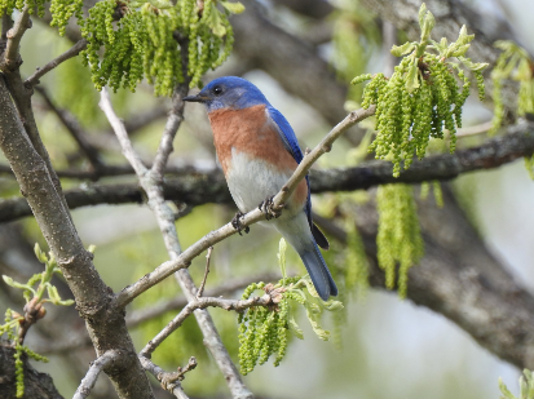
What if one of the simplest ways to support your mental health has been outside your window all along? Most people have heard birds singing or have watched one perched in a tree (Figure 1), but they rarely stop to consider how these ordinary experiences could affect the brain. With more than 11,000 bird species worldwide, there are many opportunities to watch birds. In the United States alone, approximately 96 million people participated in birdwatching in 2022. Despite how common birdwatching is, scientists have only started asking what it could be doing to our brains. Early research suggests that watching birds can engage attention and memory while also helping people feel more mentally refreshed.1,2,3 What exactly is happening in the brain when we watch birds, and why might it be good for us?
What Happens When We Birdwatch
Birdwatching may look simple, but identifying a bird is a complex cognitive task! Every observation requires the brain to process thousands of tiny pieces of information from the surrounding environment. Within seconds, a birdwatcher may notice a bird’s size, color, shape, movement, and song while comparing those features with memories of prior birds and filtering out irrelevant information. That is a lot of work for something that can feel almost effortless! Even experienced birdwatchers rarely rely on a single clue. Instead, they combine multiple cues to distinguish between species that may look or sound remarkably similar. Since bird identification draws on several cognitive processes, birdwatching provides an interesting way to study how attention, perception, learning, and memory work together.1
The Expert Brain Adapts to Notice Birds
How is the brain of a birdwatching expert different from that of a novice? One recent study investigated whether bird identification expertise was associated with differences in brain structure and function.1 They compared 29 expert birdwatchers with 29 novices matched for age, sex, and education. Participants completed bird identification tasks and underwent two types of magnetic resonance imaging (MRI), allowing researchers to examine both brain structure and activity. The study found that expert birdwatchers differed from novices in several brain regions involved in attention and perception, including the intraparietal sulcus (IPS), right lateral occipitotemporal cortex, and left fusiform gyrus. These regions are involved in processes such as directing visual attention and recognizing objects.1 Basically, experienced birdwatchers may have brains that are especially tuned to know exactly what to look for!
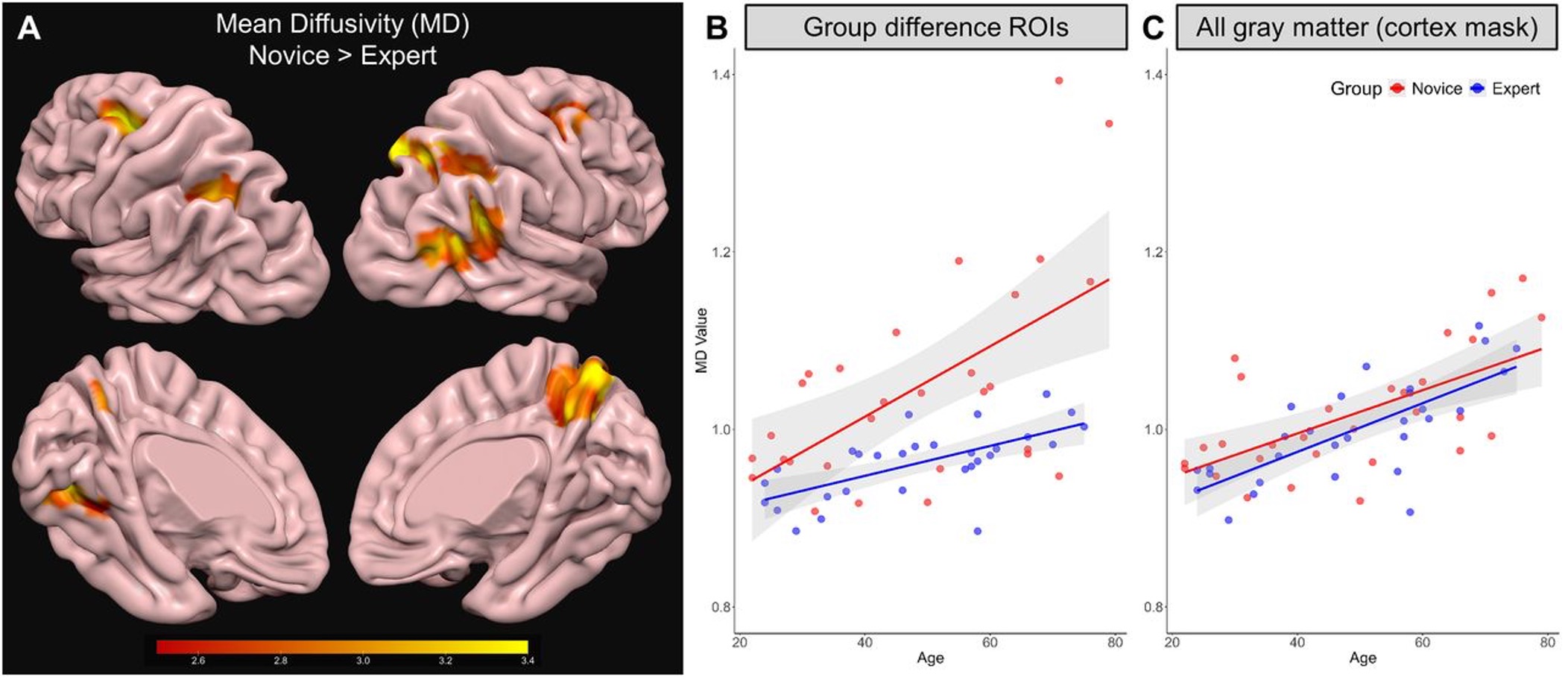
To look for differences in brain structure, the researchers measured how freely water molecules moved through the tissue. This measurement, called mean diffusivity (MD), was lower in experts in these regions. Lower MD can reflect greater tissue complexity because more densely organized cellular structures can restrict the movement of water molecules (Figure 2A). In other words, years of experience may be associated with subtle structural changes in parts of the brain used for bird identification. MD increased with age in both groups, but novices consistently showed higher MD than experts in the brain regions where the groups differed (Figure 2B). The pattern showing higher MD was not seen across cortical gray matter overall, suggesting that the differences were specific to certain regions rather than spread throughout the cortex (Figure 2C).1 Among experts, lower MD in these regions was also associated with better bird-identification performance. Some of these same brain regions became more active when experts identified less familiar or nonlocal birds, meaning they were recruited more during harder trials. These results suggest that years of bird identification expertise can lead to measurable differences in brain structure and activity. One explanation may be experience-related neuroplasticity, where repeated practice shapes how the brain processes information needed for bird identification.
Why Birds May Be Good for the Mind
While expertise shapes how the brain responds to bird identification, you do not need to be an expert birdwatcher to experience the potential psychological benefits. People who were more committed to birdwatching reported feeling greater psychological restoration, meaning they felt more mentally refreshed, regardless of how skilled they were.2 In a 2022 study from King’s College London, researchers looked at how everyday encounters with birds related to mental well-being.3 Rather than bringing participants into a lab, they used a smartphone app called Urban Mind to capture these experiences in daily life. Several times a day, the app asked participants whether they could see or hear birds and how they were feeling in that moment. Over two weeks, more than 1,200 participants completed over 26,000 surveys. The study found that participants reported better well-being when seeing or hearing birds. Interestingly, this positive association was observed in both participants without a mental health diagnosis and those with a diagnosis of depression (Figure 3). The association remained even after accounting for differences in participants’ backgrounds and their exposure to other natural features, like trees, plants, and water.3 What stands out is how ordinary these encounters were. Participants were simply seeing or hearing birds during their normal day!
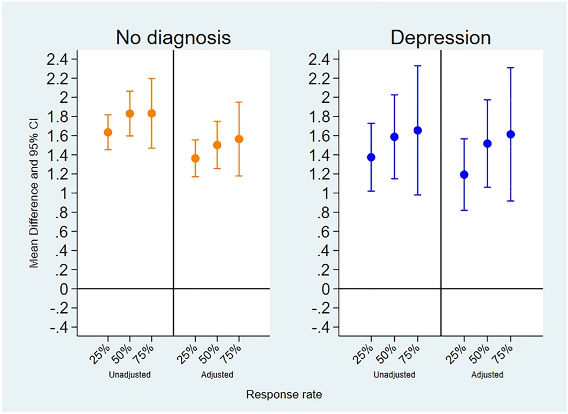
Since this was an observational study, the researchers could not determine whether seeing or hearing birds directly caused these improvements. The study did not compare encounters with birds to other activities, so this study cannot tell us whether these benefits are unique to birds. However, in one such study, researchers compared birdsong with traffic noise and found that participants who listened to birdsong reported reductions in anxiety and paranoia, providing additional evidence that exposure to birdsong may support psychological well-being.4 In a separate qualitative study, researchers asked 20 adults about natural sounds and found that birdsong and calls were the sounds most often associated with perceived recovery from stress and mental fatigue.5 However, not all bird sounds were viewed as restorative, so responses may depend on the type of bird sound and the listeners’ experiences.5 The type of bird sound could matter just as much as hearing birds in the first place.
Another way researchers have explored the potential benefits of birds is through contemplative birdwatching, which involves watching birds in a calm and deliberate way. Researchers have suggested that birdwatching may share similarities with mindfulness, the practice of maintaining awareness of the present moment. When you think about it, birdwatching naturally asks you to slow down, pay attention, and notice what is happening around you. However, whether contemplative birdwatching promotes mindfulness requires more research.6
What Makes Birdwatching Different?
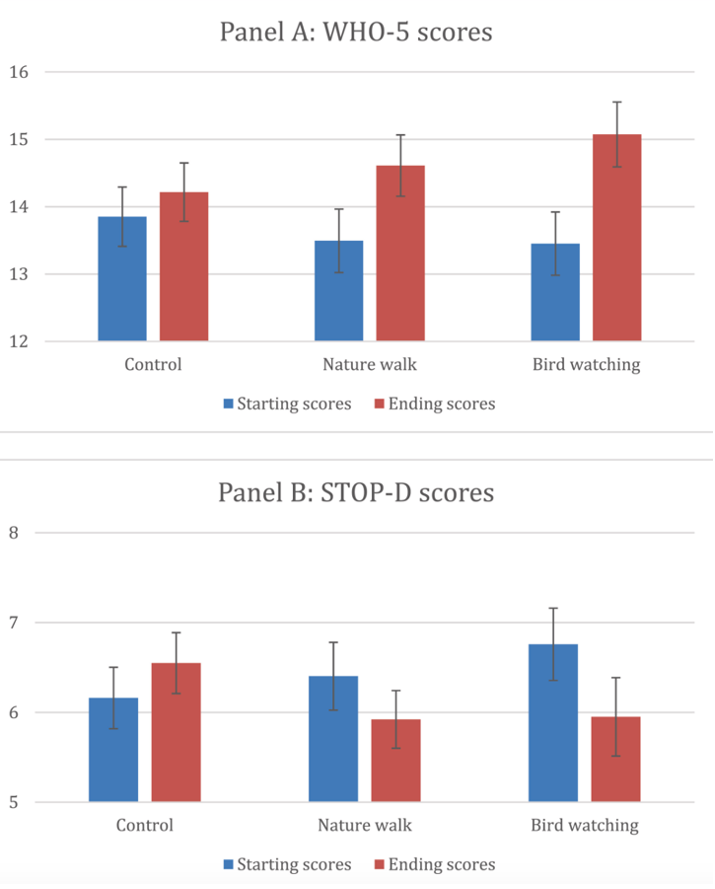
The Urban Mind study found that seeing or hearing birds was associated with higher momentary well-being, but what happens if people go birdwatching “on purpose”? In one study, participants completed a five-week birdwatching program while other participants were assigned to either a nature walk or a control group that continued with its usual daily activities without an assigned walk.7 Researchers measured participants’ psychological well-being and distress before and after the program with questionnaires that asked about feelings of well-being, anxiety, depression, and stress. The birdwatching group showed a statistically significant reduction in psychological distress compared with the control group or those who went on a nature walk (Figure 4). The findings provide preliminary evidence that intentionally engaging with birds may reduce psychological distress. So, the next time you have an exam or big decision coming up, it might be time to take a step back and go look for some birds!
The Science Is Just Taking Flight
What appears to be a simple outdoor activity can shockingly engage our attention, perception, learning, and memory. Better yet, birdwatching may also support better mental well-being. Research on experienced birdwatchers shows that bird identification expertise is associated with differences in brain structure and activity1. Birdwatching is more than a quiet pastime: it can offer more than one reason to step outside and pay closer attention to the birds around you! In a digital age where screens, apps, and TV demand our time and attention, birdwatching offers a unique opportunity to try something new that may just become your new favorite hobby. Many questions remain on how the cognitive and psychological effects of birdwatching may be connected. Is it the cognitive processes involved in birdwatching when we hear their song? Or could it be that simply being in nature plays a larger role? Understanding these connections may provide broader insights into how everyday experiences shape the brain and overall well-being.
TL; DR:
- Birdwatching engages attention, perception, learning, and memory.
- Seeing or hearing birds has been associated with improved psychological well-being.
- Experienced birdwatchers show differences in brain structure and activity, but researchers are still investigating how these findings may be connected.
Reference
- Wing EA, Chad JA, Mariotti G, Ryan JD, Gilboa A. The tuned cortex: Convergent expertise-related structural and functional remodeling across the adult lifespan. Journal of Neuroscience. 2026;46(12):e1307252026. doi:10.1523/JNEUROSCI.1307-25.2026.
- Randler C, Murawiec S, Tryjanowski P. Committed bird-watchers gain greater psychological restorative benefits compared to those less committed regardless of expertise. Ecopsychology. 2022;14(2):101–110. doi:10.1089/eco.2021.0062.
- Hammoud R, Tognin S, Burgess L, et al. Smartphone-based ecological momentary assessment reveals mental health benefits of birdlife. Scientific Reports. 2022;12:17589. doi:10.1038/s41598-022-20207-6.
- Stobbe E, Sundermann J, Ascone L, Kühn S. Birdsongs alleviate anxiety and paranoia in healthy participants. Scientific Reports. 2022;12:16414. doi:10.1038/s41598-022-20841-0.
- Ratcliffe E, Gatersleben B, Sowden PT. Bird sounds and their contributions to perceived attention restoration and stress recovery. Journal of Environmental Psychology. 2013;36:221–228. doi:10.1016/j.jenvp.2013.08.004.
- Andrews JG, Ammirati RJ, Andrews CJM. Birding benefits: A review of mental health, cognitive, social, and conservation impacts. Ecopsychology. 2025;17(1):1–17. doi:10.1089/eco.2024.0019.
- Peterson MN, Larson LR, Hipp A, et al. Birdwatching linked to increased psychological well-being on college campuses: A pilot-scale experimental study. Journal of Environmental Psychology. 2024;96:102306. doi:10.1016/j.jenvp.2024.102306.

