By: Cynthia Lascarez
Attention-Deficit/Hyperactivity Disorder (ADHD) is an extremely common neurodevelopmental condition that impacts roughly 22.5 million individuals in the United States. Although this number includes an estimated 15.5 million adults, a common and persistent misconception is that ADHD exclusively presents in early childhood1. Indeed, if you do not display the conventional symptoms of ADHD before 12 years old, such as behavioral issues, disorganization, or restlessness, you are unlikely to receive a diagnosis until much later in life, a phenomenon that disproportionately affects women. One 2023 Swedish study of 85,330 individuals with ADHD revealed that females received an ADHD diagnosis about 4 years after their male counterparts2. Another 2024 study analyzing health care records of a Welsh population and found that roughly 32.9% of males and 45.6% of females were diagnosed after age 12, while only 8.4% of men and 17.1% of women were diagnosed in adulthood3. As one of the 61% of women who receive a diagnosis in adulthood, I have first-hand experienced the frustration that comes from not receiving an ADHD diagnosis earlier. But why does this discrepancy exist?
Why Is ADHD in Women Misdiagnosed?
Dating back to the 1980s, research on ADHD predominately focused on characteristics identified in young boys, including hyperactivity, impulsivity, disorganization, restlessness, and problems staying on task3-6. The IV edition of the Diagnostic and Statistical Manual of Mental Disorders (DSM-IV), which was still in use until 2013, and required an individual to demonstrate symptoms of impairment before the age of 7. This early male-centric view of ADHD has had long-lasting implications for how the disorder is diagnosed and treated among women. It was not until later editions, beginning with the DSM-5, that the age-of-impairment criteria were increased to include individuals from age 12 through adulthood. However, even though the diagnostic materials have evolved to represent a larger population, women remain underdiagnosed. One possible explanation for this discrepancy is that many clinicians who were trained under the old DSM criteria continue to practice under the same criteria. While this may play a role in ADHD diagnosis, differences in biology, behavior, and social experiences between males and females may also contribute to the persistent gap in how ADHD is recognized and diagnosed in men and women. Understanding the complexity of ADHD diagnosis therefore requires consideration of the factors that contribute to persistent diagnostic disparities between men and women.
What factors contribute to the gender disparity in ADHD diagnosis?
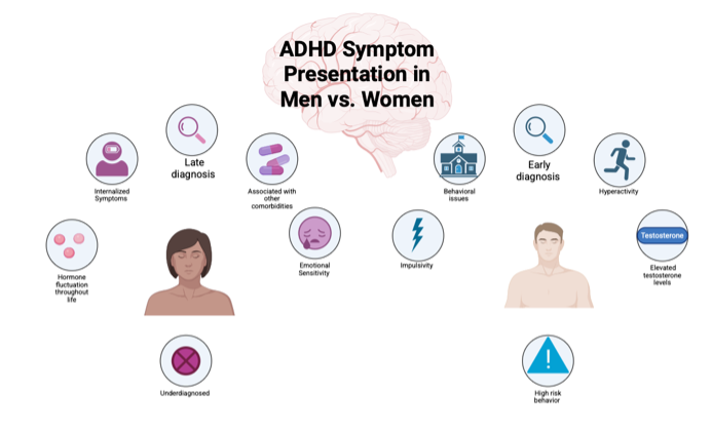
First, hormonal fluctuations throughout development play a critical role in the onset and diagnosis of ADHD in males and females. One hormone associated with ADHD-related behaviors is testosterone, the primary male sex hormone. Studies have linked higher testosterone levels to behavioral traits commonly associated with ADHD, including increased hyperactivity, sensation seeking, and aggression. Since males tend to have significantly higher amounts of testosterone than females, this offers one explanation to why ADHD-associated traits are less prominent in girls, and in effect contribute to challenges in recognition and diagnosis9. Other hormones are also implicated in the prominence of ADHD characteristics. Unlike males, females are constantly undergoing significant hormone changes throughout their lifetime that can significantly change the onset and presentation of ADHD symptoms. The three major hormone-altering moments a woman can experience are puberty (and with it, menstruation), pregnancy, and menopause. During these events, changing levels of the primary female sex hormones progesterone and estrogen also cause alterations in dopamine, a neurotransmitter that carries messages from one nerve cell to another. Dopamine plays an important role in attention, focus, and motivation, and changes in dopamine signaling are often linked to the difficulties with these aspects of executive function experienced by individuals with ADHD10. When dopamine levels are high, ADHD symptoms are generally managed or not noticeable; it is not until those levels drop that ADHD symptoms may worsen. For example, directly before menstruation, estrogen and progesterone levels fall to their lowest point of the entire menstrual cycle. This triggers dopamine levels to drastically drop, resulting in a lack of motivation, focus, and overall cognitive clouding, also referred to as brain fog (Figure 1). Because ADHD symptoms may mimic those associated with normal menstrual-cycle fluctuations and temporarily improve at certain points in the cycle, these symptoms may be attributed to hormonal changes rather than ADHD, potentially confounding symptom recognition and diagnosis.
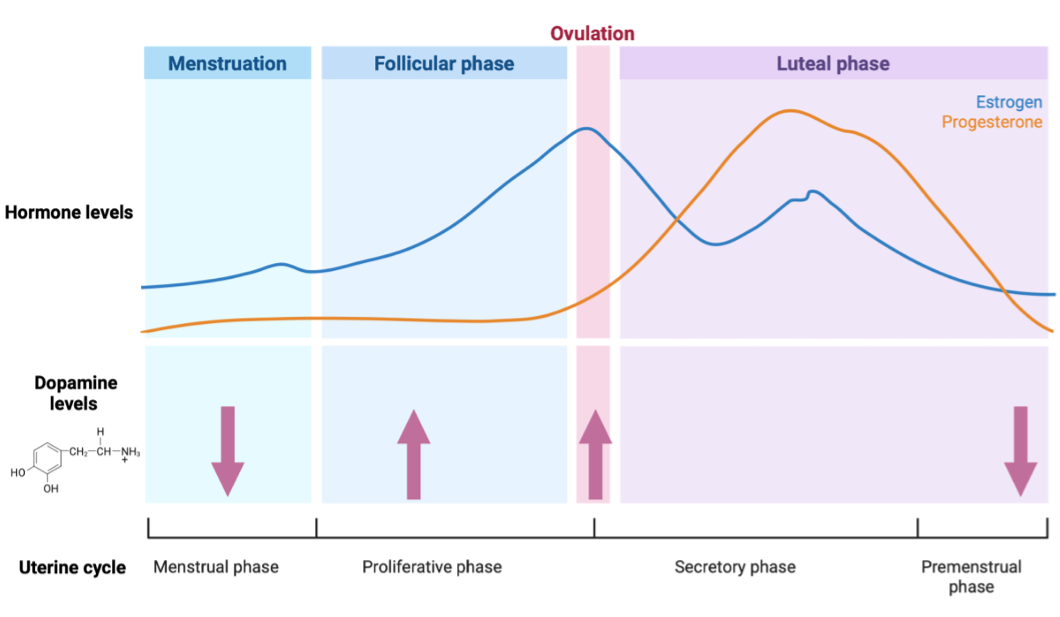
Pregnancy also drastically alters hormone levels, which can further influence ADHD symptoms in women, although research on the topic is minimal11. Then, during menopause, estrogen drops, causing similar dopamine-linked changes in focus and motivation. Overall, women experience heightened or worsening symptoms during major hormonal shifts throughout their cycle and across their lifespan, which likely contributes to the diagnostic gap11.
Beyond hormones, another variable that complicates ADHD diagnosis is that women often seek clinical attention for other psychiatric conditions, such as anxiety and depression, which can further mask ADHD recognition12. In fact, over 60% of females diagnosed with ADHD also have at least one other comorbidity, or co-occurring psychiatric condition, many of which have significant overlap with ADHD symptoms, such as emotional dysregulation and emotional sensitivity7,12,13. This means that girls and women presenting ADHD symptoms may be misdiagnosed with personality and other disorders, leaving the door open for undiagnosed ADHD.
The different social expectations of girls compared to boys is another likely contributor to delayed ADHD diagnoses in young girls. In general, boys are more socially tolerated for disruptive or reckless behaviors, whereas girls are often held to greater expectations of being compliant, organized, emotionally controlled, and agreeable. This can lead to higher degrees of symptom masking in young girls, a technique in which individuals learn to repress neurological symptoms to better fit in with society at large. Essentially, girls are more likely to hide their impulsive behaviors or emotional responses to meet social expectations, internalizing their symptoms as personality flaws rather than recognizing them as manifestations of an underlying condition12-14. When girls learn to mask their symptoms from an early age, these strategies may persist into adolescence and adulthood, allowing ADHD to remain unrecognized for many years. Academic and professional success may further obscure these symptoms, contributing to delayed diagnosis in girls and women who may not fit traditional expectations of ADHD presentation7.
Overall, the combined effects of hormonal fluctuations, psychiatric comorbidities, and learned compensatory behaviors can obscure ADHD symptoms in girls and women, contributing to persistent challenges in recognition and diagnosis.
What Can Be Done to Improve ADHD Diagnosis in Women?
Unfortunately, mis- or undiagnosed ADHD can come with lasting consequences and affect individuals on a larger scale in adulthood. Years of untreated ADHD can have negative impacts on familial, romantic, and professional relationships. An early diagnosis can help decrease these negative outcomes, and many ADHD patients agree: a systematic review found that 38% of women who received a later diagnosis wished they had been diagnosed earlier1,3,15. Earlier identification by teachers and parents can be improved by providing resources and education that allow these caregivers to better identify ADHD symptom differences between boys and girls. For instance, caregivers should know to be on high alert for signs of ADHD in girls brought on by hormonal changes, such as during puberty or after the first menstrual cycle. Recognizing these differences may help caregivers identify symptoms earlier and seek appropriate evaluation and support6. Additionally, including reevaluations for women after other major life hormonal changes such as pregnancy or menopause may be useful, since these hormonal fluctuations can cause changes in ADHD symptoms that may be overlooked or attributed to the hormone-disrupting events. To this end, researchers suggest that ADHD assessments may be most informative when conducted at a time when hormonal fluctuations have less influence on the symptoms being evaluated11,16.
Ultimately, ADHD assessments should be re-evaluated to include a more gender-sensitive diagnosis. This assessment should take into consideration the symptom presentation and biological discrepancies between boys and girls to diminish the number of girls that go undiagnosed. Hopefully, by bringing more attention to the difference between ADHD in males and females across developmental stages, we can ensure that individuals of any gender receive proper evaluation, diagnosis, and thus, treatment, early on.
TL; DR:
- ADHD is diagnosed earlier in men than women.
- ADHD studies have focused on male disorder presentation, resulting in misdiagnosis in women, particularly due to hormonal changes throughout a woman’s life.
- Gender sensitive assessment is needed to reduce undiagnosed ADHD.
References
- Staley BS, Robinson LR, Claussen AH, et al. Attention-Deficit/Hyperactivity Disorder Diagnosis, Treatment, and Telehealth Use in Adults — National Center for Health Statistics Rapid Surveys System, United States, October–November 2023. MMWR Morb Mortal Wkly Rep 2024;73:890–895. DOI: http://dx.doi.org/10.15585/mmwr.mm7340a1
- Skoglund, C., Sundström Poromaa, I., Leksell, D., Ekholm Selling, K., Cars, T., Giacobini, M., Young, S., & Kopp Kallner, H. (2024). Time after time: failure to identify and support females with ADHD – a Swedish population register study. Journal of child psychology and psychiatry, and allied disciplines, 65(6), 832–844. https://doi.org/10.1111/jcpp.13920
- Martin, J., Langley, K., Cooper, M., Rouquette, O. Y., John, A., Sayal, K., Ford, T., & Thapar, A. (2024). Sex differences in attention-deficit hyperactivity disorder diagnosis and clinical care: a national study of population healthcare records in Wales. Journal of child psychology and psychiatry, and allied disciplines, 65(12), 1648–1658. https://doi.org/10.1111/jcpp.13987
- Müller, E. D., & Fender, A. C. (2026). Sex differences in the response to treatment of attention deficit hyperactivity disorder. Naunyn-Schmiedeberg’s archives of pharmacology, 399(3), 3143–3157. https://doi.org/10.1007/s00210-025-04716-5
- Concannon, J. T., & Schechter, M. D. (1982). Failure of amphetamine isomers to decrease hyperactivity in developing rats. Pharmacology, biochemistry, and behavior, 17(1), 5–9. https://doi.org/10.1016/0091-3057(82)90253-2
- Klefsjö, U., Kantzer, A. K., Gillberg, C., & Billstedt, E. (2021). The road to diagnosis and treatment in girls and boys with ADHD – gender differences in the diagnostic process. Nordic journal of psychiatry, 75(4), 301–305. https://doi.org/10.1080/08039488.2020.1850859
- Young, S., Adamo, N., Ásgeirsdóttir, B. B., Branney, P., Beckett, M., Colley, W., Cubbin, S., Deeley, Q., Farrag, E., Gudjonsson, G., Hill, P., Hollingdale, J., Kilic, O., Lloyd, T., Mason, P., Paliokosta, E., Perecherla, S., Sedgwick, J., Skirrow, C., Tierney, K., … Woodhouse, E. (2020). Females with ADHD: An expert consensus statement taking a lifespan approach providing guidance for the identification and treatment of attention-deficit/ hyperactivity disorder in girls and women. BMC psychiatry, 20(1), 404. https://doi.org/10.1186/s12888-020-02707-9
- Young S. R. (2026). When Professional Success Masks Neurodevelopmental Disorder: Late-Diagnosed ADHD in a Physician. Cureus, 18(4), e107189. https://doi.org/10.7759/cureus.107189
- Martel, M. M., & Roberts, B. A. (2014). Prenatal testosterone increases sensitivity to prenatal stressors in males with disruptive behavior disorders. Neurotoxicology and teratology, 44, 11–17. https://doi.org/10.1016/j.ntt.2014.05.001
- Piekarski, D. J., Johnson, C. M., Boivin, J. R., Thomas, A. W., Lin, W. C., Delevich, K., M Galarce, E., & Wilbrecht, L. (2017). Does puberty mark a transition in sensitive periods for plasticity in the associative neocortex?. Brain research, 1654(Pt B), 123–144. https://doi.org/10.1016/j.brainres.2016.08.042
- Eng, A. G., Nirjar, U., Elkins, A. R., Sizemore, Y. J., Monticello, K. N., Petersen, M. K., Miller, S. A., Barone, J., Eisenlohr-Moul, T. A., & Martel, M. M. (2024). Attention-deficit/hyperactivity disorder and the menstrual cycle: Theory and evidence. Hormones and behavior, 158, 105466. https://doi.org/10.1016/j.yhbeh.2023.105466
- Hinshaw, S. P., Nguyen, P. T., O’Grady, S. M., & Rosenthal, E. A. (2022). Annual Research Review: Attention-deficit/hyperactivity disorder in girls and women: underrepresentation, longitudinal processes, and key directions. Journal of child psychology and psychiatry, and allied disciplines, 63(4), 484–496. https://doi.org/10.1111/jcpp.13480
- Lange, K. W., Reichl, S., Lange, K. M., Tucha, L., & Tucha, O. (2010). The history of attention deficit hyperactivity disorder. Attention deficit and hyperactivity disorders, 2(4), 241–255. https://doi.org/10.1007/s12402-010-0045-8
- Sarah L. Perkins, Angela Trombley, The Undiagnosed: Ending the Lost Generation of Girls With ADHD, The Journal for Nurse Practitioners, Volume 22, Issue 5, 2026,105784, ISSN 1555-4155, https://doi.org/10.1016/j.nurpra.2026.105784.
- Attoe, D. E., & Climie, E. A. (2023). Miss. Diagnosis: A Systematic Review of ADHD in Adult Women. Journal of attention disorders, 27(7), 645–657. https://doi.org/10.1177/10870547231161533
- Kelly, T., May, B., Porter, C. N., & Palace, M. (2026). Exploring Women’s Experiences of a Late ADHD Diagnosis: Unveiling a Personal Superpower Through Reflexive Thematic Analysis. Journal of attention disorders, 10870547261469625. Advance online publication. https://doi.org/10.1177/10870547261469625

