By: Selin Ozkaya
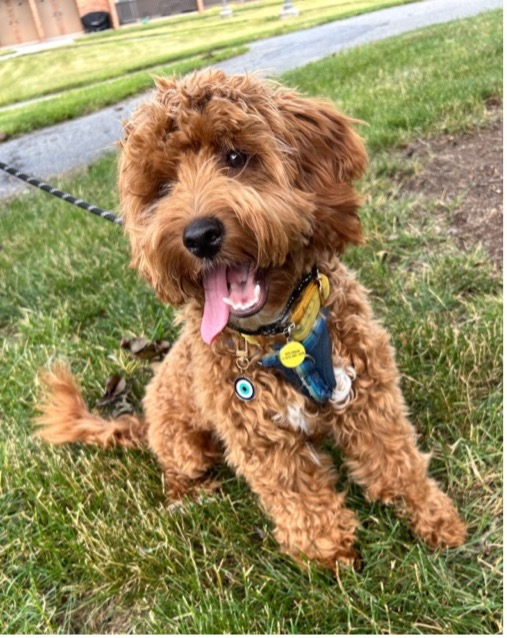
Graduate school has a peculiar way of following you home: a failed experiment, a looming deadline, or an unanswered email does not disappear when you leave work. For many graduate students, the line between work and life is incredibly difficult to draw. When I come home, however, I am greeted by Tarchin (Figure 1), my nine-month-old mini Goldendoodle and emotional support animal (ESA). Tarchin does not know what a graduate school is. He does not care whether my experiment worked or if I am close to publishing a paper. He does care that I have been gone all day. He needs to eat, go outside, and play. That responsibility might seem like an unusual form of emotional support, yet it is part of what makes our relationship interesting to me. Tarchin forces interruptions into days when I might otherwise continue working, creates routine outside of the lab, and provides companionship when I come home. As I have felt the positive impact of having Tarchin in my life, the scientist in me has wondered about what scientific evidence is out there to support how ESA can benefit graduate students.
Graduate school as a chronic stressor
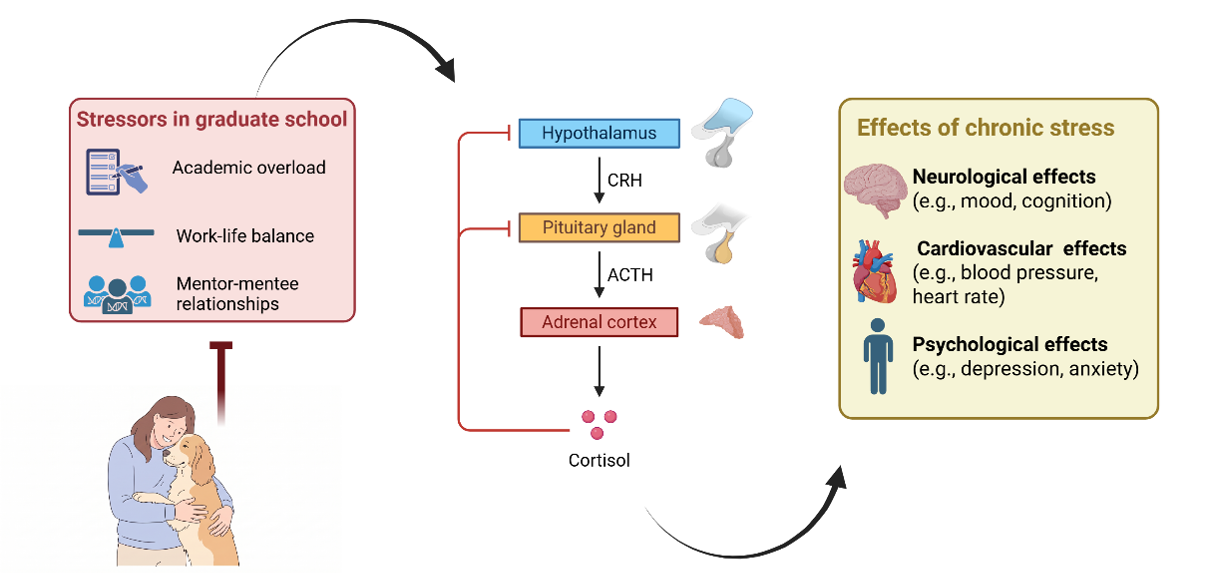
Mental health concerns among graduate students are not new, but research over the past several years has helped establish their scale. In 2018, a paper published in Nature Biotechnology put a striking label on this problem, coining it the “mental health crisis in graduate education”1. In this study, researchers surveyed a total of 2,279 graduate students from 234 institutions across 26 countries. The results demonstrated that 41% of respondents for anxiety and 39% for depression scored in the moderate-to-severe range, rates more than six times higher than estimates for the general population. These findings not only helped draw widespread attention to graduate student mental health, but allowed researchers to identify factors associated with the psychological well-being of graduate students. One such factor was work–life balance. Among graduate students experiencing moderate-to-severe anxiety, 56% reported that they did not have a good work–life balance. Similarly, 55% of those experiencing moderate to severe depression reported poor work-life balance. Relationships with faculty advisors were also associated with students’ mental health. Approximately half of those reporting anxiety or depression felt that their advisors did not provide adequate mentorship or support. Even more concerning, over half did not feel valued by their mentors. These findings highlight how graduate student mental health is closely tied to the stressful environment in which students train. Although stress is not itself a mental health disorder, prolonged exposure to stress can contribute to the development or worsening of mental health conditions, such as anxiety and depression. For graduate students, the demands of academic training, particularly when coupled with poor work-life balance and inadequate mentorship, may contribute to ongoing stress. The researchers emphasized the need for cultural changes within academia, including better mentorship, greater access to mental health resources, and an academic environment that encourages work-life balance rather than rewarding excessively long hours. While institutional changes are essential, understanding how support outside the laboratory might help students manage stress is another important piece of the puzzle.
Stress is more than a feeling
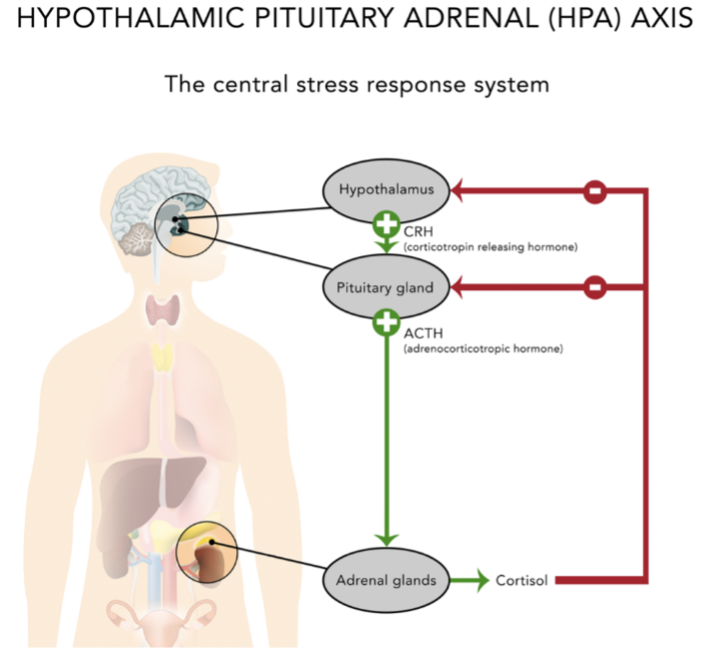
Beyond feeling anxiety, depression, overwhelm, and other negative feelings associated with chronic stress, stress produces measurable physiological responses. When the brain perceives a stressor, one system it recruits is the hypothalamic-pituitary-adrenal (HPA) axis (Figure 2). The hypothalamus releases corticotropin-releasing hormone, a chemical messenger that stimulates the pituitary gland to release adrenocorticotropic hormone (ACTH)2. ACTH then travels through the bloodstream to the adrenal cortex, where it stimulates the release of cortisol. Alongside this hormonal response, stress also activates the sympathetic nervous system, which can increase heart rate and blood pressure. Therefore, stress can be studied not only through questionnaires, but also by measuring cortisol levels, heart rate, and blood pressure. During a short-term stressful situation, such as giving a presentation, cortisol helps mobilize energy and coordinate an appropriate physiological response. This physiological response is adaptive, helping us meet immediate demands. However, when stressors are persistent, as they can be during demanding periods of graduate training, repeated activation of stress-response systems may negatively affect health and well-being. Identifying ways to manage this ongoing stress is therefore important, and interactions with animals have emerged as one potential approach worth investigating.
One investigation into how animals may lower stress examined 122 university students with moderate-to-high perceived stress before and after a 15-minute canine-assisted interaction3. The interaction involved spending time with one of the six privately owned dogs that were comfortable interacting with strangers but were not certified therapy dogs. Researchers assessed students’ perceived stress, pulse rate, and blood pressure at three timepoints: before a 15-minute rest period, immediately before meeting the dogs, and after the interaction. Salivary cortisol was measured at the first and last timepoints. The two assessments before the interaction allowed researchers to examine whether stress-related measures changed during the rest period, even before students encountered the dogs. Following the interaction with the dogs, students reported significantly lower perceived stress. Although blood pressure did not show significant change, students exhibited lower pulse rates and salivary cortisol concentrations post-canine interactions. Overall, this study demonstrated that even a brief canine-assisted interaction can reduce acute psychological and physiological stress responses.
Another randomized controlled trial sought to understand the benefits of canine interaction over a longer period. The study included 104 health-science graduate students, with 53 assigned to a canine-assisted intervention and 51 to a control group with no intervention4. The first group participated in 35-minute canine-assisted sessions once weekly for six weeks. Using self-reported assessments, researchers measured anxiety, perceived stress, quality of life, occupational performance, and adjustment to the graduate-student role. Following the intervention, participants in the canine-assisted group reported significantly lower anxiety and perceived stress and higher quality of life relative to controls. Together, these studies suggest that canine interaction may influence both acute stress responses and broader measures of psychological well-being. However, it remains unclear whether these effects extend to the ongoing, everyday relationship between a student and an emotional support animal, as neither study included such a relationship.
Not all support animals are the same
Interacting with a therapy dog for 15 or 35 minutes in a controlled setting is fundamentally different from living with an ESA every day. Unlike service animals, which are trained to perform specific tasks for people with disabilities, or therapy animals, which participate in structured interactions, ESAs provide support primarily through everyday companionship rather than specialized training. Living with an animal also combines companionship with responsibility. Feeding, exercise, and other caregiving responsibilities create routines, interrupt long periods of work, and can increase physical activity and time outside. Particularly for dog owners, these routines may also create opportunities for social interaction, as anyone who has walked a friendly dog knows how quickly a five-minute walk can turn into conversations with complete strangers. As a result, any relationship between ESA ownership and psychological well-being may reflect several interacting factors: companionship, physical contact, responsibility, behavioral routine, physical activity, and social connection. To this end, one qualitative study of students living with ESAs identified four recurring positive themes: presence, empowerment, symptom alleviation, and acting as a social catalyst5. These themes are especially important for graduate students, who can feel particularly isolated.
However, the evidence for the benefits of ESAs remains preliminary. The qualitative study was small, with nine participants in the initial interviews and four additional participants interviewed during the COVID-19 pandemic. Although the findings described how students perceive and experience living with an ESA, the study also identified challenges associated with ESA ownership, including housing accommodations, inadequate ESA education, and negative social experiences that should be analyzed in greater detail. Additionally, the study did not include any assessment of the impact of ESA ownership on overall mental health. Therefore, a study that follows graduate students longitudinally, before and after ESA acquisition, with repeated assessments of perceived stress, anxiety, depression, loneliness, sleep, physical activity, and social interaction, alongside physiological measures such as salivary cortisol and blood pressure changes, could address some of these limitations.
Where the science ends…for now
Research so far suggests that interacting with animals may help alleviate stress, with studies reporting improvements in perceived stress, anxiety, and certain physiological measures. However, these findings largely come from brief or structured interactions rather than the everyday companionship of an ESA. The relevant scientific question is therefore not simply whether pets are “good for mental health,” but which components of human-animal interaction influence stress, through which mechanisms, and under what conditions.
On difficult days, it is easy for graduate school to consume everything, to stay late, come home thinking about unfinished experiments, and convince myself that I should keep working. However, Tarchin is waiting at the door when I come home. He needs a walk even when I feel exhausted, and within a few minutes I am outside instead of sitting alone with the day still running through my head. People stop to ask about him. He stops to investigate absolutely everything. For a little while, my attention is pulled toward something immediate and completely unrelated to graduate school. I cannot say what that does to my cortisol or whether it changes my stress physiology, but I know that it changes the way some difficult days end. While science is yet to provide a definite answer about the long-term effects of ESA on stress, I do know for a fact that my Tarchin is good for me.
TL; DR:
- Graduate students face substantial mental health challenges, often associated with work–life balance and mentorship.
- Research suggests that interacting with animals may improve psychological well-being and stress-related physiological measures.
- However, whether emotional support animals provide similar benefits through everyday companionship remains unclear.
References
- Evans TM, Bira L, Gastelum JB, Weiss LT, Vanderford NL. Evidence for a mental health crisis in graduate education. Nat Biotechnol. 2018;36(3):282-4. doi: 10.1038/nbt.4089. PubMed PMID: 29509732.
- Herman JP, McKlveen JM, Ghosal S, Kopp B, Wulsin A, Makinson R, Scheimann J, Myers B. Regulation of the Hypothalamic-Pituitary-Adrenocortical Stress Response. Compr Physiol. 2016;6(2):603-21. Epub 20160315. doi: 10.1002/cphy.c150015. PubMed PMID: 27065163; PMCID: PMC4867107.
- Yotanyamaneewong S, Junla D, Brown JL, Siriapaipant N, Yodkamol N, Prachasilchai W, Saengthong A, Sanguansak P, Kankonsue T, Punyapornwithaya V, Sansamur C, Nganvongpanit K, Khonmee J. The impact of canine-assisted intervention on stress reduction among university students in Thailand. PLoS One. 2025;20(3):e0318777. Epub 20250312. doi: 10.1371/journal.pone.0318777. PubMed PMID: 40072925; PMCID: PMC11902293.
- Kivlen C, Winston K, Mills D, DiZazzo-Miller R, Davenport R, Binfet JT. Canine-Assisted Intervention Effects on the Well-Being of Health Science Graduate Students: A Randomized Controlled Trial. Am J Occup Ther. 2022;76(6). doi: 10.5014/ajot.2022.049508. PubMed PMID: 36410405.
- Kirnan JP, Shapiro AR, Mistretta AJ, Sellet M, Fotinos G, Blair B. Emotional support animals supporting college students’ mental health and well-being: A qualitative analysis exploring practices, policies, and perceptions. J Am Coll Health. 2024;72(6):1864-75. Epub 20220711. doi: 10.1080/07448481.2022.2095871. PubMed PMID: 35816762.

